Mary Russell - Doc
Здесь есть возможность читать онлайн «Mary Russell - Doc» весь текст электронной книги совершенно бесплатно (целиком полную версию без сокращений). В некоторых случаях можно слушать аудио, скачать через торрент в формате fb2 и присутствует краткое содержание. Год выпуска: 2011, ISBN: 2011, Издательство: RANDOM HOUSE, Жанр: Историческая проза, на английском языке. Описание произведения, (предисловие) а так же отзывы посетителей доступны на портале библиотеки ЛибКат.
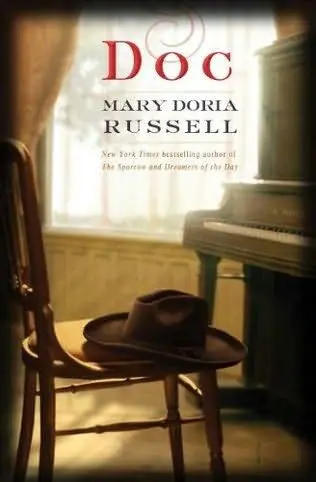
- Название:Doc
- Автор:
- Издательство:RANDOM HOUSE
- Жанр:
- Год:2011
- ISBN:978-0-679-60439-6
- Рейтинг книги:3 / 5. Голосов: 1
-
Избранное:Добавить в избранное
- Отзывы:
-
Ваша оценка:
Doc: краткое содержание, описание и аннотация
Предлагаем к чтению аннотацию, описание, краткое содержание или предисловие (зависит от того, что написал сам автор книги «Doc»). Если вы не нашли необходимую информацию о книге — напишите в комментариях, мы постараемся отыскать её.
Beautifully educated, born to the life of a Southern gentleman, Dr. John Henry Holliday is given an awful choice at the age of twenty-two: die within months in Atlanta or leave everyone and everything he loves in the hope that the dry air and sunshine of the West will restore him to health. Young, scared, lonely, and sick, he arrives on the rawest edge of the Texas frontier just as an economic crash wrecks the dreams of a nation. Soon, with few alternatives open to him, Doc Holliday is gambling professionally; he is also living with Mária Katarina Harony, a high-strung Hungarian whore with dazzling turquoise eyes, who can quote Latin classics right back at him. Kate makes it her business to find Doc the high-stakes poker games that will support them both in high style. It is Kate who insists that the couple travel to Dodge City, because 'that's where the money is.'
And that is where the unlikely friendship of Doc Holliday and Wyatt Earp really begins — before Wyatt Earp is the prototype of the square-jawed, fearless lawman; before Doc Holliday is the quintessential frontier gambler; before the gunfight at the O.K. Corral links their names forever in American frontier mythology — when neither man wanted fame or deserved notoriety.
Authentic, moving, and witty, Mary Doria Russell's fifth novel redefines these two towering figures of the American West and brings to life an extraordinary cast of historical characters, including Holliday's unforgettable companion, Kate. First and last, however, Doc is John Henry Holliday's story, written with compassion, humor, and respect by one of our greatest contemporary storytellers.
Doc — читать онлайн бесплатно полную книгу (весь текст) целиком
Ниже представлен текст книги, разбитый по страницам. Система сохранения места последней прочитанной страницы, позволяет с удобством читать онлайн бесплатно книгу «Doc», без необходимости каждый раз заново искать на чём Вы остановились. Поставьте закладку, и сможете в любой момент перейти на страницу, на которой закончили чтение.
Интервал:
Закладка:
She shrugged.
“Twenty bucks says Wyatt don’t even raise his voice,” Morg offered, “and the Texans do as they’re told.”
Doc reached over to lift Kate’s hand to his lips. “You’re on your own with this one, darlin’. I wouldn’t take that bet.”
“Make it ten,” Kate told Morgan. “We’re short.”
Third Hand
The River
Winters in Kansas could fool you, John Riney always warned newcomers.
A man would come west in the springtime, and it would be just like the newspaper said. Homesteads weren’t free anymore, but they were sure enough dirt cheap. There were no trees to clear nor swamps to drain. No rocks to dig out before you could break ground. First day you got up and ran your eyes over your land at sunrise, you’d be so glad you came to Kansas, you’d think, Damn, how’m I gonna know when I’m in heaven after living someplace this good?
Couple months later, you knew just how tough that grassland was, and how hard you and your wife and kids and the mule had to work to bust through it—and not a particle of shade for five hundred miles, sun beating on you like a hammer. Still, you’d get your crop in, and when that first summer passed, you’d have a pretty good harvest, even after the cyclone that one time and a long stretch of dry in August.
And anyways, you could get bad weather back East, too. Farming’s the biggest gamble there is. Ask the man who’s tried it.
With no trees, you wouldn’t even notice so much that it was getting to be autumn, but then nights would cool off a lot. You’d tell your wife, “Well, it’s hot as hell, summer, but when the heat breaks, the weather’s real pleasant.” There’d be cold snaps and frost in October and you’d think, Oh, Lord. Here comes the snow! But that was squaw winter, and November would surprise you. The air would turn mild and sweet, and the light was soft and golden, slanting in low as the days shortened.
The first sign of what you were in for? Just a shift in the wind. Right before Christmas, usually. Huge clouds the color of spent charcoal would pile up on the far horizon. Suddenly the temperature would drop like a rock, and the first blizzard of the season would roar across the plains and hit you like a damn train. Men would get caught outdoors—fixing a fence, maybe—no coat, just wearing what seemed sensible that morning when the sun was shining and it looked to be another pretty day. Happened so fast, you didn’t hardly know what to think.
That’s how it was the year John Riney took over a farm from a Dutch fella, out north of Dodge. The Dutchie had a run of bad luck and went bust, what with the drought and the hoppers and the depression, but John reckoned him and Mabel and the boys could make a go of it, and by December he could see his way clear to proving up on the land.
Then one day—mid-December—John was out in the shed working on a broken harness when the breeze came up. Before he even thought twice, the wind was so strong, the whole little building started to shake and the snow was coming down like nothing he ever seen in north Arkansas. Can’t last, he told himself and went back to the harness, figuring he’d wait it out, but the storm just got worse and worse, and next time he peered through a gap in the siding, he couldn’t see the house anymore, nor hear his own voice above the wind when he hollered.
Before long, it got so bad, he said to himself, “Damn if this shed ain’t gonna come down around me.” So he crawled in between a couple of bales of hay he’d used to prop up a workbench, hoping they’d break the fall of the roof.
He never knew until that day how cold a man could get. He was shaking like anything, but all he could do was wrap his arms around himself, curl up like a babe and wait for the storm to blow itself out, except it didn’t. It just went on and on like that, and then the air started crackling, and there was lightning and thunder—in a snowstorm!—which seemed against nature.
“By God, it’s the End,” John cried, and gave himself up to Jesus and prayed for salvation. Sure enough, he felt strangely warm after a while and finally stopped shivering. In the peacefulness that followed, he believed he was dying, and though he regretted leaving his family, he was happy that the Lord was coming for him.
Later, the Ford County Globe reported that the temperature hit sixteen below, and that the plains surrounding Dodge were littered with the carcasses of antelope and deer and livestock and coyotes and birds. Several farmhands froze to death, but John Riney had always been a lucky man, and the proof of it was that Mabel and the boys got to him before he died, digging through the snow with their hands and an iron fry pan. They slid him out of the shed and drug him back into the house, where the door faced southeast and could still be opened, even though the snow on the northwest side reached the roofline.
It was the Lord’s mercy that John only lost parts of his feet and most of his fingers instead of his life, but there he was: a cripple, and no farmer anymore. And you’d have to call that bad luck, except that very year, Dodge City got itself a committee and built a bridge over the Arkansas.
In those days, the river was swimming-deep and too fast to cross without danger most of the time. Freighters needed to double up their ox teams to pull the wagons through it, and that meant a lot of extra work, unyoking and yoking and what all, and then their merchandise got wet because the wagon beds weren’t high enough to stay above the waterline. Or let’s say you were trying to take a herd through the river. Some of the cattle you drove all the way up from Texas would get pulled downstream and be lost, just before you got them to market. Now and then, somebody on your crew’d drown, too. That was a hell of a thing.
So it was pretty bad until Bob Wright figured out that a bridge would make Dodge more attractive as a railhead for the cattle trade. Bob’s old partner Charlie Rath knew how to build bridges, from during the war, so they got together with a finance man from Leavenworth and ordered in a lot of wood, special, and construction began.
Then Bob had the notion that folks would be willing to pay to drive across the only bridge between Hutchinson and the Colorado line just to avoid the trouble of crossing that damn river for free. Which they were. And that meant there had to be a tollbooth, and someone to be there all day and all night to collect the tolls, and you didn’t hardly need more than four fingers, total, to do a job like that.
See? That’s how lucky John Riney was, and he defied anyone to tell him different.
There was a nice tollhouse for him and Mabel and the kids to live in, fairly large and built real tight against the storms, and the boys swam all summer in the river, and John himself could just sit there and let the world come to him. He collected $1.50 for a two-horse team and wagon, $2 for a four- or six-horse hitch, and two bits a man, mounted. Pedestrians were 25 cents, too, but since 1874, John Riney had never once seen anybody walk across the bridge, until this very day.
“Official business,” Bat Masterson told him, ducking under the gate.
“Me, too,” said Charlie Bassett.
They were both carrying shotguns and wearing two pistols apiece. So were Morgan Earp and John Stauber, but those two didn’t cross the bridge. They just waited on either side of the end nearest the tollbooth.
Morgan said, “John, you might want to send Mabel and the kids down to Jake Collar’s for an ice cream or something.”
“Why?” John asked. “What’s going on?”
“Probably nothing, but it might get kinda noisy around here. Better safe than sorry.”
Morg’s brother Wyatt was down at the corner, talking to Jack Brown and Chuck Trask, who were sitting in the upstairs windows down at the Green Front and the Lady Gay, one leg in, one leg out, shotgun stocks resting against their thighs on the outside.
Читать дальшеИнтервал:
Закладка:
Похожие книги на «Doc»
Представляем Вашему вниманию похожие книги на «Doc» списком для выбора. Мы отобрали схожую по названию и смыслу литературу в надежде предоставить читателям больше вариантов отыскать новые, интересные, ещё непрочитанные произведения.







Обсуждение, отзывы о книге «Doc» и просто собственные мнения читателей. Оставьте ваши комментарии, напишите, что Вы думаете о произведении, его смысле или главных героях. Укажите что конкретно понравилось, а что нет, и почему Вы так считаете.