Alison Weir - Captive Queen
Здесь есть возможность читать онлайн «Alison Weir - Captive Queen» весь текст электронной книги совершенно бесплатно (целиком полную версию без сокращений). В некоторых случаях можно слушать аудио, скачать через торрент в формате fb2 и присутствует краткое содержание. Год выпуска: 2010, ISBN: 2010, Издательство: BALLANTINE, Жанр: Историческая проза, на английском языке. Описание произведения, (предисловие) а так же отзывы посетителей доступны на портале библиотеки ЛибКат.
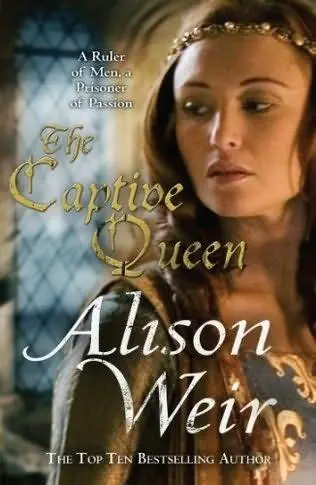
- Название:Captive Queen
- Автор:
- Издательство:BALLANTINE
- Жанр:
- Год:2010
- ISBN:978-0-345-52195-8
- Рейтинг книги:3 / 5. Голосов: 1
-
Избранное:Добавить в избранное
- Отзывы:
-
Ваша оценка:
Captive Queen: краткое содержание, описание и аннотация
Предлагаем к чтению аннотацию, описание, краткое содержание или предисловие (зависит от того, что написал сам автор книги «Captive Queen»). Если вы не нашли необходимую информацию о книге — напишите в комментариях, мы постараемся отыскать её.
Renowned for her highly acclaimed and bestselling British histories, Alison Weir has in recent years made a major impact on the fiction scene with her novels about Queen Elizabeth and Lady Jane Grey. In this latest offering, she imagines the world of Eleanor of Aquitaine, the beautiful twelfth-century woman who was Queen of France until she abandoned her royal husband for the younger man who would become King of England. In a relationship based on lust and a mutual desire for great power, Henry II and Eleanor took over the English throne in 1154, thus beginning one of the most influential reigns and tumultuous royal marriages in all of history. In this novel, Weir uses her extensive knowledge to paint a most vivid portrait of this fascinating woman.
Captive Queen — читать онлайн бесплатно полную книгу (весь текст) целиком
Ниже представлен текст книги, разбитый по страницам. Система сохранения места последней прочитанной страницы, позволяет с удобством читать онлайн бесплатно книгу «Captive Queen», без необходимости каждый раз заново искать на чём Вы остановились. Поставьте закладку, и сможете в любой момент перейти на страницу, на которой закончили чтение.
Интервал:
Закладка:
“Hardly!” Henry grinned. “Not with all his wavering and lack of guile. Just the right man for the job! There’ll be no obstinacy from this one.”
When Eleanor had refreshed herself and rested after her journey, a page came to summon her to the council chamber. There, she found the King and her sons waiting for her, with the new Archbishop, who quavered a greeting, and the barons of England, resplendent in their fine tunics and heavy furred mantles of scarlet, blue, vermilion, or tawny.
Henry handed her to the seat of honor next to his—he does want something, badly, she thought—and then, the company being also seated, called upon their three sons to come forward and publicly make their peace before her. They stood forward, Richard’s and Geoffrey’s faces set, John’s triumphant—and stiffly gave one another the kiss of peace. Then they stood facing their parents, waiting to see what would happen next.
Henry turned to Eleanor. He’d given her no formal warning of what he was about to say—but she had guessed! “My lady,” he said in ringing tones, “I now ask you to approve the assignment of Aquitaine to the Lord John.”
Eleanor stared at him, fury mounting within her breast. How dare he! How dare he do this to Richard, to her, publicly, in the face of his entire council! She could see the flush of anger on Richard’s handsome face, hear his sharp, indrawn breath, sense Geoffrey’s secret enjoyment of this human drama being enacted before him—and catch John’s complacent, gloating smirk.
“My lord, we should discuss this privately,” she murmured, her profile rigid. She could not look at Henry.
“There is no need for discussion, my lady,” he countered. “I only wish to make a fairer distribution of my empire. Surely you can understand that?”
“All I understand is that you are depriving your rightful heir of his lawful inheritance in favor of your favorite son, who has yet to prove himself,” she said.
“Richard, always Richard!” Henry muttered, fuming. Then, in a louder voice, he reiterated his demand for Eleanor to approve the transfer of Aquitaine to John.
“No, my lord, I will not approve it,” Eleanor stated firmly.
The barons leaned forward, to a man. This was going to be interesting!
“I call upon you all, my lords of England,” the Queen went on, “to tell my lord the King if this is indeed a fair division of his domains.”
“I say it is not!” thundered Richard, who had been itching to speak.
“And I!” echoed Geoffrey. John glowered at him.
“Shut up,” Henry said brutally, his face puce with rage. Eleanor would pay for her defiance! By the eyes of God, she would pay! “Well, my lords?” His jutting jaw brooked no opposition.
The lords, who had been conferring perplexedly among themselves, looked at their sovereign warily. None of them wanted to see that spoiled brat John in control of Aquitaine, and none of them wanted to offend the man who might well be their future king, for Richard’s reputation was fearsome indeed; yet they were all afraid of Henry’s notorious temper.
The quavering voice of the new Archbishop broke the silence, to everyone’s astonishment. “Lord King, I say this cannot be a fair division,” the saintly Baldwin opined, and if an angel from Heaven had come down and voiced his view, Henry could not have been more shocked.
“And you thought he’d be useful to you!” Eleanor mocked quietly under her breath.
Some of the barons took courage from the brave old man’s stand and added their voices to his. Much gratified, Eleanor turned to Henry. “You must know, my lord,” she warned him, “that I can appeal this matter to King Philip, of whom I hold Aquitaine. And if I do, you know as well as I that he will support me, if only to discountenance you and drive a wedge between you and your sons.”
Henry threw her a murderous look. “I see I am defied on all sides. Very well. My Lord Archbishop, a word in private, if you please!” With that, he rose and stalked out of the council chamber in high dudgeon, with the faltering prelate scuttling in his wake. Poor old man, Eleanor thought, having to face the King’s wrath, and so soon after his election.
But she had won, she reminded herself exultantly, as she went to embrace her two eldest sons, John having flounced off in a sulk. It was some small, sweet revenge for Alys and Bellebelle!
61
Windsor, 1184–1185
When Eleanor arrived at Windsor Castle for the Christmas court, wondering why Henry had bothered inviting her after their spectacular falling out at Westminster, after which he sent her summarily back to Winchester with not a word of farewell, the first person who came to greet her was Constance, now grown tall and proud, bearing a tiny infant in her arms. Yet her face bore no trace of the serenity and joy of young motherhood; instead, the winged brows were creased in a petulant frown, the wide, bee-stung lips pouting in a disagreeable grimace. Barely had the Duchess of Brittany risen from her curtsey than she was complaining.
“Madame the Queen, I beg of you, go to the King for me. He will not permit me to join Geoffrey in Normandy for Christmas. It’s so unfair!”
“Daughter,” Eleanor enjoined, a touch sharply, “will you not allow me a moment to get my breath after braving these treacherous roads?” She sank thankfully into a cushioned chair. “And first things first! May I not greet my new grandchild?” She held out her arms. Plainly irritated by this distraction, Constance placed the baby in them, then opened her mouth to have her say …
“Oh, you are gorgeous!” Eleanor cooed to the tiny pink and white face blinking up from the swaddled bundle. “Is it a boy?”
“No,” Constance said flatly, smarting with disappointment, for she had been convinced she was carrying an heir to Brittany—and perhaps to more than that, if her own and Geoffrey’s ambitions were fulfilled; she was convinced that her instincts would prove correct in regard to that.
“A little girl! How delightful!” Eleanor baited her, tracing the soft cheek with her finger. “And what is she called?”
“She is named after you, my lady,” Constance said grudgingly, recalling how Geoffrey had insisted, despite her protests.
“I am most touched. How kind!” Eleanor smiled sweetly, and handed the baby back. Immediately, Constance called for the nurse to take her, at which Eleanor deliberately prolonged matters by calling for wine and comfits.
“Now,” she said comfortably, when they were brought, “what’s all this about Geoffrey and Normandy?”
“The King sent him to take charge of Normandy while he himself was in England,” Constance told her, with the air of one throwing down the gauntlet.
Eleanor was surprised. “Indeed,” she managed. Was this some new ploy of Henry’s to discountenance her and Richard? Could it—surely not!—even mean that the King was now grooming Geoffrey to succeed to his empire? One look at Constance’s smug face was enough to tell her that it could—or at least that Constance herself was interpreting it that way, and therefore probably other people as well.
She mastered herself. “And you want to join him there?” she inquired, neatly deflecting the subject in favor of something far less contentious.
“Yes, my lady, that’s why you must go to the King for me!” Constance insisted.
“Must?” Eleanor lifted her eyebrows. “I should have thought that with you so lately delivered and barely up on your feet, braving the conditions out there would be foolhardy. The King has made a very sensible, and considerate, decision in keeping you here. You must rest, child, and then you can join your lord when the weather is improved.”
“But, madame!” Constance protested. Eleanor cut her short.
Читать дальшеИнтервал:
Закладка:
Похожие книги на «Captive Queen»
Представляем Вашему вниманию похожие книги на «Captive Queen» списком для выбора. Мы отобрали схожую по названию и смыслу литературу в надежде предоставить читателям больше вариантов отыскать новые, интересные, ещё непрочитанные произведения.





Обсуждение, отзывы о книге «Captive Queen» и просто собственные мнения читателей. Оставьте ваши комментарии, напишите, что Вы думаете о произведении, его смысле или главных героях. Укажите что конкретно понравилось, а что нет, и почему Вы так считаете.