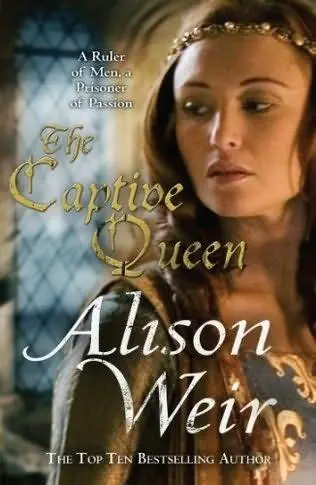
Alison Weir - Captive Queen
Здесь есть возможность читать онлайн «Alison Weir - Captive Queen» весь текст электронной книги совершенно бесплатно (целиком полную версию без сокращений). В некоторых случаях можно слушать аудио, скачать через торрент в формате fb2 и присутствует краткое содержание. Год выпуска: 2010, ISBN: 2010, Издательство: BALLANTINE, Жанр: Историческая проза, на английском языке. Описание произведения, (предисловие) а так же отзывы посетителей доступны на портале библиотеки ЛибКат.
- Название:Captive Queen
- Автор:
- Издательство:BALLANTINE
- Жанр:
- Год:2010
- ISBN:978-0-345-52195-8
- Рейтинг книги:3 / 5. Голосов: 1
-
Избранное:Добавить в избранное
- Отзывы:
-
Ваша оценка:
Captive Queen: краткое содержание, описание и аннотация
Предлагаем к чтению аннотацию, описание, краткое содержание или предисловие (зависит от того, что написал сам автор книги «Captive Queen»). Если вы не нашли необходимую информацию о книге — напишите в комментариях, мы постараемся отыскать её.
Renowned for her highly acclaimed and bestselling British histories, Alison Weir has in recent years made a major impact on the fiction scene with her novels about Queen Elizabeth and Lady Jane Grey. In this latest offering, she imagines the world of Eleanor of Aquitaine, the beautiful twelfth-century woman who was Queen of France until she abandoned her royal husband for the younger man who would become King of England. In a relationship based on lust and a mutual desire for great power, Henry II and Eleanor took over the English throne in 1154, thus beginning one of the most influential reigns and tumultuous royal marriages in all of history. In this novel, Weir uses her extensive knowledge to paint a most vivid portrait of this fascinating woman.
Captive Queen — читать онлайн бесплатно полную книгу (весь текст) целиком
Ниже представлен текст книги, разбитый по страницам. Система сохранения места последней прочитанной страницы, позволяет с удобством читать онлайн бесплатно книгу «Captive Queen», без необходимости каждый раз заново искать на чём Вы остановились. Поставьте закладку, и сможете в любой момент перейти на страницу, на которой закончили чтение.
Интервал:
Закладка:
To be fair, despite his thuggish means of wresting Aquitaine from Richard, Henry had since treated both Richard and herself with consideration, seeking their counsel on various matters concerning the duchy, and even allowing them each a share in its government. He had also granted them the right to issue charters. It had been Eleanor’s particular pleasure to bestow gifts and concessions on the abbey of Fontevrault, where she had stayed on her way south, exulting in its long-missed spiritual peace and tranquillity, which was such a balm to her troubled soul. One day, she had resolved, she would be laid to rest here. She could not think of a better sepulchre.
Yes, it had felt good to come home, after twelve years of exile—so good that, even now, months later she could not stop thanking God for it. Every place she visited was utterly dear to her, every old acquaintance inestimably precious. The realization that her people remembered her with affection and love had been sheer joy; and in this expansive and thankful mood, she had continued to help rule them with increasing wisdom and kindness.
Then there had come the never-to-be-forgotten day when Henry, impressed by the way she’d used the power he had given her, relented, granting her humble request and allowing her to cede all her rights in the duchy once more to Richard, leaving their son effectively ruler of Aquitaine once more. Henry’s reasoning was often fathomless, but on this occasion Eleanor suspected that his iron determination to keep Aquitaine had gradually been softened and tempered by Richard’s prolonged display of filial devotion and her own conformity to his will. Besides, it had become abundantly clear that Richard could rule the duchy better than anyone—and that it was in everyone’s interests for him to continue to do so. At Philip’s insistence, Henry had even agreed that Alys could be married to Richard as soon as the wedding could be arranged, although there was no sign of him hurrying to give orders for that. He was too busy calculating how to keep Alys for himself, or as a useful bargaining tool, Eleanor thought dourly.
Nevertheless, she reflected, looking down and smiling as she espied her damsels playing hide-and-seek amid the trees, things had improved greatly. Yet, although relations between them and their sons were far more cordial these days, she still did not trust Henry. The matter of the disposition of his empire was still unresolved, and she suspected he had plans that he was keeping to himself, which no amount of oblique probing could prompt him to disclose. She feared that the future would see a resurgence of the rivalry that had blighted their house, but knew herself powerless to forestall it.
John, clearly, was not going to live up to Henry’s high expectations. The petted favorite had been dispatched to Ireland with plain instructions to establish good relations with the Norman barons who had fought to colonize the English Pale around Dublin, and with the Irish kings who still reigned supreme in the wild and beautiful lands beyond that. But Henry made the fatal mistake of allowing John to be accompanied by his giggling young cronies, and when the native kings had come with gifts, to pay homage to their new overlord, John and his silly friends outraged their sensibilities by pulling on their long beards and making fun of their strange attire and time-honored rituals that seemed outlandish to the newcomers. To compound these insults, John had enraged the Norman barons by seizing their hard-won territories and bestowing them on his worthless intimates. Even now, John was on his way back to England in disgrace. Henry had endured enough of his crassness and appointed a viceroy to go and sort out the mess his son had created.
John was impossible. Henry had spoiled and indulged him, and they were all now suffering the consequences. In contrast, Eleanor had few worries about her daughters. Matilda and her family had at last found it safe to return to Germany, where a new Emperor ruled, one amenable to making peace with the exiles. Eleanor and Joanna were, it seemed, reasonably happily settled in their distant kingdoms. Only John and Geoffrey were giving Eleanor real cause for concern.
Geoffrey had gone to Paris, where he was even now fraternizing mysteriously with that menace Philip, and no doubt plotting some fresh mischief. You never knew with Geoffrey. Reports had it that he was as close as a blood brother to the French king. Eleanor had sometime since picked up on the fact that he was dissatisfied with being merely Duke of Brittany and wanted more. Not so long ago he thought he had Normandy within his grasp. Now he was making noises about Anjou. It was all a great annoyance to the King, and doubtless Philip was relishing abetting Geoffrey in his ambitions. Anything to discountenance Henry!
The Queen sighed. Soon, to her great sadness, she would have to leave this beloved city and travel north, for Henry was bound for England and wanted her to accompany him. They were to lodge for a time at Winchester. She did not want to go. How could she forsake the golden lands of the sunny South to waste the coming summer in a castle that would be forever associated in her mind with her long captivity?
But of course she had, as usual, no choice in the matter.
64
Winchester, 1186
Eleanor could have cried over the unjustness of it all! The situation with Geoffrey and Philip having become increasingly a matter for concern, she had thought to write to her son, urging him to come to England, where she hoped to talk some sense into him. But Henry intercepted the letter—she had not realized that her correspondence was still subject to the scrutiny of his officers—and his suspicious mind interpreted it as evidence that she was involved in a plot against him. After all, had she not schemed with King Louis, on that earlier, fateful occasion when her sons sought refuge and support in Paris?
Nothing she said could fully deflect Henry’s mistrust. He muttered that he accepted her explanation, but his eyes told a different story. And now she had a new custodian to replace Ralph FitzStephen, whose services had been dispensed with sometime before. She would have liked Ranulf Glanville, but he had been deployed to more pressing duties of state. At least Henry Berneval was an upright, amiable man of little charm or imagination, and he treated her with great deference and kindness; but he was her gaoler, nonetheless, and tailed her, two guards at his heels, wherever she went, even with the King in residence, which he was all that summer.
Eleanor was still smarting from the unfairness of it all when the messenger from France arrived at Winchester and she received a summons to the King’s lodgings. There, she was confronted by an ashen-faced Henry, slumped in his chair, a wine goblet lying in a pool of liquid on the rush matting, where he had evidently dropped it.
Shutting the door on Henry Berneval and his guards, so she could be alone with her husband, she knelt down before him in alarm.
“Henry! What has happened? Is it war? Has Geoffrey allied with Philip against you?”
The King looked at her dully. His eyes were bloodshot; he had been drinking a lot lately. He was quite drunk now, she realized.
“Worse. I know not how to tell you,” he mumbled, slurring his words. “Geoffrey is dead, killed in a tournament in Paris.”
“Oh God!” Eleanor cried. “No!”
A tear slid down Henry’s weathered cheek. He leaned forward and placed one tentative hand on her shoulder in a gesture intended to comfort. She barely noticed it in her distress.
“What happened? Tell me—I must know!” she wept, unable to believe that God had been so cruel as to take yet another of her children to Himself. And Geoffrey, like the Young King, had been but twenty-eight years old. Yet, unlike what happened with the Young King three years earlier, there had been no warning to prepare her, no vision vouchsafed of the bliss that lay ahead for the precious departed. This, in contrast, was a brutal shock.
Читать дальшеИнтервал:
Закладка:
Похожие книги на «Captive Queen»
Представляем Вашему вниманию похожие книги на «Captive Queen» списком для выбора. Мы отобрали схожую по названию и смыслу литературу в надежде предоставить читателям больше вариантов отыскать новые, интересные, ещё непрочитанные произведения.










Обсуждение, отзывы о книге «Captive Queen» и просто собственные мнения читателей. Оставьте ваши комментарии, напишите, что Вы думаете о произведении, его смысле или главных героях. Укажите что конкретно понравилось, а что нет, и почему Вы так считаете.