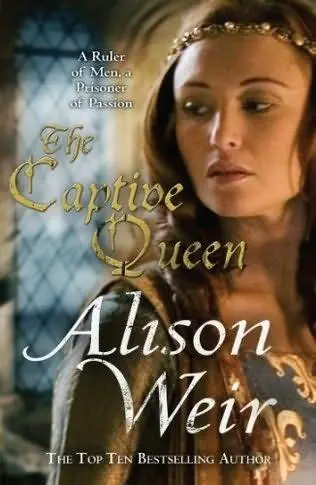
Alison Weir - Captive Queen
Здесь есть возможность читать онлайн «Alison Weir - Captive Queen» весь текст электронной книги совершенно бесплатно (целиком полную версию без сокращений). В некоторых случаях можно слушать аудио, скачать через торрент в формате fb2 и присутствует краткое содержание. Год выпуска: 2010, ISBN: 2010, Издательство: BALLANTINE, Жанр: Историческая проза, на английском языке. Описание произведения, (предисловие) а так же отзывы посетителей доступны на портале библиотеки ЛибКат.
- Название:Captive Queen
- Автор:
- Издательство:BALLANTINE
- Жанр:
- Год:2010
- ISBN:978-0-345-52195-8
- Рейтинг книги:3 / 5. Голосов: 1
-
Избранное:Добавить в избранное
- Отзывы:
-
Ваша оценка:
Captive Queen: краткое содержание, описание и аннотация
Предлагаем к чтению аннотацию, описание, краткое содержание или предисловие (зависит от того, что написал сам автор книги «Captive Queen»). Если вы не нашли необходимую информацию о книге — напишите в комментариях, мы постараемся отыскать её.
Renowned for her highly acclaimed and bestselling British histories, Alison Weir has in recent years made a major impact on the fiction scene with her novels about Queen Elizabeth and Lady Jane Grey. In this latest offering, she imagines the world of Eleanor of Aquitaine, the beautiful twelfth-century woman who was Queen of France until she abandoned her royal husband for the younger man who would become King of England. In a relationship based on lust and a mutual desire for great power, Henry II and Eleanor took over the English throne in 1154, thus beginning one of the most influential reigns and tumultuous royal marriages in all of history. In this novel, Weir uses her extensive knowledge to paint a most vivid portrait of this fascinating woman.
Captive Queen — читать онлайн бесплатно полную книгу (весь текст) целиком
Ниже представлен текст книги, разбитый по страницам. Система сохранения места последней прочитанной страницы, позволяет с удобством читать онлайн бесплатно книгу «Captive Queen», без необходимости каждый раз заново искать на чём Вы остановились. Поставьте закладку, и сможете в любой момент перейти на страницу, на которой закончили чтение.
Интервал:
Закладка:
“He had a fever,” Henry related, his words coming slowly and unevenly, for he too was dazed from the blow, and somewhat befuddled by alcohol. “Even so, he insisted on taking part in that damned tournament, but he was unsaddled in the mêlée and …” He could not go on.
Eleanor could imagine the scene in its full horror: the merciless sun beating down on the jousting ground, the stands packed with baying spectators, the deadly clash of swords, the ferocious, heaving fray of fighting men engaged in frenzied combat, the screams of horses, the cries of the wounded … and her son, her Geoffrey, lying there in the bloodied dust, his body broken and trampled …
It tore her apart, and she moaned in her misery, rocking back and forth on her haunches. Weeping freely, Henry drew her to him, and in that awkward embrace, and the violent tempest of their grief, they drew some small comfort from each other.
When he at last disengaged himself from Eleanor, Henry seemed embarrassed; it was as if he had somehow compromised himself by exposing his raw emotions, or betraying any need for her; as if the fragile truce between them was in danger of being subverted by the acknowledgment of a bond that had long ago been thought severed. But Eleanor did not care. She was too immersed in her sorrow to give much thought to Henry. He had comforted her when she was in desperation: she would read into his kindness nothing more than that. He need not worry.
They sat in the quiet intimacy born of years of marriage as he told her haltingly of Geoffrey’s burial in the cathedral of Notre Dame in Paris.
“Philip has sent to offer his condolences and to tell me that he is building him a fine tomb in the choir. The messenger said that Philip was so mad with grief that he had to be forcibly restrained from throwing himself onto the coffin in the open tomb.” He stopped, choked.
“If I had been there, I would have done the same!” Eleanor cried passionately. “Henry, we should have been there.”
“It was too late,” he replied heavily. “The hot weather …” His voice trailed off. “At least God has spared us two sons.” His voice was bitter. “And Constance is pregnant again. There may yet be an heir to Brittany.”
“She must be taking this hard,” Eleanor said, without much conviction.
“I dare say.” Henry’s ravaged face bore a sardonic expression. He knew, as well as she, that Constance would not grieve overly for Geoffrey.
“What will you do?” she ventured to ask. “Will Richard still be your heir?”
“As long as he is faithful to me,” he replied. “I have sent for John to join me. I leave for Guildford tomorrow.”
Henry had sent for his favorite son for comfort. He was abandoning her to her grief. Eleanor could not believe that he could be so selfish and callous. “Let me send for Richard,” she urged. If he could have his favorite, then she had need of hers.
Henry looked at her as if she had lost her wits. “Richard is needed in Aquitaine,” he said dismissively.
65
Sarum, 1188
Henry had done it at last, the thing he’d always threatened: he sent her back to Sarum, and now he was coming, presumably, to gloat on her predicament.
She supposed she could not blame him. Richard’s long-festering resentment toward his father finally drove him into the open arms of Philip, and the result had been a bloody war, with Henry on one side, backed by John and the bastard Geoffrey the Chancellor, and Richard and Philip on the other.
“Philip wants a foothold in Brittany,” Henry had said, quivering with anger and the need for action. “He dares to claim young Arthur as his ward. It wouldn’t surprise me if Constance had something to do with that. Ever since the brat was born, she’s not stopped making mischief.”
That was true. It had all begun with the naming of the baby. Henry wanted Geoffrey’s heir to be called after himself, but Constance and her Breton counselors insisted on baptizing him Arthur, in honor of the legendary hero-king who once ruled Brittany—and as a gesture to demonstrate that duchy’s desire to be free of Angevin rule. Henry had been hurt—and angered.
“I have never liked or trusted Constance,” Eleanor had warned, and he roundly agreed.
“I shall find her a new husband,” he’d declared, “one who will keep her in check.” And he had done just that: the Earl of Chester was one of his most loyal vassals, and Constance, her protests ignored, was speedily pushed into his open arms.
Then there had been the contentious matter of Alys. Again and again Philip had tried to force Henry’s hand and have her wed to Richard. When Henry had stalled, Philip had threatened to take back the Vexin and Berry and break the betrothal, demanding that Alys be returned to Paris. Then Henry had cheerily suggested that Alys be married to John instead—and at that point Philip saw red. Indeed, that proved the final straw and provoked him into raising an army and marching into Berry with the intention of seizing it—which was when Richard had deserted his father and gone over to the enemy.
Reports of what happened next had troubled Eleanor deeply, and her concerns still bedeviled her, even now in the dark reaches of the hours before dawn. Duke Richard had ridden to Paris, and there he had been so honored by Philip that they ate at the same table and shared the same dishes every day; and at night, the bed did not separate them. Those were the very words the King’s spy had written. The bed did not separate them .
Eleanor had never until now doubted her son’s sexual inclinations. Those terrible revelations of savagery and rapine in Aquitaine were enough to confirm that Richard had inherited the lust of his race. She knew that there had been women in his life, for he had acknowledged two bastard sons; her unknown grandchildren were called Philip and Fulk, Fulk being one of the favored names of the old Counts of Anjou. She grimly guessed whom Philip was named for. Of course, she would not have expected Richard to confide details of his amours to his mother, but now she realized that she had never heard any of his mistresses mentioned by name, which she had always taken to mean that they were casual encounters of the kind in which his father indulged. She realized too that Richard had never shown the slightest affection for Alys, or any inclination to wed her—but there was nothing odd about that: many men were reluctant to marry the brides chosen for them. It was what Alys represented that mattered to Richard. That was completely understandable.
But then Henry had shown her the confidential report revealing that Richard was sharing a bed with Philip. He himself had not commented; she alone had been a little disturbed by it. But what nonsense! she told herself; Richard and Philip were like brothers, by all accounts, and many brothers shared the same bed. Yet that wording was disturbing, almost as if some sinister meaning had been intended. Her imagination began to run amok. She could not bear to think of Richard preferring the love of his own sex, enduring a barren life, being cast out from and despised by the normal run of men, and risking the scandalized censure of the Church, or even charges of heresy for having offended against the natural order of God’s creation. She would not be able to bear it. He was her favorite son, her cherished one, and she wanted to see him happily settled in marriage with a brood of thriving children at his knee.
By day, she could dismiss her fears; by night, they came to torment her. She told herself she was being silly, irrational, and womanish. But the anxiety would not leave her. She dared not confide her concerns to Henry; she remembered how he had reacted to the implied suggestion that he and Becket had been lovers, all those years ago, and could imagine him exploding with wrath, and either venting that wrath on Richard or herself, or bringing the whole matter out into the open and making things infinitely worse. So she kept quiet, nursing her worries and letting them fester. Soon she was alert for any snippet of gossip that would confirm or demolish her fears. It was exhausting, wearing herself into the ground like this.
Читать дальшеИнтервал:
Закладка:
Похожие книги на «Captive Queen»
Представляем Вашему вниманию похожие книги на «Captive Queen» списком для выбора. Мы отобрали схожую по названию и смыслу литературу в надежде предоставить читателям больше вариантов отыскать новые, интересные, ещё непрочитанные произведения.










Обсуждение, отзывы о книге «Captive Queen» и просто собственные мнения читателей. Оставьте ваши комментарии, напишите, что Вы думаете о произведении, его смысле или главных героях. Укажите что конкретно понравилось, а что нет, и почему Вы так считаете.