Alison Weir - Captive Queen
Здесь есть возможность читать онлайн «Alison Weir - Captive Queen» весь текст электронной книги совершенно бесплатно (целиком полную версию без сокращений). В некоторых случаях можно слушать аудио, скачать через торрент в формате fb2 и присутствует краткое содержание. Год выпуска: 2010, ISBN: 2010, Издательство: BALLANTINE, Жанр: Историческая проза, на английском языке. Описание произведения, (предисловие) а так же отзывы посетителей доступны на портале библиотеки ЛибКат.
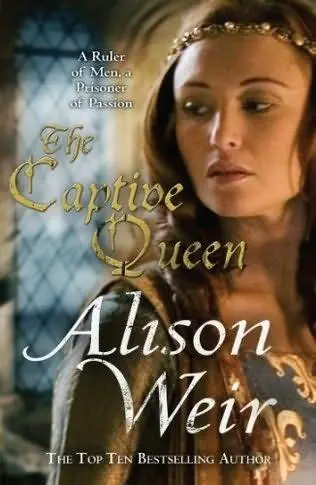
- Название:Captive Queen
- Автор:
- Издательство:BALLANTINE
- Жанр:
- Год:2010
- ISBN:978-0-345-52195-8
- Рейтинг книги:3 / 5. Голосов: 1
-
Избранное:Добавить в избранное
- Отзывы:
-
Ваша оценка:
Captive Queen: краткое содержание, описание и аннотация
Предлагаем к чтению аннотацию, описание, краткое содержание или предисловие (зависит от того, что написал сам автор книги «Captive Queen»). Если вы не нашли необходимую информацию о книге — напишите в комментариях, мы постараемся отыскать её.
Renowned for her highly acclaimed and bestselling British histories, Alison Weir has in recent years made a major impact on the fiction scene with her novels about Queen Elizabeth and Lady Jane Grey. In this latest offering, she imagines the world of Eleanor of Aquitaine, the beautiful twelfth-century woman who was Queen of France until she abandoned her royal husband for the younger man who would become King of England. In a relationship based on lust and a mutual desire for great power, Henry II and Eleanor took over the English throne in 1154, thus beginning one of the most influential reigns and tumultuous royal marriages in all of history. In this novel, Weir uses her extensive knowledge to paint a most vivid portrait of this fascinating woman.
Captive Queen — читать онлайн бесплатно полную книгу (весь текст) целиком
Ниже представлен текст книги, разбитый по страницам. Система сохранения места последней прочитанной страницы, позволяет с удобством читать онлайн бесплатно книгу «Captive Queen», без необходимости каждый раз заново искать на чём Вы остановились. Поставьте закладку, и сможете в любой момент перейти на страницу, на которой закончили чтение.
Интервал:
Закладка:
Once back in the safety of her bower, she told a surprised Amaria and a skeptical Ralph FitzStephen of her experiences. FitzStephen had the maze searched, and the tower unlocked and inspected, but found nothing to account for what Eleanor had heard and seen. It was not until two mornings later that she was given a less than satisfactory explanation for what had happened, when Amaria brought the local laundry woman to see her. They had fallen to chatting on the banks of the River Glyne, as the woman washed sheets, and Amaria told her of the Queen’s fright in the labyrinth.
The laundress was nervous of speaking to so great a lady, but determined to tell Eleanor what she knew.
“That baint no ‘uman soul in that there maze,” she declared. “She walks. Some has heard her, heard her footsteps. They be all around, no rhyme or reason to them.”
“Who walks?” Eleanor asked gently. The laundress’s words had chilled her.
“Why, the Fair Rosamund, o’ course, lady, her as people say was murd—” She stopped in mid-flight, remembering to whom she spoke. “Begging your pardon, lady, it’s only what fools say. But she walks, no doubt about it. And she’ve been seen up in that tower. She weeps for her sins! And another thing, young Matt, the miller’s boy, he’s seen her, in the maze! Well, not her, so to speak of—but he caught a glimpse of her gown; it were gray!”
Eleanor froze. She had not mentioned that detail.
She still did not quite know if she believed what the laundress had said when permission arrived for her to remove to Winchester so she could be present at Matilda’s confinement. If the tale was true, then why should Rosamund appear to her rival, Eleanor, the woman she had wronged in life?
“Stop thinking about it,” Amaria counseled in her blunt way. “It’s just gossip.”
“I’m not so sure,” Eleanor said thoughtfully. “It was a nightmarish experience, but I did not dream it. Can malice survive the grave? I can hardly believe Rosamund was trying to seek my forgiveness—it was an odd way to go about it, scaring me half to death like that.”
“It’s all nonsense!” Amaria snorted.
“I know what I heard, and saw,” Eleanor insisted. “You were not there. But we will say no more of it.”
“Mayhap, my lady,” interrupted FitzStephen, staggering into the bower with a pile of cloth-wrapped bundles in his arms, “there is no reasoning behind the appearances of spirits, and it means nothing at all—or you were mistaken in what you heard and saw; it could have been a shadow, or some small creatures of the night. Now, here are some parcels for you from the Lord King.”
Eleanor temporarily forgot her puzzlement as she unwrapped the gifts and exclaimed delightedly over the bold scarlet bliaut lined with gray miniver that she found in the first, the saddle worked with gold and trimmed with fur in the second, and the embroidered cushions in the third. Nor had Henry omitted to send gifts to Amaria, of whom he soundly approved: for her, there were fine linen headrails and an amethyst brooch.
Peace offerings, Eleanor told herself. He won’t admit that he has again treated me—and our sons—unjustly, so he sends presents instead. Her spirits lifted and she had to smile. It was so typical of Henry—and it augured well for a happy resolution to all the quarreling.
As for that strange Rosamund business, she knew she would never convince herself entirely that it had not been a supernatural experience. And the appalling thought occurred to her that Rosamund had not yet found the eternal peace that is every Christian soul’s hope and desire, and that her shade was condemned to a relentless earthly purgatory in expiation of her sins. The notion chilled her immeasurably, for she herself was no longer young, and Divine Judgment could not be far off! Might she too be condemned to walk this Earth for eternity, at Poitiers, the place where she had plotted her husband’s betrayal—or, worse still, in the grim keep of Sarum? Heaven forbid! She had best start ensuring that she lived wisely and virtuously from now on. That would make a change, she thought, with the hint of a darkly humorous smile playing on her lips.
Matilda, with the minimum of fuss, had a healthy little boy, to Eleanor’s joy, and called him William in honor of the Conqueror and the Queen’s father. Eleanor had arrived at Winchester just in time to greet her new grandchild as he emerged from his mother’s womb, and she was thrilled to be able to spend the following weeks in her daughter’s company, taking pleasure in the infant’s progress.
This happy interlude was marred by the arrival one morning of two more packages, both of identical size.
“For the Queen!” announced the steward, placing them on the chest. “A gift from the Lord King.”
Henry was trying to make amends! Eleanor smiled and unwrapped the first package. It contained more rich items of clothing: a lightweight summer cloak and hood of the deepest blue samite, and a good few yards of colorfully embroidered trimming for edging garments. Suitable peace offerings! It was gratifying to know that Henry was thinking of her and that her good opinion counted for something with him; and, of course, such gifts might well signal that she was soon to be set at liberty again.
She opened the second bundle to find, to her astonishment, that it contained exactly the same items. Why would Henry send two of everything, and in separate packages? Then her eye was drawn to a tiny scroll of parchment that lay on the floor; it must have fallen out of one of the bundles. She picked it up and saw that it was a receipt of sorts, written by some clerk who had obviously intended to file it away in the royal accounts but mistakenly wrapped it with the gifts. He would be looking for it, no doubt. But what was it that he had scribed? “£55.17s. for the clothes of the Queen and of Bellebelle, for the King’s use.”
Who was Bellebelle, and why had she been provided with exactly the same gifts of clothing as herself? Looking at the final phrase, her heart sinking, Eleanor suddenly knew the answer. The garments could not be for the King’s use, of course—but the mysterious Bellebelle obviously was.
Her mind disquieted, she made it her business, while at Winchester, to seek out Alys, Richard’s betrothed, telling herself firmly that any plan of Henry’s to divorce her and take Alys as his wife in her place could not have been Alys’s fault. But when she saw Alys, now a beautiful, buxom young woman in her early twenties, she was not so sure.
Alys’s welcome was muted; Eleanor supposed that she was permitted few visitors, since Henry was still keeping her under guard, no doubt fearing that Richard might descend on the castle and spirit her off to the altar, thereby depriving his father of a valuable bargaining tool in his tortuous power games with Philip. And of course the poor girl had suffered so many turns of fortune that she’d probably given up all hope of ever getting married. No doubt she anticipated that the Queen had come with news of yet another unwelcome development, or simply to gloat at her luckless rival; hence her understandable wariness.
She found Alys hard work. All her questions met with monosyllabic replies, and in the end Eleanor almost gave up. Clearly, Alys bore a deep resentment toward her, and small wonder, she thought grimly: but for herself, Alys would have been Queen of England these nine years. Instead, she was shut away here, wasting her youth to no purpose.
Had Alys actually loved Henry? Did she love him still? Eleanor had to know. She needed to reassure herself that this had not been the kind of grand passion that Henry shared with the ill-fated Rosamund, that Alys was no real threat to her.
Читать дальшеИнтервал:
Закладка:
Похожие книги на «Captive Queen»
Представляем Вашему вниманию похожие книги на «Captive Queen» списком для выбора. Мы отобрали схожую по названию и смыслу литературу в надежде предоставить читателям больше вариантов отыскать новые, интересные, ещё непрочитанные произведения.







Обсуждение, отзывы о книге «Captive Queen» и просто собственные мнения читателей. Оставьте ваши комментарии, напишите, что Вы думаете о произведении, его смысле или главных героях. Укажите что конкретно понравилось, а что нет, и почему Вы так считаете.