Alison Weir - Captive Queen
Здесь есть возможность читать онлайн «Alison Weir - Captive Queen» весь текст электронной книги совершенно бесплатно (целиком полную версию без сокращений). В некоторых случаях можно слушать аудио, скачать через торрент в формате fb2 и присутствует краткое содержание. Год выпуска: 2010, ISBN: 2010, Издательство: BALLANTINE, Жанр: Историческая проза, на английском языке. Описание произведения, (предисловие) а так же отзывы посетителей доступны на портале библиотеки ЛибКат.
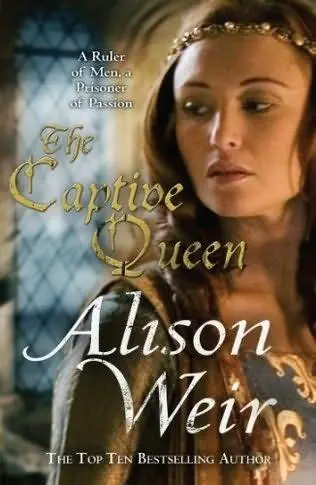
- Название:Captive Queen
- Автор:
- Издательство:BALLANTINE
- Жанр:
- Год:2010
- ISBN:978-0-345-52195-8
- Рейтинг книги:3 / 5. Голосов: 1
-
Избранное:Добавить в избранное
- Отзывы:
-
Ваша оценка:
Captive Queen: краткое содержание, описание и аннотация
Предлагаем к чтению аннотацию, описание, краткое содержание или предисловие (зависит от того, что написал сам автор книги «Captive Queen»). Если вы не нашли необходимую информацию о книге — напишите в комментариях, мы постараемся отыскать её.
Renowned for her highly acclaimed and bestselling British histories, Alison Weir has in recent years made a major impact on the fiction scene with her novels about Queen Elizabeth and Lady Jane Grey. In this latest offering, she imagines the world of Eleanor of Aquitaine, the beautiful twelfth-century woman who was Queen of France until she abandoned her royal husband for the younger man who would become King of England. In a relationship based on lust and a mutual desire for great power, Henry II and Eleanor took over the English throne in 1154, thus beginning one of the most influential reigns and tumultuous royal marriages in all of history. In this novel, Weir uses her extensive knowledge to paint a most vivid portrait of this fascinating woman.
Captive Queen — читать онлайн бесплатно полную книгу (весь текст) целиком
Ниже представлен текст книги, разбитый по страницам. Система сохранения места последней прочитанной страницы, позволяет с удобством читать онлайн бесплатно книгу «Captive Queen», без необходимости каждый раз заново искать на чём Вы остановились. Поставьте закладку, и сможете в любой момент перейти на страницу, на которой закончили чтение.
Интервал:
Закладка:
There was no response.
54
Winchester, 1181
Geoffrey and Constance were married—it had been a summer wedding—and Henry had gone straight back to England afterward and made his bastard son, the other Geoffrey, Lord Chancellor of England. Eleanor shook her head in dismay at both pieces of news. Devious her Geoffrey might be, but Constance was worse, and was probably running rings around him. As for the bastard, the King was heaping far too many rewards on him: he was Archdeacon of Rouen, treasurer of York Minster, and the proud owner of two castles in Anjou. She could foresee jealousy poisoning his relations with his legitimate siblings, and of course there was no telling where the young man’s ambition might lead him. Henry, she feared, was making a rod for his own back.
Recent news from over the sea was not good. Joanna had borne, with great difficulty, a son who died at birth. And Matilda was in exile with her husband, who had quarreled with the Emperor and fled from Germany; the word was that the couple might seek refuge in England. Eleanor wept for her daughters, and prayed for Matilda to come home, that she might comfort her. It had been thirteen years since she had set eyes on her, and she hungered to see her. She longed to see all her children. Her heart quailed at the thought of another lonely, unhappy Christmas.
She would have thought that eight years of imprisonment had taught her patience and resignation, but it had not. She’d relived the events leading up to her sons’ rebellion a thousand times and still felt, deep within her, that she had been right to support them. She knew that if she had her chance again, she would make the same choice, because it had been the only, the right, choice. A mother’s instinct was to defend her children. Yet what a terrible price she had paid for it. Never hearing from them, by Henry’s express order, she wondered if they still cherished the same affection for her—or if she was now but a distant memory in their young minds.
Thank God her spirit was still strong, unquenched by adversity, even if her body was aging. She had lost weight, and her mirror reflected a haunted face with the skin stretched lightly over the bones beneath; it was too pale from her long confinement, even if she was allowed to take the air in the garden these days. And there was always a yearning look in her eyes.
Of Henry, she rarely thought these days, unless it was with sadness or in passing. There was no room left in her for bitterness. She had prayed often for the grace to forgive, and with the long passage of time, found that such grace had been accorded her.
Occasionally, at night, when she lay awake with Amaria snoring peacefully beside her—she’d gotten used to that, but God knew it had taken all her patience—she would imagine that it was her husband who lay there in the darkness, and would remember his hand reaching across to claim her, and the weight of his body as he mounted hers. Those were the worst moments, for even now she could feel the surge of desire, almost to the point where she feared she might go mad if she could not assuage it. Henry had been such an exceptional lover that she could never forget the joy and sense of liberation that she’d experienced in his arms. But then she would find herself back on the old treadmill, remembering that he had never been faithful to her, and that all the love they shared had not counted for much in the long run. Her memories were forever tainted; it was best not to think of the past, but to dwell on the mundane round of her daily life and the things of the spirit. But oh, how she yearned for a man to warm her bed in the darkest reaches of the night!
55
Caen, 1182
Henry’s eyes swept over the packed hall of the Norman Exchequer in the castle of Caen with satisfaction. They had come in response to his summons. His sons were here, and together, in this fine new building, they would preside over a glittering Yuletide court that had been deliberately arranged to rival any that ambitious puppy, Philip of France, might hold in Paris.
The festivities were in full swing, the hall smoky from the fire that blazed merrily in the central hearth, and lit by a giant circular iron candelabra, suspended from the roof between the high arched windows. It was the early hours of Christmas morning, and the court, having attended Midnight Mass, was in high spirits, tucking into the traditional feast known in the duchy as Le Réveillon.
Henry was keeping a wary eye on his sons, who were ranged on either side of him at the high table. It was not going to be a happy gathering. The Young King had arrived in the company of Bertran de Born, whom Henry did not like or trust, and was in a foul mood; the King watched him sitting there sulking and pointedly ignoring his wife, whose homely face bore a strained, troubled expression. Henry thought it odd that for once his eldest son had not brought William Marshal with him; the two were normally inseparable, and the King approved of William’s influence on his hothead of an heir.
For Young Henry had not only upset Queen Marguerite, but had fallen out spectacularly with Richard, who was glowering heatedly at him down the table—their father had to ensure that they were seated as far apart as possible. The quarrel had erupted back in spring, in Aquitaine, where the young Duke Richard’s harsh rule finally provoked his volatile vassals to open rebellion. The evil genius behind this was the malicious adventurer Bertran de Born, who saw Richard’s oppression as the rape of his land, and had incited the Young King to join the rebels. Resentful of his brother having more power than himself, that rash young man had been easy to persuade. Not to be left out, Geoffrey, greedily anticipating the spoils of fighting, hastened to join him. Aquitaine had been abruptly plunged into war, with one brother against the other two.
For some months, Henry had no choice but to let them get on with it, having his hands full in Normandy, but as soon as the campaigning season came to an end in the autumn, and he summoned the Young King north, meaning to divert him from the bloodbath in the South, the arrogant young fool loudly demanded that he cede to him Normandy and Anjou. When Henry angrily refused, the Young King stormed off in a temper to Paris, where that puppy Philip—who would soon need to be firmly muzzled—had welcomed him with sympathetic arms and fallen to plotting with him.
Young Henry had stormed back to Rouen, demanding to be given the power that should be his. He would take the Cross and go on crusade, he threatened, if the King refused his reasonable demand. Indeed, he would prefer banishment to being treated like a subordinate. He was a king, was he not? Or had he imagined those coronations at Westminster and Winchester?
Henry had ignored the sarcasm. He had also ignored his heir’s demands, which left the young fool threatening suicide. In the end, worn down by the pressure, the King bought his son off with a generous allowance and sent him to live with his sister Matilda at Argentan Castle, where Henry had offered her and her husband and children refuge during their exile. Having given his oath not to make further demands, the Young King, with Queen Marguerite in tow, went off to join her household. Henry hoped that Matilda might talk some sense into him; she had a lot of her wise grandmother and namesake in her. But it seemed that his hopes had been in vain.
Henry had insisted, in the interests of restoring peace, that all his sons attend the Christmas court. Matilda was present too; she had grown into a handsome matron of twenty-four, and was now the mother of a large brood, of whom Henry was inordinately proud.
Dark-haired Geoffrey was exerting his usual charm, his ready flow of words smoother than oil, but Henry knew him to be slippery, grasping, and dangerous. He had few scruples—there had been disturbing reports of him plundering abbeys and churches at will—and although he was of tireless endeavor, he was a hypocrite in nearly everything that mattered, and certainly not to be trusted.
Читать дальшеИнтервал:
Закладка:
Похожие книги на «Captive Queen»
Представляем Вашему вниманию похожие книги на «Captive Queen» списком для выбора. Мы отобрали схожую по названию и смыслу литературу в надежде предоставить читателям больше вариантов отыскать новые, интересные, ещё непрочитанные произведения.










Обсуждение, отзывы о книге «Captive Queen» и просто собственные мнения читателей. Оставьте ваши комментарии, напишите, что Вы думаете о произведении, его смысле или главных героях. Укажите что конкретно понравилось, а что нет, и почему Вы так считаете.