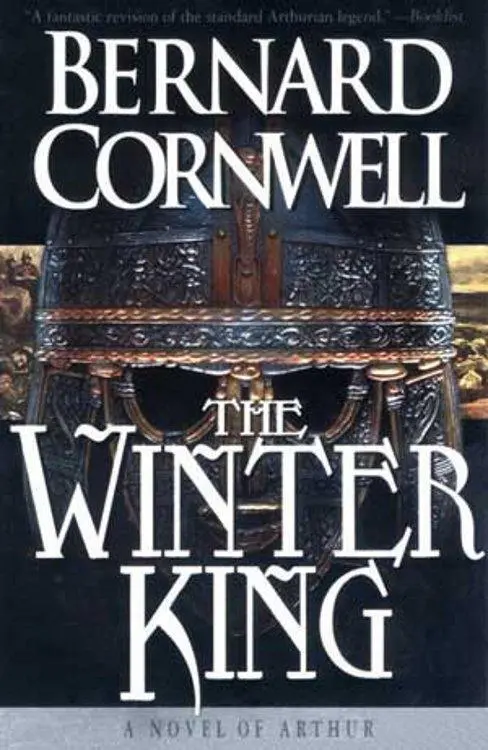
Bernard Cornwell - The Winter King
Здесь есть возможность читать онлайн «Bernard Cornwell - The Winter King» весь текст электронной книги совершенно бесплатно (целиком полную версию без сокращений). В некоторых случаях можно слушать аудио, скачать через торрент в формате fb2 и присутствует краткое содержание. Год выпуска: 1997, Издательство: MacMillan Publishers, Жанр: Историческая проза, на английском языке. Описание произведения, (предисловие) а так же отзывы посетителей доступны на портале библиотеки ЛибКат.
- Название:The Winter King
- Автор:
- Издательство:MacMillan Publishers
- Жанр:
- Год:1997
- ISBN:нет данных
- Рейтинг книги:4 / 5. Голосов: 1
-
Избранное:Добавить в избранное
- Отзывы:
-
Ваша оценка:
The Winter King: краткое содержание, описание и аннотация
Предлагаем к чтению аннотацию, описание, краткое содержание или предисловие (зависит от того, что написал сам автор книги «The Winter King»). Если вы не нашли необходимую информацию о книге — напишите в комментариях, мы постараемся отыскать её.
Fifth century Britain lies on the edge of darkness. Memories of Roman civilization are fading; the pagan Gods are retreating before the spread of Christianity; the Saxons are snapping and snarling at the borders. Only fragile bonds unite the unruly kingdoms of Britain against the invaders, bonds cemented by the vigour of the High King, Uther Pendragon. But the Pendragon is failing, and his heir is no strong leader but a child, born on a bitter winter night.
Only one man could keep Uther's throne safe,only he could hold the warring kingdoms together to face their true enemy, the Saxons. That man is Arthur: soldier, statesman, Merlin's protege, Uther's illegitimate son. But he has been banished, exiled by his own father to Brittany. Derfel, one of his spearmen, narrates the story of Arthur's return and of his quest for peace: embattled, bloody and, finally, triumphant.
The Winter King is a magnificent tale of the Dark Ages and the reality of war and political strife in a land where religion vied with magic for the souls of the people. It portrays Arthur the man rather than the legend, a military genius who, with a small band of warriors bound to him by loyalty and love, struggled to keep alive a flicker of civilization.
The Winter King — читать онлайн бесплатно полную книгу (весь текст) целиком
Ниже представлен текст книги, разбитый по страницам. Система сохранения места последней прочитанной страницы, позволяет с удобством читать онлайн бесплатно книгу «The Winter King», без необходимости каждый раз заново искать на чём Вы остановились. Поставьте закладку, и сможете в любой момент перейти на страницу, на которой закончили чтение.
Интервал:
Закладка:
“Someone must,” he said, then turned to scowl at me with his one eye. “Who are you?”
“Derfel, Father, of Dumnonia. We met two years ago. I'm surprised you're still here.”
“Your surprise is of no interest to me, Derfel of Dumnonia. Besides, I did leave for a while. I went to Rome. Filthy place. I thought the Vandals might have cleaned it up, but the place is still full of priests and their plump little boys, so I came back here. Ban's harpists are much prettier than Rome's catamites.” He gave me an unfriendly look. “Do you care about my safety, Derfel of Dumnonia?” I could hardly answer no, though I was tempted to. “My job is to protect lives,” I said rather pretentiously, 'including yours, Father."
“Then I put my life in your hands, Derfel of Dumnonia,” he said as he turned his ugly face back to the table and pushed the cat away from his quill. “I lay my life on your conscience, Derfel of Dumnonia, and now you can go and fight and leave me to do something useful.” I tried to ask the priest about Rome, but he waved my questions away and so I went down to the storehouse on the western wall that would be our home for the rest of the siege. Galahad, who considered himself an honorary Dumnonian now, was with us and he and I tried to count the Franks who were retreating from the incoming tide after another attempt to discover the track across the sands. The bards, singing of Ynys Trebes's siege, say the enemy outnumbered the grains of sand in the bay. They were not quite that many, but still they were formidable. Every Prankish war-band in western Gaul had combined to help capture Ynys Trebes, the jewel of Armorica which, it was rumoured, was crammed with the treasures of Rome's fallen Empire. Galahad estimated we were faced by three thousand Franks, my guess was two thousand, while Lancelot assured us there were ten thousand. But by anyone's count there was a terrible lot of them.
The first attacks brought the Franks nothing but disaster. They found a way across the sand and assaulted the main gate and were repelled bloodily, then the next day they attacked our part of the wall and were given the same treatment, only this time they stayed too long and a large part of their force was cut off by the incoming tide. Some tried to wade to the mainland and were drowned, others retreated to the shrinking stretch of sand before our walls where they were slaughtered by a sally of spearmen led from the gate by Bleiddig, the chief who had fetched me to Benoic and who was now the leader of Benoic's veterans. Bleiddig's sortie across the sand was in direct disobedience to Lancelot's rule that we must stay inside the city's wall, but the dead were so many that Lancelot pretended to have ordered the attack and later, after Bleiddig's death, he even claimed to have led the sally. The fill made a song telling how Lancelot had dammed the bay with Prankish dead, but in truth the Prince stayed in the palace while Bleiddig attacked. For days afterwards the bodies of Prankish warriors swilled around the island's base, carried by the tide and providing rich carrion for the gulls.
The Franks then began to build a proper causeway. They cut hundreds of trees and laid them on the sand, then weighted the trunks with rocks carried to the shore by slaves. The tides in Ynys Trebes's wide bay were fierce, sometimes rising forty feet, and the new causeway was ripped by the currents so that at low tide the flats were littered with floating logs, but always the Franks brought more trees and stone and so plugged the gaps. They had captured thousands of slaves and did not care how many died in building the new road. The causeway became longer as our food supplies grew shorter. Our few remaining boats still went fishing, and others carried grain from Broceliande, but the Franks launched their own boats from the shore and after two of our fishing boats were captured and their crews disembowelled, our shipmasters stayed at home. The poets on the hilltop, posturing with their spears, lived off the palace's rich stores, but we warriors scraped barnacles off the rocks, ate mussels and razor clams or stewed the rats we trapped in our storehouse that was still filled with pelts, salt and barrels of nails. We did not starve. We had willow fish traps at the base of the rocks and most days they yielded a few small fish though at low tide the Franks would send raiding parties to destroy the traps. At high tide the Prankish boats rowed round the island to pull up the fish traps set further from the city's shore. The bay was shallow enough for the enemy to see the traps and then to break them with spears. One such boat grounded on its return to the mainland and was left stranded a quarter-mile from the city as the tide fell. Culhwch ordered a sortie and thirty of us climbed down fishing nets suspended from the wall's top. The twelve men of the boat's crew fled as we approached, and inside the abandoned craft we found a barrel of salted fish and two dry loaves of bread that we carried back in triumph. When the tide rose we brought the boat back to the city and tied it safe beneath our wall. Lancelot watched our disobedience, but sent no reprimand though a message did come from Queen Elaine demanding to know what supplies we had fetched back from the ship. We sent some dried fish up the road and no doubt the gift was construed as an insult. Lancelot then accused us of capturing the boat so that we could desert Ynys Trebes and ordered us to deliver the ship to the island's small harbour. For answer I climbed the hill to the palace and demanded that he back up his accusation of cowardice with his sword. I shouted the challenge around the courtyard, but the Prince and his poets stayed inside their locked doors. I spat on their threshold and left.
Galahad was happier the more desperate things became. Part of his happiness sprang from the presence of Leanor, the harpist who had welcomed me two years before, the girl for whom Galahad had confessed his lust to me, the same girl Lancelot had raped. She and Galahad lived in a corner of the store-room. We all had women. There was something about the hopelessness of our plight that eroded normal behaviour and so we crammed as much living as we could into those hours before our expected deaths. The women stood guard with us and hurled rocks whenever the Franks tried to dismantle our fragile fish traps. We had long run out of spears, except for those we had brought to Benoic ourselves and which we were saving for the main assault. Our handful of archers had no missiles except the ones shot into the city by the Franks, and that supply increased when the enemy's causeway was a short bow's shot from the city gate. The Franks erected a timber fence at the end of the causeway and their archers stood behind the fence and poured arrows on the gate's defenders. The Franks made no attempt to extend the causeway all the way to the city, for the new roadway was only ever intended to give them a dry passage to the place where their assault could begin. We knew that attack must come soon. It was early summer when the causeway was finished. The moon was full and brought huge tides. For much of the time the causeway was under water, but at low tide the sands stretched wide about Ynys Trebes, and the Franks, who were learning the secrets of the sand flats day by day, ranged all about us. Their drums were our constant music and their threats were ever in our ears. One day brought a feast special to their tribes and instead of attacking us they lit great fires on the beach then marched a column of slaves to the causeway's end where, one by one, the captives were beheaded. The slaves were Britons, some of them with relatives watching from the city's wall, and the barbarism of the slaughter goaded some of Ynys Trebes's defenders to rush out of the gate in a vain attempt to rescue the doomed women and children. The Franks were waiting for the attack and formed a shield-wall on the sand, but the men of Ynys Trebes, crazed by anger and hunger, charged home. Bleiddig was one of the attackers. He died that day, cut down by a Prankish spear. We Dumnonians watched as a handful of survivors fled back to the city. There was nothing we could have done except add our corpses to the pile. Bleiddig's body was flayed, disembowelled, then planted on a stake at the causeway's end so that we were forced to look at him until the next high tide. Somehow, though, the body stayed on the stake despite being immersed so that next morning, in a grey dawn, the gulls were tearing at his salt-washed corpse.
Читать дальшеИнтервал:
Закладка:
Похожие книги на «The Winter King»
Представляем Вашему вниманию похожие книги на «The Winter King» списком для выбора. Мы отобрали схожую по названию и смыслу литературу в надежде предоставить читателям больше вариантов отыскать новые, интересные, ещё непрочитанные произведения.











Обсуждение, отзывы о книге «The Winter King» и просто собственные мнения читателей. Оставьте ваши комментарии, напишите, что Вы думаете о произведении, его смысле или главных героях. Укажите что конкретно понравилось, а что нет, и почему Вы так считаете.