Bernard Cornwell - The Winter King
Здесь есть возможность читать онлайн «Bernard Cornwell - The Winter King» весь текст электронной книги совершенно бесплатно (целиком полную версию без сокращений). В некоторых случаях можно слушать аудио, скачать через торрент в формате fb2 и присутствует краткое содержание. Год выпуска: 1997, Издательство: MacMillan Publishers, Жанр: Историческая проза, на английском языке. Описание произведения, (предисловие) а так же отзывы посетителей доступны на портале библиотеки ЛибКат.
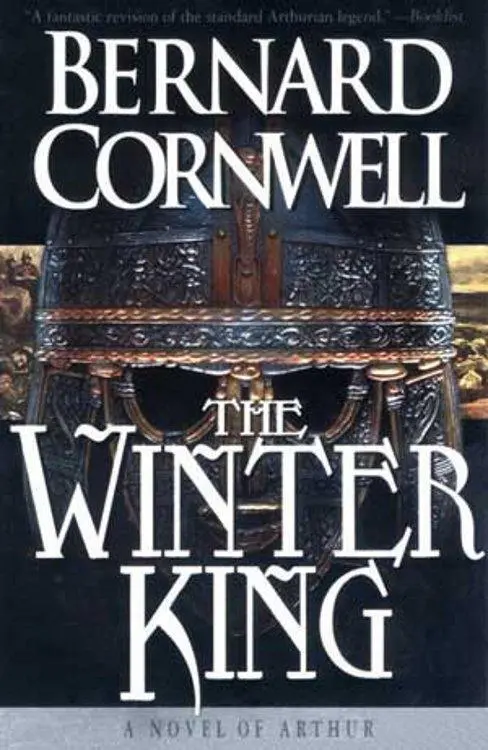
- Название:The Winter King
- Автор:
- Издательство:MacMillan Publishers
- Жанр:
- Год:1997
- ISBN:нет данных
- Рейтинг книги:4 / 5. Голосов: 1
-
Избранное:Добавить в избранное
- Отзывы:
-
Ваша оценка:
The Winter King: краткое содержание, описание и аннотация
Предлагаем к чтению аннотацию, описание, краткое содержание или предисловие (зависит от того, что написал сам автор книги «The Winter King»). Если вы не нашли необходимую информацию о книге — напишите в комментариях, мы постараемся отыскать её.
Fifth century Britain lies on the edge of darkness. Memories of Roman civilization are fading; the pagan Gods are retreating before the spread of Christianity; the Saxons are snapping and snarling at the borders. Only fragile bonds unite the unruly kingdoms of Britain against the invaders, bonds cemented by the vigour of the High King, Uther Pendragon. But the Pendragon is failing, and his heir is no strong leader but a child, born on a bitter winter night.
Only one man could keep Uther's throne safe,only he could hold the warring kingdoms together to face their true enemy, the Saxons. That man is Arthur: soldier, statesman, Merlin's protege, Uther's illegitimate son. But he has been banished, exiled by his own father to Brittany. Derfel, one of his spearmen, narrates the story of Arthur's return and of his quest for peace: embattled, bloody and, finally, triumphant.
The Winter King is a magnificent tale of the Dark Ages and the reality of war and political strife in a land where religion vied with magic for the souls of the people. It portrays Arthur the man rather than the legend, a military genius who, with a small band of warriors bound to him by loyalty and love, struggled to keep alive a flicker of civilization.
The Winter King — читать онлайн бесплатно полную книгу (весь текст) целиком
Ниже представлен текст книги, разбитый по страницам. Система сохранения места последней прочитанной страницы, позволяет с удобством читать онлайн бесплатно книгу «The Winter King», без необходимости каждый раз заново искать на чём Вы остановились. Поставьте закладку, и сможете в любой момент перейти на страницу, на которой закончили чтение.
Интервал:
Закладка:
“Sixty men?” he sneered. “Is that all Arthur can manage?”
“Yes, Lord,” I said.
“Sixty men led by a child,” Lancelot said scornfully. He was only a year or two older than I yet he possessed the world-weariness of a much older man. He was savagely handsome, tall and well built, with a narrow, dark-eyed face that was as striking in its maleness as Guinevere's was in its femininity, though there was something disconcertingly serpent-like in Lancelot's aloof looks. He had black hair that he wore in oiled loops pinned with gold combs, his moustache and beard were neatly trimmed and oiled to a gloss, and he wore a scent that smelled of lavender. He was the best-looking man I ever saw and, worse, he knew it, and I had disliked him from the very first moment I saw him. We met in Ban's feasting hall, which was unlike any feasting hall I was ever in. This one had marble pillars, white curtains that misted the sea view, and smooth plastered walls on which were paintings of Gods, Goddesses and fabulous animals. Servants and guards lined the walls of the gracious room that was lit by a myriad of small bronze dishes in which wicks floated in oil, while thick beeswax candles burned on the long table covered by a white cloth which I was constantly soiling with drips of butter, just as I was smearing the awkward toga that King Ban had insisted I wore to the feast.
I was loving the food and hating the company. Father Celwin was present and I would have welcomed a chance to talk with him, but he was annoying one of the three poets at the table, all of them members of King Ban's beloved band offili, while I was marooned at the table's end with Prince Lancelot. Queen Elaine, who was seated beside her husband, the King, was defending the poets against Celwin's barbs, which seemed much more amusing than Prince Lancelot's bitter conversation. “Arthur does insult us,” Lancelot insisted again.
“I am sorry you should think so, Lord,” I answered.
“Do you never argue, child?” he demanded of me.
I looked into his flat, hard eyes. “I thought it unwise for warriors to argue at a feast, Lord Prince,” I said.
“So you're a timid child!” he sneered.
I sighed and lowered my voice. “Do you really want an argument, Lord Prince?” I asked, my patience at last nearing its end, 'because if you do then just call me a child again and I'll tear your skull off." I smiled.
“Child,” he said after a heartbeat.
I gave him another puzzled look, wondering if he played a game the rules of which I could not guess, but if he did then the game was in deadly earnest. “Ten times the black sword,” I said.
“What?” He frowned, not recognizing the Mithraic formula which meant he was not my brother. “Have you gone mad?” he asked, and then, after a pause, “Are you a mad child, as well as a timid one?” I hit him. I should have kept my temper, but my discomfort and anger overcame all prudence. I gave him a backswing with my elbow that bloodied his nose, cracked his lip and spilt him backwards off the chair. He sprawled on the floor and tried to swing the fallen chair at me, but I was too fast and too close for the blow to have any force. I kicked the chair aside, hauled him upright then rammed him backwards against a pillar where I smashed his head against the stone and put my knee into his groin. He flinched. His mother was screaming, while King Ban and his poetic guests just gaped at me. A nervous white-cloaked guard put his spear-point at my throat. “Take it away,” I told the guard, 'or you're a dead man." He took it away.
“What am I, Lord Prince?” I asked Lancelot.
“A child,” he said.
I put my forearm across his throat, half choking him. He struggled, but he could not shift me. “What am I, Lord?” I asked again.
“A child,” he croaked.
A hand touched my arm and I turned to see a fair-haired man of my own age smiling at me. He had been sitting at the table's opposite end and I had assumed he was another poet, but that assumption was wrong. “I've long wanted to do what you're doing,” the young man said, 'but if you want to stop my brother insulting you then you'll have to kill him and family honour will insist I shall have to kill you and I'm not sure I want to do that."
I eased my arm from Lancelot's throat. For a few seconds he stood there, trying to breathe, then he shook his head, spat at me, and walked back to the table. His nose was bleeding, his lips swelling and his carefully oiled hair hung in sad disarray. His brother seemed amused by the fight. “I'm Galahad,” he said,
'and proud to meet Derfel Cadarn."
I thanked him, then forced myself to cross to King Ban's chair where, despite his avowed dislike of respectful gestures, I knelt down. “For the insult to your house, Lord King,” I said, “I apologize and submit to your punishment.”
“Punishment?” Ban said in a surprised voice. “Don't be so silly. It's just the wine. Too much wine. We should water our wine as the Romans did, shouldn't we, Father Celwin?”
“Ridiculous thing to do,” the old priest said.
“No punishment, Derfel,” Ban said. “And do stand up, I can't abide being worshipped. And what was your offence? Merely to be avid in argument, and where is the fault in that? I like argument, isn't that so, Father Celwin? A supper without argument is like a day without poetry' the King ignored the priest's acid comment about how blessed such a day would be 'and my son Lancelot is a hasty man. He has a warrior's heart and a poet's soul, and that, I fear, is a most combustible mix. Stay and eat.” Ban was a most generous monarch, though I noted that his Queen, Elaine, was anything but pleased at his decision. She was grey-haired, yet her face was unlined and contained a grace and calm that suited Ynys Trebes's serene beauty. At that moment, though, the Queen was frowning at me in severe disapproval.
“Are all Dumnonian warriors so ill-mannered?” she asked the table at large in an acid voice.
“You want warriors to be courtiers?” Celwin retorted brusquely. “You'd send your precious poets to kill the Franks? And I don't mean by reciting their verses at them, though come to think of it that might be quite effective.” He leered at the Queen and the three poets shuddered. Celwin had somehow evaded the prohibition on ugly things in Ynys Trebes for, without the cowl he had worn in the library, he appeared as an astonishingly ill-favoured man with one sharp eye, a mildewed eyepatch on the other, a sour twisted mouth, lank hair that grew behind a ragged tonsure line, a filthy beard half hiding a crude wooden cross hanging on his hollow chest, and with a bent, twisted body that was distorted by its stupendous hump. The grey cat that had been draped about his neck in the library was now curled on his lap eating scraps of lobster.
“Come to my end of the table,” Galahad said, 'and don't blame yourself."
“But I do,” I said. “It's my fault. I should have kept my temper.”
“My brother,” Galahad said when the seating had been rearranged, 'my half-brother, rather, delights in goading people. It's his sport, but most daren't fight back because he's the Edling and that means one day he'll have powers of life and death. But you did the right thing."
“No, the wrong thing.”
“I won't argue. But I will get you ashore tonight.”
“Tonight?” I was surprised.
“My brother does not take defeat lightly,” Galahad said softly. “A knife in the ribs while you're sleeping? If I were you, Derfel Cadarn, I should join your men ashore and sleep safe in their ranks.” I looked down the table to where the darkly handsome Lancelot was now being consoled by his mother as she dabbed at the blood on his face with a napkin dampened by wine. “Half-brother?” I asked Galahad.
Читать дальшеИнтервал:
Закладка:
Похожие книги на «The Winter King»
Представляем Вашему вниманию похожие книги на «The Winter King» списком для выбора. Мы отобрали схожую по названию и смыслу литературу в надежде предоставить читателям больше вариантов отыскать новые, интересные, ещё непрочитанные произведения.





Обсуждение, отзывы о книге «The Winter King» и просто собственные мнения читателей. Оставьте ваши комментарии, напишите, что Вы думаете о произведении, его смысле или главных героях. Укажите что конкретно понравилось, а что нет, и почему Вы так считаете.