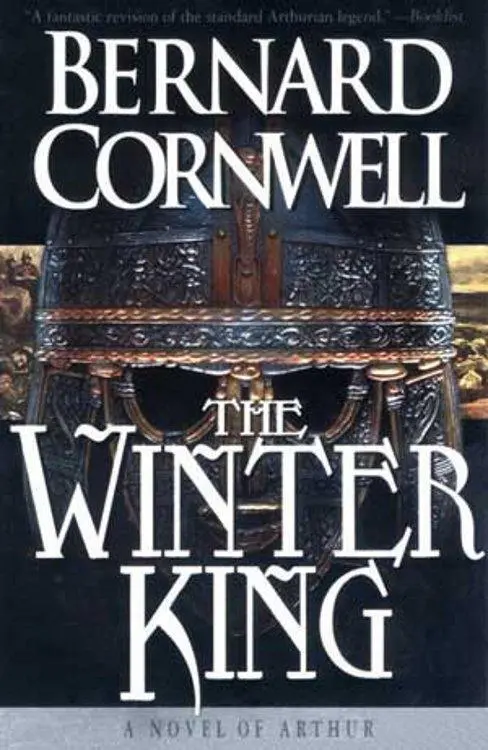
Bernard Cornwell - The Winter King
Здесь есть возможность читать онлайн «Bernard Cornwell - The Winter King» весь текст электронной книги совершенно бесплатно (целиком полную версию без сокращений). В некоторых случаях можно слушать аудио, скачать через торрент в формате fb2 и присутствует краткое содержание. Год выпуска: 1997, Издательство: MacMillan Publishers, Жанр: Историческая проза, на английском языке. Описание произведения, (предисловие) а так же отзывы посетителей доступны на портале библиотеки ЛибКат.
- Название:The Winter King
- Автор:
- Издательство:MacMillan Publishers
- Жанр:
- Год:1997
- ISBN:нет данных
- Рейтинг книги:4 / 5. Голосов: 1
-
Избранное:Добавить в избранное
- Отзывы:
-
Ваша оценка:
The Winter King: краткое содержание, описание и аннотация
Предлагаем к чтению аннотацию, описание, краткое содержание или предисловие (зависит от того, что написал сам автор книги «The Winter King»). Если вы не нашли необходимую информацию о книге — напишите в комментариях, мы постараемся отыскать её.
Fifth century Britain lies on the edge of darkness. Memories of Roman civilization are fading; the pagan Gods are retreating before the spread of Christianity; the Saxons are snapping and snarling at the borders. Only fragile bonds unite the unruly kingdoms of Britain against the invaders, bonds cemented by the vigour of the High King, Uther Pendragon. But the Pendragon is failing, and his heir is no strong leader but a child, born on a bitter winter night.
Only one man could keep Uther's throne safe,only he could hold the warring kingdoms together to face their true enemy, the Saxons. That man is Arthur: soldier, statesman, Merlin's protege, Uther's illegitimate son. But he has been banished, exiled by his own father to Brittany. Derfel, one of his spearmen, narrates the story of Arthur's return and of his quest for peace: embattled, bloody and, finally, triumphant.
The Winter King is a magnificent tale of the Dark Ages and the reality of war and political strife in a land where religion vied with magic for the souls of the people. It portrays Arthur the man rather than the legend, a military genius who, with a small band of warriors bound to him by loyalty and love, struggled to keep alive a flicker of civilization.
The Winter King — читать онлайн бесплатно полную книгу (весь текст) целиком
Ниже представлен текст книги, разбитый по страницам. Система сохранения места последней прочитанной страницы, позволяет с удобством читать онлайн бесплатно книгу «The Winter King», без необходимости каждый раз заново искать на чём Вы остановились. Поставьте закладку, и сможете в любой момент перейти на страницу, на которой закончили чтение.
Интервал:
Закладка:
'but if the King belongs to Arthur, then so does Dumnonia."
“Is that so bad?” I asked.
It's better for you and me, boy, if the land belongs to Owain." Griffid fingered one of the gold torques around his neck to show what he meant. They all called me boy or lad, but only because I was the youngest in the troop and still un blooded by proper battle against other warriors. They also believed that my presence in their ranks brought them good luck because I had once escaped from a Druid's death-pit. All Owain's men, like soldiers everywhere, were mightily superstitious. Every omen was considered and debated; every man carried a hare's foot or a lightning stone; and every action was ritualized, so that no man would pull on a right boot before a left or sharpen a spear in his own shadow. There were a handful of Christians in our ranks and I had thought they might show less fear of the Gods, spirits and ghosts, but they proved every bit as superstitious as the rest of us.
King Melwas's capital, Venta, was a poor frontier town. Its workshops had long closed down and the walls of its large Roman buildings showed great scorch marks from the times when the town had been sacked by raiding Saxons. King Melwas was terrified that the town was about to be sacked again. The Saxons, he said, had a new leader who was hungry for land and dreadful in battle. “Why didn't Owain come?” he demanded petulantly, 'or Arthur? They want to destroy me, is that it?“ He was a fat and suspicious man with the foulest breath of anyone I ever met. He was the king of a tribe, rather than of a country, which made him of the second rank, though to look at him you would have thought Melwas was a serf and a querulous serf at that. ”There aren't many of you, are there?“ he complained to Griffid. ”It's a good thing I raised the levy."
The levy was Melwas's citizen army and every able-bodied man in his Belgic tribe was supposed to serve, though a good few had made themselves scarce and most of the richer tribesmen had sent slaves as substitutes. Nevertheless Melwas had managed to assemble a force of more than three hundred men, each carrying his own food and bringing his own weapons. Some of the levy had once been warriors and came equipped with fine war spears and carefully preserved shields, but most had no armour and a few had nothing but single-sticks or sharpened mattocks for weapons. A lot of women and children accompanied the levy, unwilling to stay alone in their homes when the Saxons were threatening. Melwas insisted that he and his own warriors would stay to defend the crumbling ramparts of Venta, which meant that Griffid had to lead the levy against the enemy. Melwas had no idea where the Saxons were and so Griffid blundered helplessly into the deep woods east of Venta. We were more of a rabble than a war-band, and the sight of a deer would start a mad whooping pursuit that would have alerted any enemy within a dozen miles, and the pursuit would always finish with the levy scattered across a swathe of woodland. We lost nearly fifty men that way, either because their careless pursuit led them into Saxon hands, or else because they simply became lost and decided to go home. There were plenty of Saxons in those woods, though at first we saw none. Sometimes we found their campfires still warm and once we found a small Belgic settlement that had been raided and burned. The men and the old people were still there, all of them dead but the young and the women had been taken as slaves. The smell of the dead dampened the high spirits of the remaining levy and made them stay together as Griffid edged on eastwards.
We encountered our first Saxon war-band in a wide river valley where a group of the invaders was making a settlement. By the time we arrived they had built half a wooden stockade and planted the wood pillars of their main hall, but our appearance at the edge of the woods made them drop their tools and pick up their spears. We outnumbered them three to one, yet even so Griffid could not persuade us charge their well-knit, fierce-speared shield-line. We younger men were keen enough and some of us pranced like fools in front of the Saxons, but there were never enough of us to charge home and the Saxons ignored our taunts while the rest of Griffid's men drank their mead and cursed our eagerness. To me, desperate to earn a warrior ring made from Saxon iron, it seemed madness that we did not attack, but I had yet to experience the butchery of two locked shield-walls, nor had I learned how hard it is to persuade men to offer their bodies to that grisly work. Griffid did make some half-hearted efforts to encourage an attack; then was content to drink his mead and shout insults; and thus we faced the enemy for three hours or more without ever advancing more than a few steps. Griffid's timidity at least gave me a chance to examine the Saxons who, in truth, did not look so very different from ourselves. Their hair was fairer, their eyes palely blue, their skins ruddier than ours, and they liked to wear a lot of fur about their clothes, but otherwise they dressed like us and the only differences in weapons were that most Saxons carried a long-bladed knife that was wicked for close-quarter work, and many of them used huge broad-bladed axes that could split a shield with one stroke. Some of our own men were so impressed by the axes that they carried such weapons themselves, but Owain, like Arthur, disdained them as clumsy. You cannot parry with an axe, Owain used to say, and a weapon that does not defend as well as attack was no good in his eyes. The Saxon priests were quite different from our own holy men, for these foreign sorcerers wore animal skins and caked their hair with cow dung so that it stood in spikes about their heads. On that day in the river valley one such Sais priest sacrificed a goat to discover whether or not they should fight us. The priest first broke one of the animal's back legs, then stabbed it in the neck and let it run away with its broken leg trailing. It lurched bleeding and crying along their battle line, then turned towards us before collapsing on the grass, and that was evidently a bad omen for the Saxon shield-line lost its defiance and summarily retreated through their half-built compound, across a ford, and back into the trees. They took their women, children, slaves, pigs and herd with them. We called it a victory, ate the goat and pulled down their stockade. There was no plunder.
Our levy was now hungry, for in the manner of all levies they had eaten their whole supply of food in the first few days and now had nothing to eat except for the hazelnuts they stripped from the wood's trees. That lack of food meant we had no choice but to retreat. The hungry levy, eager to be home, went first while we warriors followed more slowly. Griffid was dour, for he was returning with neither gold nor slaves, though in truth he had accomplished as much as most war-bands that roamed the disputed lands. But then, when we were almost back in familiar country, we met a Saxon war-band returning the other way. They must have encountered part of our retreating levy for they were burdened with captured weapons and women.
The meeting was a surprise to both sides. I was at the rear of Griffid's column and only heard the beginning of the fight which started when our vanguard emerged from the trees to find a half dozen Saxons crossing a stream. Our men attacked, then spearmen from both sides rushed to join the haphazard fight. There was no shield-wall, just a bloody brawl across a shallow stream, and once again, just like that day when I had killed my first enemy in the woods south of Ynys Wydryn, I experienced the joy of battle. It was, I decided, the same feeling that Nimue felt when the Gods filled her; like having wings, she had said, that lift you high into glory, and that was just how I felt that autumn day. I met my first
Читать дальшеИнтервал:
Закладка:
Похожие книги на «The Winter King»
Представляем Вашему вниманию похожие книги на «The Winter King» списком для выбора. Мы отобрали схожую по названию и смыслу литературу в надежде предоставить читателям больше вариантов отыскать новые, интересные, ещё непрочитанные произведения.







Обсуждение, отзывы о книге «The Winter King» и просто собственные мнения читателей. Оставьте ваши комментарии, напишите, что Вы думаете о произведении, его смысле или главных героях. Укажите что конкретно понравилось, а что нет, и почему Вы так считаете.