Anchee Min - Empress Orchid
Здесь есть возможность читать онлайн «Anchee Min - Empress Orchid» весь текст электронной книги совершенно бесплатно (целиком полную версию без сокращений). В некоторых случаях можно слушать аудио, скачать через торрент в формате fb2 и присутствует краткое содержание. Жанр: Историческая проза, на английском языке. Описание произведения, (предисловие) а так же отзывы посетителей доступны на портале библиотеки ЛибКат.
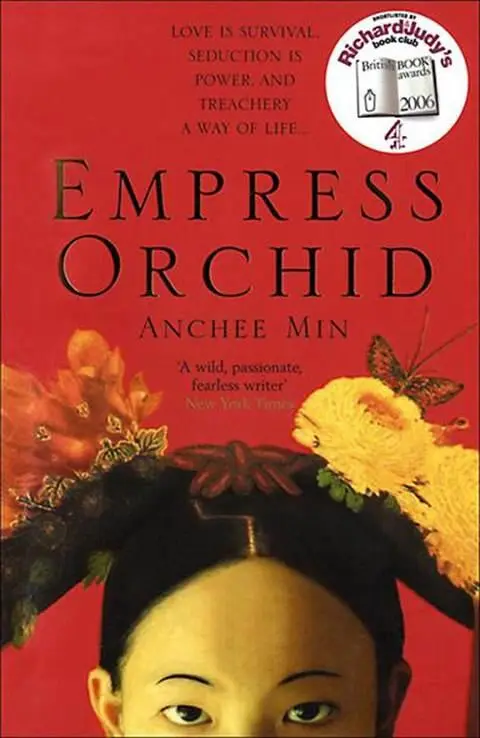
- Название:Empress Orchid
- Автор:
- Жанр:
- Год:неизвестен
- ISBN:нет данных
- Рейтинг книги:3 / 5. Голосов: 1
-
Избранное:Добавить в избранное
- Отзывы:
-
Ваша оценка:
Empress Orchid: краткое содержание, описание и аннотация
Предлагаем к чтению аннотацию, описание, краткое содержание или предисловие (зависит от того, что написал сам автор книги «Empress Orchid»). Если вы не нашли необходимую информацию о книге — напишите в комментариях, мы постараемся отыскать её.
To rescue her family from poverty and avoid marrying her slope-shouldered cousin, seventeen-year-old Orchid competes to be one of the Emperor's wives. When she is chosen as a lower-ranking concubine she enters the erotically charged and ritualised Forbidden City. But beneath its immaculate facade lie whispers of murders and ghosts, and the thousands of concubines will stoop to any lengths to bear the Emperor's son. Orchid trains herself in the art of pleasuring a man, bribes her way into the royal bed, and seduces the monarch, drawing the attention of dangerous foes. Little does she know that China will collapse around her, and that she will be its last Empress.
Empress Orchid — читать онлайн бесплатно полную книгу (весь текст) целиком
Ниже представлен текст книги, разбитый по страницам. Система сохранения места последней прочитанной страницы, позволяет с удобством читать онлайн бесплатно книгу «Empress Orchid», без необходимости каждый раз заново искать на чём Вы остановились. Поставьте закладку, и сможете в любой момент перейти на страницу, на которой закончили чтение.
Интервал:
Закладка:
I adored the wildness. I wouldn’t have minded living in Jehol. I thought it would be a good place to raise Tung Chih. He could learn the Bannermen’s trade. He could learn to hunt. I wanted so much for him to grow up on horseback as his ancestors did. I wished I didn’t have to remind myself that we were in exile.
Jehol was a great silent place. The bleached light of the sun reflected softly from its tiled roofs. The courtyards were paved with cobblestones. Doors were flanked by thick walls. Since Chien Lung’s death half a century before, most of the palaces had stood vacant and they smelled of mold. Battered by decades of wind and rain, the exteriors seemed to fade into the landscape. The original color had been sand yellow; now it was brown and green. Inside, mildew covered the ceilings and darkened the corners of the spacious rooms.
The royal families swept into Jehol and the place came to life. The slumbering halls, courtyards and buildings were wakened to the echo of human voices and footfalls. Doors were pushed open to the sound of scraping wood and metal. Rusty window locks broke off when we attempted to open them. The eunuchs did their best to remove the must and grime of years.
I was given an apartment next to Nuharoo’s on one side of the main palace. The Emperor occupied the largest bedroom, of course, right in the middle. His office, which was called the Hall of Literary Zest, was next to the apartments of Su Shun and the other grand councilors on the other side of the palace. Nuharoo watched over Tung Chih while I attended Hsien Feng. Our schedules and responsibilities now ran according to the needs of the father and the son.
Since His Majesty had stopped giving audiences, he was no longer presented documents to review or sign. The court’s business continued to be managed solely by Su Shun. Brewing herbs for Hsien Feng had become my job. The bitter smell was so strong that he complained. I had to tell the servants to take the pots to the kitchen, which was at the far end of the palace. I worked with the herbalist and Doctor Sun Paotien to make sure that the medicine was properly prepared. It wasn’t easy. One of the prescriptions required that the soup be mixed with fresh deer blood, which spoiled quickly. The kitchen staff had to slaughter a deer every two days, immediately prepare the medicine, then hope that His Majesty wouldn’t throw up right after we poured it down his throat.
In late October the maple trees looked like they were set to burning by the sun. One morning when Nuharoo and I took Tung Chih for a walk we discovered that a nearby spring was surprisingly warm. A eunuch who had guarded the palaces all his life said that there were several hot springs in the area. It was how Jehol got its name: je-hol, hot river.
“The spring gets hotter when it snows,” the eunuch said. “You can feel the water with your hand.” Tung Chih was curious and insisted on bathing in the spring. Nuharoo was about to give in, but I opposed the idea. Tung Chih didn’t know how to swim and had just recovered from a cold. Resenting my discipline, he turned to Nuharoo, pouting. My son knew that Nuharoo outranked me and that I was not allowed to disobey her. It had become a pattern with Nuharoo, my son and me. It was irritating and left me feeling defenseless. The kitchen became my place of escape.
Hsien Feng’s health seemed to have stabilized a little. As soon as he was able to sit up, Prince Kung sent him drafts of the treaties. I was summoned to help.
“Your brother expects you to honor the terms,” I said, summarizing Prince Kung’s letter to His Majesty. “He says that these are the final documents. Peace and order will be restored after you sign.”
“The barbarians are asking me to reward them for spitting in my face,” Hsien Feng said. “I now understand why my father wouldn’t close his eyes when he died-he couldn’t swallow the insult.”
I waited for him to calm down before I resumed reading. Some of the terms disturbed His Majesty so much that he gasped for air. Bubbling sounds would come from his throat and then he would burst out coughing.
Tiny blood spots covered the floor and the blankets. I didn’t want to go on reading, but the documents had to be returned within ten days. If not, Prince Kung said, the Allies would destroy the capital.
It was no use for Emperor Hsien Feng to beat his chest and shout, “All foreigners are brute beasts!” It was also no use to issue edicts urging the army to fight harder. The situation was irreversible.
Tung Chih watched his father drag himself out of bed and get down on his knees to beg Heaven for help. Again and again Hsien Feng wished he had the courage to take his own life.
It was in the Hall of Literary Zest where the treaties with France and Great Britain were sealed. Both treaties continued to validate the previous Tientsin Treaty, but with items added. It was the first time in several thousand years that China had borne such shame.
Emperor Hsien Feng was forced to open the city of Tientsin as a new trading port. To him this not only allowed the barbarians to trade in his front yard, but also permitted their military access to the capital through the open sea. His Majesty was also forced to “rent” Kowloon to the British as war compensation. The treaties stated that Western missionaries were to be given total freedom and protection to operate in China, which included building churches. Chinese laws would not apply to any foreigners, and violations of the treaties by any Chinese were to be punished swiftly. China was made to pay indemnities of eight million taels to the British and the French.
As if this were not enough, the Russians submitted a new draft of the Sino-Russian Treaty of Peking. The Russian envoy tried to persuade Prince Kung that the burning of the Imperial palaces indicated that China needed military protection from Russia. Although fully aware of what the Russians were up to, Prince Kung couldn’t say no. China was in no position to defend itself and could not afford to make Russia an enemy.
“When a wolf pack hunts down a sick deer, what can the deer do but beg for mercy?” Prince Kung wrote in a letter. The Russians wanted the Amur lands in the north, which the tsarists had already seized. Russians had already settled along the whole of the Ussuri River east to the border of Korea. They had claimed the crucial Chinese port of Haishenwei, soon to be known as Vladivostok.
I will never forget the moment when Emperor Hsien Feng signed the treaties. It was like a death rehearsal.
The brush pen he held seemed to weigh a thousand pounds. His hand couldn’t stop shaking. He couldn’t bring himself to write his name. To stabilize his elbows I added two more pillows behind his back. Chief Eunuch Shim prepared the ink and laid flat the pages of the treaties in front of him on a rice paper pad.
My sorrow for Hsien Feng and my country was beyond expression. Saliva gathered at the corners of His Majesty’s purple lips. He was crying, but there were no tears. He shouted and screamed for days. Finally his voice simply died. Each breath was now a struggle.
His fingers were like brittle sticks. His frame was no better than a skeleton. He had begun the journey of vanishing into a ghost. His ancestors hadn’t answered his prayers. Heaven had been merciless to its son. In Hsien Feng’s helplessness, however, he demonstrated the dignity of the Emperor of China. His struggle was heroic-the dying man holding on to his brush, refusing to sign China away.
I asked Nuharoo to bring Tung Chih. I wanted him to witness his father’s struggle to perform his duty. Nuharoo rejected the idea. She said that Tung Chih should be exposed to glory, not shame.
I could have fought with Nuharoo. And I almost did. I wanted to tell her that dying was not shameful, nor was having the courage to face reality. Tung Chih’s education should begin at his father’s deathbed. He should watch the signing of the treaties and remember and understand why his father was crying.
Читать дальшеИнтервал:
Закладка:
Похожие книги на «Empress Orchid»
Представляем Вашему вниманию похожие книги на «Empress Orchid» списком для выбора. Мы отобрали схожую по названию и смыслу литературу в надежде предоставить читателям больше вариантов отыскать новые, интересные, ещё непрочитанные произведения.


Обсуждение, отзывы о книге «Empress Orchid» и просто собственные мнения читателей. Оставьте ваши комментарии, напишите, что Вы думаете о произведении, его смысле или главных героях. Укажите что конкретно понравилось, а что нет, и почему Вы так считаете.