Anchee Min - Empress Orchid
Здесь есть возможность читать онлайн «Anchee Min - Empress Orchid» весь текст электронной книги совершенно бесплатно (целиком полную версию без сокращений). В некоторых случаях можно слушать аудио, скачать через торрент в формате fb2 и присутствует краткое содержание. Жанр: Историческая проза, на английском языке. Описание произведения, (предисловие) а так же отзывы посетителей доступны на портале библиотеки ЛибКат.
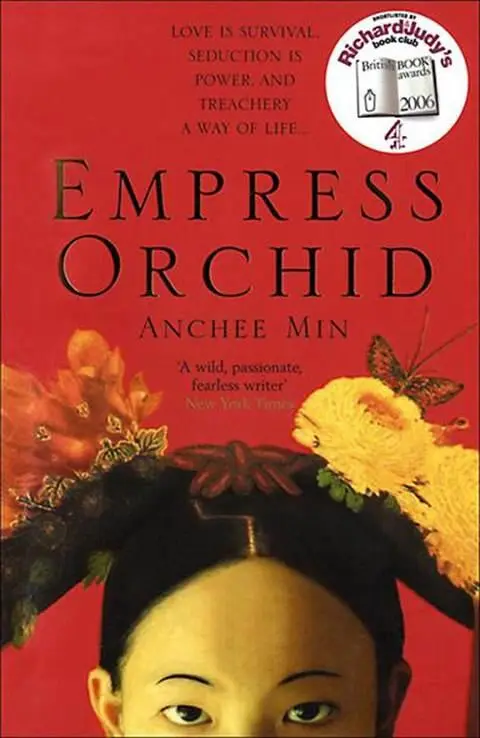
- Название:Empress Orchid
- Автор:
- Жанр:
- Год:неизвестен
- ISBN:нет данных
- Рейтинг книги:3 / 5. Голосов: 1
-
Избранное:Добавить в избранное
- Отзывы:
-
Ваша оценка:
Empress Orchid: краткое содержание, описание и аннотация
Предлагаем к чтению аннотацию, описание, краткое содержание или предисловие (зависит от того, что написал сам автор книги «Empress Orchid»). Если вы не нашли необходимую информацию о книге — напишите в комментариях, мы постараемся отыскать её.
To rescue her family from poverty and avoid marrying her slope-shouldered cousin, seventeen-year-old Orchid competes to be one of the Emperor's wives. When she is chosen as a lower-ranking concubine she enters the erotically charged and ritualised Forbidden City. But beneath its immaculate facade lie whispers of murders and ghosts, and the thousands of concubines will stoop to any lengths to bear the Emperor's son. Orchid trains herself in the art of pleasuring a man, bribes her way into the royal bed, and seduces the monarch, drawing the attention of dangerous foes. Little does she know that China will collapse around her, and that she will be its last Empress.
Empress Orchid — читать онлайн бесплатно полную книгу (весь текст) целиком
Ниже представлен текст книги, разбитый по страницам. Система сохранения места последней прочитанной страницы, позволяет с удобством читать онлайн бесплатно книгу «Empress Orchid», без необходимости каждый раз заново искать на чём Вы остановились. Поставьте закладку, и сможете в любой момент перейти на страницу, на которой закончили чтение.
Интервал:
Закладка:
“Moral ground?” Su Shun sneered. “What ground do the barbarians have regarding their behavior in China? They make demands of the Son of Heaven. How dare you side with the barbarians! Are you representing His Majesty the Emperor of China or the Queen of England?”
“Su Shun!” Prince Kung’s face turned red and his hands were clenched. “It’s my duty to serve His Majesty with truthfulness!”
Su Shun walked up to Emperor Hsien Feng. “Your Majesty, Prince Kung must be stopped. He has deceived the court. He and his father-in-law have been in charge of all the negotiations. Based on the outcome of the treaties and information provided by my investigators, we have reason to suspect that Prince Kung has profited from his position.” Su Shun paused, his body pivoted toward Prince Kung as if cornering him. “Haven’t you made deals with our enemies? Haven’t the barbarians promised you that when they enter the Forbidden City, you will harvest more shares?”
The veins on Prince Kung’s neck grew thick, and his eyebrows twisted into a gingerroot. He jumped on Su Shun, knocking him to the ground, and started punching him.
“Manners!” Emperor Hsien Feng called. “Su Shun had my permission to express himself.”
His Majesty’s words crushed Prince Kung. He dropped his hands and threw himself down on his knees. “My Imperial brother, nothing will be achieved by taking their ambassador. I will bet my head on it. The situation will only go against us. Instead of backing down, they will send their fleets to our shores. I have studied long enough to know their ways.”
“Of course.” Su Shun got back on his feet, his long sleeves fluttering in the air. “Long enough to develop connections and long enough to forget who you are.”
“One more word, Su Shun,” Prince Kung clenched his jaws, “and I’ll pull your tongue out!”
Despite Kung’s warnings, an edict was issued to capture the ambassador of Britain. For the next few days the Forbidden City was quiet. When the news came that the ambassador had been taken, Peking celebrated. Su Shun was hailed as a hero. Almost immediately, reports of foreign attacks along the coastline took away the excitement. The documents sent to His Majesty from the frontier smelled of smoke and blood. Soon the papers were piled high against the walls. I had no way of sorting them. The situation went exactly as Prince Kung had predicted.
August 1, 1860, was the worst day for Emperor Hsien Feng.
Nothing now could stop the barbarians. Prince Kung was denounced and his Tsungli Yamen dismissed. Calling themselves “the Allies,” the British came with 173 warships and 10,000 soldiers, the French with 33 ships and 6,000 soldiers. Then the Russians joined in. Together, the three landed a force of 18,000 men on the shores of the Gulf of Chihli.
Going against the immense fortified earthworks that straddled the mouth of the Yellow River and the seaboard, the Allies scrambled ashore, sinking knee-deep in slime, and shot their way to dry ground. They then began to move toward Peking. General Seng-ko-lin-chin, the commander of Imperial forces, sent word to the Emperor that he was prepared to die-in other words, all hopes of protecting the capital were fading.
Other reports depicted bravery and patriotism, which filled me with sadness. China’s ancient way of fighting wars had become an embarrassment-only barriers made of bamboo stakes defended our forts and their complex of dikes and ditches. There was no chance for our soldiers to display their masterly martial-arts combat skills. They were shot down before they were even in sight of the enemy.
The Mongolian cavalry was known for its invincibility. Three thousand vanished in one day. The Westerners’ cannons and guns swept them away like dry leaves in a late-autumn wind.
Emperor Hsien Feng was soaked in sweat. A high fever had consumed so much of his energy that he could no longer eat. The court feared his collapse. When his fever broke, he asked me to draft five edicts to be delivered immediately to General Seng-ko-lin-chin. In His Majesty’s voice I informed the general that troops were being gathered from all over the country, and that in five days there would be a rescue led by the leg-endary General Sheng Pao. Nearly twenty thousand more men, including seven thousand cavalry, would arrive and join the counterattack.
In the next edict, I wrote as His Majesty spoke to his nation.
The treacherous barbarians were willing to sacrifice our faith in humanity. They advanced toward Tungchow. Shamelessly they announced their intention to compel me to receive them in audience. They threatened that any further forbearance on our part would be a dereliction of duty to the Empire.
Although my health is in a grievous state, I saw myself doing nothing else but fighting until my last breath. I have realized that we could no longer achieve peace and harmony without force. I am now commanding you, our armies and citizens of all races, to join the battle. I shall reward those who exhibit courage. For every head of a black barbarian [British Sikh troops] I shall reward 50 taels, and for every head of a white barbarian, I shall reward 100 taels. Subjects of other submissive states are not to be molested, and whensoever the British and French demonstrate repentance and withdraw from their evil ways, I shall be pleased to permit them to trade again, as of old. May they repent while there is still time.
The Hall of Luminous Virtue was damp from days of heavy rain. It felt like we were inside a giant coffin. A makeshift throne was built around Emperor Hsien Feng’s bed, which was raised on a temporary platform. More and more ministers came seeking emergency audiences. Everyone looked as if they were already defeated. Etiquette was neglected, and people argued and debated in loud voices. A number of elders passed out in the middle of their arguments. On the frontier the bullets and cannon shells were as thick as hail. Lying on his chair, the Emperor read the updated reports. His fever had returned. Cold towels were placed on his face and over his body. The pages slipped through his trembling fingers.
Two days later the news of the fall came. The first was the upper north fort, taken after fierce fighting under an intensive bombardment from both sides. The Allies pressed on. Seng-ko-lin-chin claimed that shells hitting the powder magazines in the northern forts had crippled his defenses.
On August 21, Seng-ko-lin-chin gave in, and the Taku forts surrendered. The path to Peking was now open.
The Allies were reported to be only twelve miles from the capital. General Sheng Pao’s troops had arrived, but proved to be of no avail. The day before, the general had lost his last division.
People hustled in and out of the audience hall like cut-paper characters in jerky motion. The words in which everyone wished His Majesty longevity sounded empty. This morning the clouds were so low that I could feel the air’s moisture with my fingers. Toads hopped all over the courtyard. They seemed desperate to move. I had ordered the eunuchs to clear away the toads an hour before, but they had returned.
General Seng-ko-lin-chin was on his knees in front of His Majesty. He begged for punishment, which was granted. All his titles were stripped from him and he was ordered into exile. He asked if he could offer His Majesty one last service.
“Granted,” Emperor Hsien Feng murmured.
Seng-ko-lin-chin said, “It’s close to a full moon…”
“Get to the point.” The Emperor turned his head toward the ceiling.
“I…” Fumbling with his hands, the general pulled out a tiny scroll from his robe’s deep pocket and passed it to Chief Eunuch Shim.
Shim opened the scroll for the Emperor to see. “Go to Jehol,” it read.
Читать дальшеИнтервал:
Закладка:
Похожие книги на «Empress Orchid»
Представляем Вашему вниманию похожие книги на «Empress Orchid» списком для выбора. Мы отобрали схожую по названию и смыслу литературу в надежде предоставить читателям больше вариантов отыскать новые, интересные, ещё непрочитанные произведения.



Обсуждение, отзывы о книге «Empress Orchid» и просто собственные мнения читателей. Оставьте ваши комментарии, напишите, что Вы думаете о произведении, его смысле или главных героях. Укажите что конкретно понравилось, а что нет, и почему Вы так считаете.