Anchee Min - Empress Orchid
Здесь есть возможность читать онлайн «Anchee Min - Empress Orchid» весь текст электронной книги совершенно бесплатно (целиком полную версию без сокращений). В некоторых случаях можно слушать аудио, скачать через торрент в формате fb2 и присутствует краткое содержание. Жанр: Историческая проза, на английском языке. Описание произведения, (предисловие) а так же отзывы посетителей доступны на портале библиотеки ЛибКат.
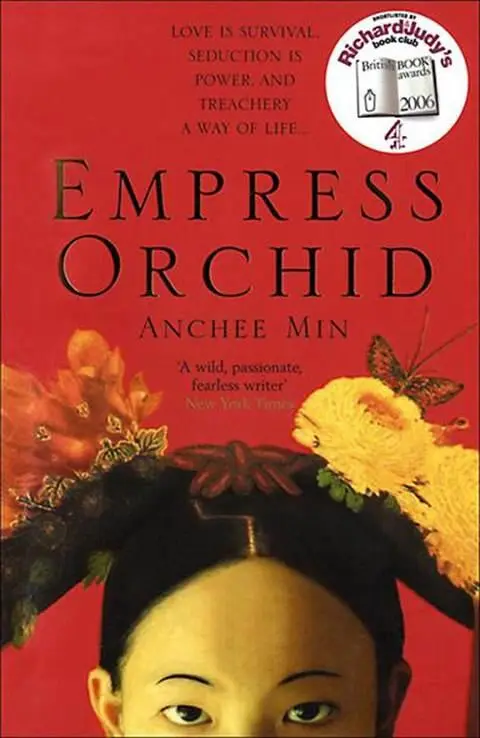
- Название:Empress Orchid
- Автор:
- Жанр:
- Год:неизвестен
- ISBN:нет данных
- Рейтинг книги:3 / 5. Голосов: 1
-
Избранное:Добавить в избранное
- Отзывы:
-
Ваша оценка:
Empress Orchid: краткое содержание, описание и аннотация
Предлагаем к чтению аннотацию, описание, краткое содержание или предисловие (зависит от того, что написал сам автор книги «Empress Orchid»). Если вы не нашли необходимую информацию о книге — напишите в комментариях, мы постараемся отыскать её.
To rescue her family from poverty and avoid marrying her slope-shouldered cousin, seventeen-year-old Orchid competes to be one of the Emperor's wives. When she is chosen as a lower-ranking concubine she enters the erotically charged and ritualised Forbidden City. But beneath its immaculate facade lie whispers of murders and ghosts, and the thousands of concubines will stoop to any lengths to bear the Emperor's son. Orchid trains herself in the art of pleasuring a man, bribes her way into the royal bed, and seduces the monarch, drawing the attention of dangerous foes. Little does she know that China will collapse around her, and that she will be its last Empress.
Empress Orchid — читать онлайн бесплатно полную книгу (весь текст) целиком
Ниже представлен текст книги, разбитый по страницам. Система сохранения места последней прочитанной страницы, позволяет с удобством читать онлайн бесплатно книгу «Empress Orchid», без необходимости каждый раз заново искать на чём Вы остановились. Поставьте закладку, и сможете в любой момент перейти на страницу, на которой закончили чтение.
Интервал:
Закладка:
The little one acted. In one determined motion, he grabbed the seal.
“Congratulations, Your Majesty!” the crowd cheered.
Crying joyfully, An-te-hai ran to the courtyard.
Rockets shot into the sky. A hundred thousand paper flowers popped open in the air.
Emperor Hsien Feng jumped up from his seat and announced, “According to the historical record, since the beginning of the Ch’ing Dynasty in 1644, only two princes grabbed the Imperial seal. They turned out to be China’s most successful emperors, Kang Hsi and Chien Lung. My son, Tung Chih, is likely to be the next one!”
The day after the ceremony, I knelt before a temple altar. Although I was exhausted, I felt that I must not neglect the gods who had helped me. I made offerings to show my gratitude. An-te-hai brought in a live fish on a golden plate. It had been caught in the lake and was tied with a red ribbon. In a rush I poured wine on the cobblestones because the fish had to be returned to the lake alive.
An-te-hai carefully placed the plate with the fish into a palanquin as if it were a person. At the lake I let go of the fish, and it leaped into the water.
To secure my son’s future and increase blessings from all of the gods, An-te-hai bought ten cages of precious birds for me to release. I granted the birds mercy on Tung Chih’s behalf.
Good news greeted me upon my return to the palace. Rong and Prince Ch’un were engaged. My mother was thrilled.
According to Emperor Hsien Feng, his brother had little talent or ambition. In his own introduction to Rong, Prince Ch’un had described himself as a “worshiper of Confucius’s teachings,” meaning that he pursued the life of a free mind. While he enjoyed the benefits that came with his royal position, he believed that “too much water makes a cup spill,” and “too many ornaments make a headdress look cheap.”
None of us realized that Prince Ch’un’s rhetoric was an umbrella covering flaws in his character. I would soon discover that Ch’un’s “modesty” and “self-imposed spiritual exile” came from his laziness.
I again warned Rong to expect no fantasy from an Imperial marriage. “Look at me,” I said. “His Majesty’s health has declined to the point of no return, and I have been preparing myself for the Imperial widowhood.”
I was not alone in my concern for the Emperor’s health. Nuharoo shared the same feeling. On her last visit we had come together on friendly terms for the first time. The fear of losing Hsien Feng bound us. She had begun to accept the fact that I had become her equal. Her sense of superiority had softened, and she began to use “would you” instead of “this is Her Majesty’s thinking.” We both knew from history what could happen to an emperor’s wives and concubines after his death. We both realized that we had only each other to depend on.
I had my own reasons for wanting Nuharoo as an ally. I sensed that my son’s fate would be in the hands of such ambitious court ministers as Grand Councilor Su Shun. He seemed to have the Emperor’s complete trust. It was public knowledge that even Prince Kung feared Su Shun.
Su Shun had been running the state’s affairs and conducting audiences in the name of Hsien Feng during His Majesty’s illness. More and more, he acted with total independence. Su Shun’s power worried me, for I thought him manipulative and cunning. When he visited Emperor Hsien Feng, he rarely discussed state matters. In the name of caring for His Majesty’s health, he isolated Hsien Feng and strengthened his own position. According to Prince Ch’un, Su Shun had been carefully constructing his own political base for years through the appointment of friends and associates to important positions.
I convinced Nuharoo that we must insist on having important documents sent to Emperor Hsien Feng. His Majesty might be too ill to review the documents, but we might help him stay informed. At least we would not be kept in the dark and could make sure that Su Shun was not abusing his power.
Nuharoo didn’t want to bother. “A wise lady ought to spend her life appreciating the beauty of nature, preserving her yin element and pursuing her longevity.”
But my instinct told me that if we refused to take part in the government, we could lose whatever control we had.
Nuharoo agreed that I had a point, but didn’t fully embrace my plan. Nonetheless, I spoke to His Majesty that evening, and the next day a decree was issued: all documents were to be sent to Emperor Hsien Feng’s office first.
It didn’t surprise me that Su Shun ignored the decree. He ordered the messengers who carried the documents to “follow the original route.” Again his excuse was the Emperor’s health. My suspicion and distrust deepened.
“I feel myself aging over your struggle to control Su Shun’s ambi-tion,” Nuharoo said. She asked me to spare her the exertion. “Do whatever you want with Su Shun as long as you respect the fact that ‘the sun rises in the east and sets in the west,’” she said, referring to the two of us.
It amazed me that Nuharoo would think of this as important. I gave her my word.
Immediately she relaxed. “Why don’t you take charge and update me once in a while?” she said. “I hate to sit in the same room with men whose breath stinks.”
At first I suspected that Nuharoo was testing my loyalty. But in time she made me realize that I was doing her a favor. She was the kind who would lose sleep over the smallest flaw in her embroidery, but not if we lost an important term in a treaty.
The sunlight on Nuharoo’s bone-thin shoulders carved a beautiful contour. She never failed to prepare herself for His Majesty’s possible appearance. Her makeup must have taken half a day to complete. Black paste made of scented flower petals was used to accent her eyelashes. Her eyes looked like two deep wells. She painted her lips a different color every day. Today was pink with a touch of vermilion. Yesterday had been rose, and the day before purple. She expected to be complimented, and I learned that it was important to our relationship that I do so.
“I’d hate to see you age, Yehonala.” Nuharoo held up all of her fingers. The two-inch-long nails were painted gold and silver with delicate details from nature. “Take my advice and have your chef prepare tang kuei soup daily. Put dry silkworm and black dates in it. The taste will be awful, but you’ll get used to it.”
“We need to talk about Su Shun and his cabinet, Nuharoo,” I said. “I get nervous about things I don’t know.”
“Oh, you will never know it all. It’s a hundred-year-old mess.” She blocked my eyes with her “finger spears.” “I’ll send my nail lady to your palace if you don’t get it done yourself.”
“I am not used to long nails,” I said. “They break too easily.”
“Am I the head of the Imperial household?” She frowned.
I sealed my lips, reminding myself of the importance of keeping harmony between us.
“Long nails are symbols of nobility, Lady Yehonala.”
I nodded, although my mind had gone back to Su Shun.
Nuharoo’s smile returned. “Like a Chinese lady who binds her feet, who doesn’t live to do labor but to be carried around in palanquins. The longer our nails, the further we depart from the ordinary. Please stop bragging about working in the garden with your hands. You embarrass not only yourself but also the Imperial family.”
I kept nodding, pretending to appreciate her advice.
“Avoid tangerine.” She leaned so close that I smelled jasmine on her breath. “Too many hot elements will give you pimples. I’ll have my eunuch send you a bowl of turtle soup to put out the fire inside you. Do honor me by accepting.”
I was sure that she felt she had achieved her goal when the Emperor stopped sharing my bed. She now had an even better reason to feel safe with me: Hsien Feng was never going to get up and walk back into my bedroom.
Читать дальшеИнтервал:
Закладка:
Похожие книги на «Empress Orchid»
Представляем Вашему вниманию похожие книги на «Empress Orchid» списком для выбора. Мы отобрали схожую по названию и смыслу литературу в надежде предоставить читателям больше вариантов отыскать новые, интересные, ещё непрочитанные произведения.

Обсуждение, отзывы о книге «Empress Orchid» и просто собственные мнения читателей. Оставьте ваши комментарии, напишите, что Вы думаете о произведении, его смысле или главных героях. Укажите что конкретно понравилось, а что нет, и почему Вы так считаете.