Anchee Min - Empress Orchid
Здесь есть возможность читать онлайн «Anchee Min - Empress Orchid» весь текст электронной книги совершенно бесплатно (целиком полную версию без сокращений). В некоторых случаях можно слушать аудио, скачать через торрент в формате fb2 и присутствует краткое содержание. Жанр: Историческая проза, на английском языке. Описание произведения, (предисловие) а так же отзывы посетителей доступны на портале библиотеки ЛибКат.
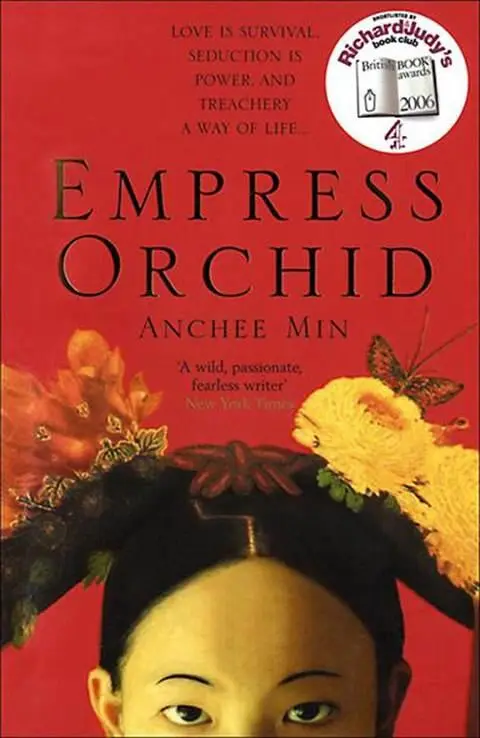
- Название:Empress Orchid
- Автор:
- Жанр:
- Год:неизвестен
- ISBN:нет данных
- Рейтинг книги:3 / 5. Голосов: 1
-
Избранное:Добавить в избранное
- Отзывы:
-
Ваша оценка:
Empress Orchid: краткое содержание, описание и аннотация
Предлагаем к чтению аннотацию, описание, краткое содержание или предисловие (зависит от того, что написал сам автор книги «Empress Orchid»). Если вы не нашли необходимую информацию о книге — напишите в комментариях, мы постараемся отыскать её.
To rescue her family from poverty and avoid marrying her slope-shouldered cousin, seventeen-year-old Orchid competes to be one of the Emperor's wives. When she is chosen as a lower-ranking concubine she enters the erotically charged and ritualised Forbidden City. But beneath its immaculate facade lie whispers of murders and ghosts, and the thousands of concubines will stoop to any lengths to bear the Emperor's son. Orchid trains herself in the art of pleasuring a man, bribes her way into the royal bed, and seduces the monarch, drawing the attention of dangerous foes. Little does she know that China will collapse around her, and that she will be its last Empress.
Empress Orchid — читать онлайн бесплатно полную книгу (весь текст) целиком
Ниже представлен текст книги, разбитый по страницам. Система сохранения места последней прочитанной страницы, позволяет с удобством читать онлайн бесплатно книгу «Empress Orchid», без необходимости каждый раз заново искать на чём Вы остановились. Поставьте закладку, и сможете в любой момент перейти на страницу, на которой закончили чтение.
Интервал:
Закладка:
I comforted Nuharoo, but was scared myself. She returned to her palace and devoured every ghost book she owned. A few days later she visited me and said that she had discovered something that I’d better know.
“The worst punishment for a female ghost is being dumped in the ‘Pool of Filthy Blood.’” Nuharoo showed me a book with lurid illustrations of the “Department of Scourging” at work in the underworld. Severed heads with long hair floated in a dark red pool-they looked like dumplings in boiling water.
“See this? This is what I wanted to talk to you about,” Nuharoo said. “The blood in the pool comes from the filth of all women. Also in the pool are poisonous snakes and scorpions that feed on the newly dead. They are the transformations of those who committed wrongdoings in their lives.”
“What if I commit no serious wrongdoing during my lifetime?” I asked.
“Orchid, the judgment of the underworld is for all women. That is why we need religion. Buddhism helps us repent the crimes we commit simply by being women and living a material life. We need to forgo all earthly pleasure and pray for Heaven’s forgiveness. We must do everything we can to accumulate virtue. Only then may we have a chance of escaping the Pool of Filthy Blood.”
Sixteen
ON HIS FIRST BIRTHDAY my son would be presented with a tray filled with a variety of items. He was expected to pick one that would give the Imperial family a clue to his future character. This was called Chua-tsui-p’an, Catch the Future in a Pan. Important court members were invited to observe.
Tung Chih’s eunuchs had been busy all week in preparation for the event. The walls, columns, doors and window frames of my palace were freshly painted in vermilion. The beams and bracket sets were accented with blue, green and gold. Against the bright northern sky, the yellow tile roof glistened like a gigantic golden crown. The white marble terraces vibrated with their exuberant carvings.
The ceremony opened in the Hall of Bodily Mercy, in the east corner of the palace, where an altar had been set up. Above the altar was a broadside explaining the ritual. In the center of the hall sat a large square redwood table. On top of the table stood a tray the size of a mature lotus leaf, larger than a child’s tub. On the tray lay symbolic items: an Imperial seal, a book of Confucius’s On Autumn and Spring, a brush pen made of goat hair, a gold ingot, a silver ingot, a riddle, a decorative sword, a miniature liquor bottle, a golden key, ivory dice, a silver cigarette box, a musical clock, a leather whip, a blue ceramic bowl painted with landscapes, an antique fan with a poem written by a famous Ming poet, a green jade hairpin crafted with butterflies, an earring in the shape of a pagoda and a pink peony.
My son had been taken from me in the morning. This was to assure that he would act of his own free will. For the past few weeks I had tried hard to guide him to the “right choices.” I showed him a map of China, colorful landscape paintings, and of course the object he was supposed to pick, the Imperial seal-a fake one for the practice runs of course. An-te-hai had made it from a block of wood. I stamped the “seal” on different boards to attract Tung Chih’s attention. But he was more interested in the pins in my hair.
The guests sat quietly in the hall and waited for Tung Chih to perform. In front of hundreds of people, I got down on my knees by the altar and lit incense.
Emperor Hsien Feng and Nuharoo sat in the center chairs. We prayed as the incense smoke began to fill the room. Tea and nuts were served. When the sun hit the beams of the hall, Tung Chih was carried in by two eunuchs. He was dressed in a golden robe embroidered with dragons. He looked around with big eyes. The eunuchs placed him on the table. He bounced up and down and was unable to sit still. The eunuchs somehow got him to bow to his father, his mothers and the portraits of his ancestors.
I felt terribly weak and alone, and wished that my mother or Rong were here. This ritual hadn’t been taken seriously in the past, when people had come simply to coo and giggle over a baby. But these days astrologers ruled-the Manchu royals were no longer sure of themselves. Everything was up to “Heaven’s will.”
What if Tung Chih picked up a flower or a hairpin instead of the Imperial seal? Would people say that my son was going to be a dandy? What about the clock? Wouldn’t he be drawn to its tinkly sound?
Tung Chih’s bib was wet from drool. When the eunuchs let him go free, he crawled toward the tray. He was so bundled up that his movements were clumsy. Leaning forward, everyone watched with anxiety. I sensed Nuharoo’s glance in my direction and tried to appear confident. I had caught a cold the night before and my head ached. I had been drinking glass after glass of water to calm myself down.
Tung Chih stopped crawling and reached out to the tray. It felt like I was the one on the table. Suddenly I desperately needed to go to the chamber pot.
I hurried out of the hall and brushed aside the maids before they could follow me. Sitting on the chamber pot, I took several deep breaths. The pain on the right side of my head had spread to the left side. I got off the pot and rinsed my hands and face with cold water. When I reentered the hall, I saw Tung Chih chewing on his bib.
The crowd was still patiently waiting. Their expectations devastated me. It was wrong to make an infant bear China’s burden! But I knew that my son would be taken from me for good if I dared to utter such a sentence.
Tung Chih was about to slide off the table. The eunuchs picked him up and turned him around. A scene came to my mind: hunters had released a deer, only to kill it with their arrows. The message seemed to be: if the deer was not strong enough to escape, it deserved to die.
Emperor Hsien Feng had promised that I would be rewarded if Tung Chih delivered a “good performance.” How could I possibly direct him?
The more I read of the broadside above the altar, the more fearful I became.
… If the prince picks the Imperial seal, he will become an emperor graced by all of Heaven’s virtue. If he picks the brush pen, the gold, the silver or the sword, he shall rule with intelligence and a forceful will. But if he picks the flower, the earring or the hairpin, he will grow up to be a pleasure seeker. If he chooses the liquor pot, he will be an alcoholic; if the dice, he will gamble away the dynasty…
Tung Chih “studied” every article but picked up none. The hall was so quiet that I could hear the sound of water running through the garden. My sweat oozed and my collar felt tight.
Tung Chih stuck a finger in his mouth. He must be hungry! The chance that he would pick up the stone seal was fading.
He resumed his crawling. This time he appeared somehow motivated. The eunuchs put up their hands around the edges of the table to prevent Tung Chih from falling.
Emperor Hsien Feng leaned over in his dragon chair. He held his head with both hands as if it was too heavy, shifting the weight from one elbow to another.
Tung Chih stopped. He fixed his eyes on the pink peony. He smiled, and his hand traveled from his mouth to the flower.
I closed my eyes. I heard Emperor Hsien Feng sigh.
Disappointment? Bitterness?
Tung Chih had turned away from the flower when I reopened my eyes.
Was he remembering the moment I punished him when he picked up the flower? I had spanked him, crying myself. I had put my fingerprints on his little behind and hated myself for it.
My son raised his tiny chin. What was he looking for? Me? Forget-ting my manners, I weaved through the crowd and stopped in front of him. I smiled and used my eyes to draw a line from his nose to the Imperial seal.
Читать дальшеИнтервал:
Закладка:
Похожие книги на «Empress Orchid»
Представляем Вашему вниманию похожие книги на «Empress Orchid» списком для выбора. Мы отобрали схожую по названию и смыслу литературу в надежде предоставить читателям больше вариантов отыскать новые, интересные, ещё непрочитанные произведения.

Обсуждение, отзывы о книге «Empress Orchid» и просто собственные мнения читателей. Оставьте ваши комментарии, напишите, что Вы думаете о произведении, его смысле или главных героях. Укажите что конкретно понравилось, а что нет, и почему Вы так считаете.