Anchee Min - Empress Orchid
Здесь есть возможность читать онлайн «Anchee Min - Empress Orchid» весь текст электронной книги совершенно бесплатно (целиком полную версию без сокращений). В некоторых случаях можно слушать аудио, скачать через торрент в формате fb2 и присутствует краткое содержание. Жанр: Историческая проза, на английском языке. Описание произведения, (предисловие) а так же отзывы посетителей доступны на портале библиотеки ЛибКат.
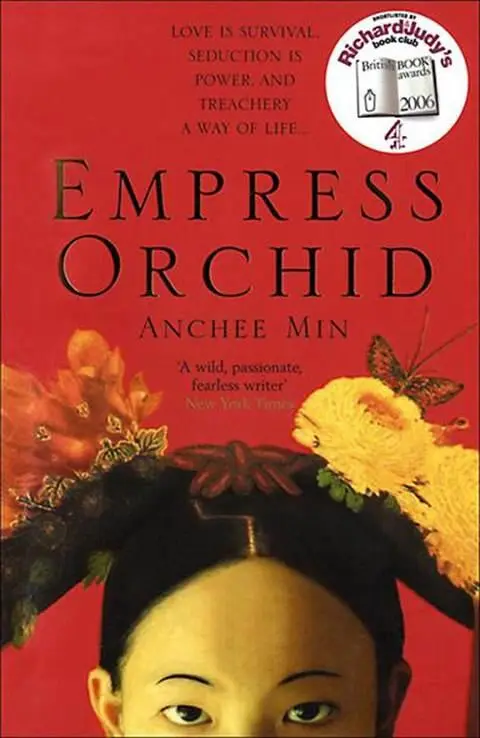
- Название:Empress Orchid
- Автор:
- Жанр:
- Год:неизвестен
- ISBN:нет данных
- Рейтинг книги:3 / 5. Голосов: 1
-
Избранное:Добавить в избранное
- Отзывы:
-
Ваша оценка:
Empress Orchid: краткое содержание, описание и аннотация
Предлагаем к чтению аннотацию, описание, краткое содержание или предисловие (зависит от того, что написал сам автор книги «Empress Orchid»). Если вы не нашли необходимую информацию о книге — напишите в комментариях, мы постараемся отыскать её.
To rescue her family from poverty and avoid marrying her slope-shouldered cousin, seventeen-year-old Orchid competes to be one of the Emperor's wives. When she is chosen as a lower-ranking concubine she enters the erotically charged and ritualised Forbidden City. But beneath its immaculate facade lie whispers of murders and ghosts, and the thousands of concubines will stoop to any lengths to bear the Emperor's son. Orchid trains herself in the art of pleasuring a man, bribes her way into the royal bed, and seduces the monarch, drawing the attention of dangerous foes. Little does she know that China will collapse around her, and that she will be its last Empress.
Empress Orchid — читать онлайн бесплатно полную книгу (весь текст) целиком
Ниже представлен текст книги, разбитый по страницам. Система сохранения места последней прочитанной страницы, позволяет с удобством читать онлайн бесплатно книгу «Empress Orchid», без необходимости каждый раз заново искать на чём Вы остановились. Поставьте закладку, и сможете в любой момент перейти на страницу, на которой закончили чтение.
Интервал:
Закладка:
“I wished that His Majesty had the desire to learn about this,” Prince Kung said. “You know the saying, ‘A long icicle doesn’t form with one night of snow’-well, the roots of the incidents can be traced to the reign of Emperor Kang Hsi. During that time, when Grand Empress Hsiao Chuang reached the autumn of her life, she became friends with a German missionary named Johann Adam Schall von Bell. It was he who converted Her Majesty to Catholicism.”
“How could that be possible? I mean, the conversion of Her Majesty?”
“Not overnight, of course. Schall von Bell was a scholar, a scientist and a priest. He was an attractive man and was introduced to the Grand Empress by the court scientist, Hsu Kuang-chi. Schall had been teaching under Hsu at the Imperial Hanlin Academy.”
“I know about Hsu. Wasn’t he the one who correctly predicted the eclipse.”
“Yes.” Prince Kung smiled. “That was Hsu, but he didn’t do it alone. Father Schall was his teacher and partner. The Emperor appointed him to reform the lunar calendar. When Schall succeeded, the Emperor appointed him as his military consultant. Schall helped manufacture the weapons that led to the suppression of a major peasant uprising.”
“How did the Grand Empress get to know Schall?”
“Well, Schall predicted that her son Prince Shih Chung would ascend to the throne, since the boy had survived smallpox while the Emperor’s other children hadn’t. Of course no one at the time understood what smallpox was, and no one believed Schall. A few years later, Shih Chung’s brother Shih Tsu died of smallpox. Her Majesty now believed that Schall had a special connection with the universe, and she asked to be converted to his religion. She became a fervent believer and welcomed the foreign missionaries.”
“Did the trouble start when the missionaries built churches?” I asked.
“Yes, when they chose sites the locals considered to have the best feng shui. Villagers believed that the shadows cast by churches onto their ancestral graveyards would disturb the dead. The Catholics also denigrated Chinese religions, which offended the local people.”
“Why wouldn’t the foreigners be more understanding?”
“They insisted that their god was the only god.”
“Our people would never accept this.”
“True.” Prince Kung nodded. “Fights started between the new converts and those who held on to their old beliefs. People of dubious reputation, even criminals, joined the Catholics. Many committed crimes in the name of their god.”
“I’m sure that would lead to violence.”
“Indeed. When the missionaries attempted to defend the criminals, the locals gathered by the thousands. They burned down the churches and murdred the missionaries.”
“Is that why the treaties made clear that China would be fined heavily if it failed to control uprisings?”
“The fines are bankrupting us.”
There was a silence, and Prince Kung turned to look at the Emperor, who was breathing deeply.
“Why don’t we tell the missionaries to leave?” I asked, wishing that I could help myself not to. “Tell them to come back when things are more stable here?”
“His Majesty did. He even gave them the date.”
“What was the response?”
“Threats of war.”
“Why do the foreigners force their ways on us? As Manchus, we don’t force our views on the Chinese. We don’t tell them to stop binding their women’s feet.”
Prince Kung gave a sarcastic laugh. “Can a beggar demand respect?” He turned to look at me as if expecting an answer.
The room began to feel cold. I watched our teacups being refilled.
“The Son of Heaven has been kicked around,” I said. “China has been kicked around. Everyone is too ashamed to admit it!”
Prince Kung gestured for me to keep my voice down.
In his sleep Hsien Feng’s cheeks flushed. He must be running a fever again. His breathing was now labored, as if not enough air was entering his lungs.
“Your brother believes in pa kua -the eight diagrams-and feng shui, ” I told Prince Kung. “He believes he is protected by the gods.”
Kung took a sip of his tea. “Everyone believes what he wants to be-lieve. But reality is like a rock from the bottom of a manure pit. It stinks!”
“How did the Westerners become so powerful?” I asked. “What should we learn about them?”
“Why do you want to bother?” He smiled. He must be thinking that this was no subject for a woman to discuss.
I told Prince Kung that Emperor Hsien Feng was interested in learning. And that I could be helpful.
A look of recognition passed between us. It seemed to make sense to him. “This is no small topic. But you might begin by reading my letters to His Majesty. We must escape the trap of self-deception and…” He raised his eyes and suddenly went quiet.
It was through Prince Kung that I learned of the third important man, the general of the Northern Army and the viceroy of Anhwei province. His name was Tseng Kuo-fan.
I had first heard the name from Emperor Hsien Feng. Tseng Kuo-fan was said to be a level-headed, dogged Chinese in his fifties. He had risen from a poor peasant family and had been appointed in 1852 to command the army in his native Hunan. He was known for his thorough methods of drilling his men. He had successfully suppressed the Taiping strongholds on the Yangtze River, which earned him praise from the anxious and impatient capital. He continued to harden his men, who came to be known as the Hunan Braves. They were the most efficient fighting force in the empire.
It was due to Prince Kung’s encouragement that the Emperor granted General Tseng a private audience.
“Orchid,” Emperor Hsien Feng called as he put on his dragon robe. “Come with me this morning and let me know your impression of Tseng Kuo-fan.” I followed my husband to the Hall of Spiritual Nurturing.
The general rose from his knees and greeted His Majesty. I noticed that he was too nervous to raise his eyes. This was not uncommon during a first Imperial audience. It happened more often among those of Chinese origin. Humble to a fault, they could not believe their ruler was receiving them.
In truth, it was not the Chinese but the Manchus who lacked confidence. Our ancestors may have conquered the mainland by force two centuries before, but we had never mastered the art of ruling. We arrived without the fundamentals, such as Confucian philosophy, which unified the nation through morality and spirituality, and without a system that effectively centralized power. We also lacked a language that allowed the Emperor to communicate with his people, 80 percent of whom were Chinese.
Wisely, our ancestors had adopted Chinese ways. In my view, this was probably unavoidable. The culture was so gracious and broad that it both accepted and served us. Confucian fundamentals continued to dominate the nation. For myself, my first language was Chinese, my eating habits Chinese, my rough schooling Chinese, and my favorite form of entertainment Peking operas!
I had come to realize that the Manchu sense of superiority had betrayed us. Today’s Manchus were as rotten as termite-infested wood. Manchu men were generally spoiled. They no longer knew how to win battles on horseback. Most had become their own enemies. Beneath their proud exterior, they were lazy and insecure. They created difficulties for my husband whenever he wished to promote someone of true talent who happened to be Chinese.
Sadly, they remained the dominant political force. Their opinions influenced Emperor Hsien Feng. Tseng Kuo-fan was the best general in the empire, yet His Majesty was afraid to promote him. This was typical. Any high-ranking Chinese could easily find himself cut off at a moment’s notice. There was never an explanation.
Читать дальшеИнтервал:
Закладка:
Похожие книги на «Empress Orchid»
Представляем Вашему вниманию похожие книги на «Empress Orchid» списком для выбора. Мы отобрали схожую по названию и смыслу литературу в надежде предоставить читателям больше вариантов отыскать новые, интересные, ещё непрочитанные произведения.




Обсуждение, отзывы о книге «Empress Orchid» и просто собственные мнения читателей. Оставьте ваши комментарии, напишите, что Вы думаете о произведении, его смысле или главных героях. Укажите что конкретно понравилось, а что нет, и почему Вы так считаете.