Anchee Min - Empress Orchid
Здесь есть возможность читать онлайн «Anchee Min - Empress Orchid» весь текст электронной книги совершенно бесплатно (целиком полную версию без сокращений). В некоторых случаях можно слушать аудио, скачать через торрент в формате fb2 и присутствует краткое содержание. Жанр: Историческая проза, на английском языке. Описание произведения, (предисловие) а так же отзывы посетителей доступны на портале библиотеки ЛибКат.
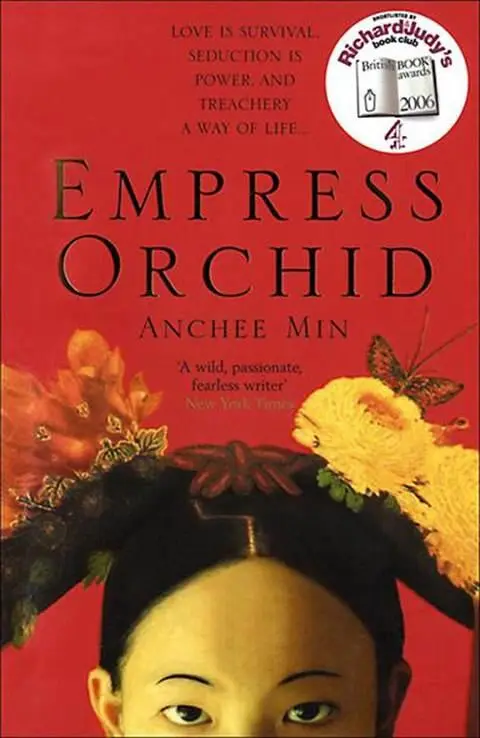
- Название:Empress Orchid
- Автор:
- Жанр:
- Год:неизвестен
- ISBN:нет данных
- Рейтинг книги:3 / 5. Голосов: 1
-
Избранное:Добавить в избранное
- Отзывы:
-
Ваша оценка:
Empress Orchid: краткое содержание, описание и аннотация
Предлагаем к чтению аннотацию, описание, краткое содержание или предисловие (зависит от того, что написал сам автор книги «Empress Orchid»). Если вы не нашли необходимую информацию о книге — напишите в комментариях, мы постараемся отыскать её.
To rescue her family from poverty and avoid marrying her slope-shouldered cousin, seventeen-year-old Orchid competes to be one of the Emperor's wives. When she is chosen as a lower-ranking concubine she enters the erotically charged and ritualised Forbidden City. But beneath its immaculate facade lie whispers of murders and ghosts, and the thousands of concubines will stoop to any lengths to bear the Emperor's son. Orchid trains herself in the art of pleasuring a man, bribes her way into the royal bed, and seduces the monarch, drawing the attention of dangerous foes. Little does she know that China will collapse around her, and that she will be its last Empress.
Empress Orchid — читать онлайн бесплатно полную книгу (весь текст) целиком
Ниже представлен текст книги, разбитый по страницам. Система сохранения места последней прочитанной страницы, позволяет с удобством читать онлайн бесплатно книгу «Empress Orchid», без необходимости каждый раз заново искать на чём Вы остановились. Поставьте закладку, и сможете в любой момент перейти на страницу, на которой закончили чтение.
Интервал:
Закладка:
We exchanged gifts. I gave Fujin a pair of shoes that An-te-hai had only moments before returned with. They featured pearls and green jade beads sewn in a beautiful floral pattern. Fujin was delighted. In return she gave me a copper smoking pipe. I had never seen anything like it. The little pipe bore a sophisticated foreign battle scene, with ships, soldiers and ocean waves. The tiny figures were incised precisely and the surface was polished as smooth as porcelain. Fujin told me that it had been made with the help of a machine invented by an Englishman. It was a gift from one of Prince Kung’s employees, a Briton named Robert Hart.
After the greetings, servants came with mats and positioned them at our feet. Prince Kung threw himself down on his mat and kowtowed to his brother all over again. His wife followed. After he was pardoned, he called for his children and concubines, who had been waiting, all dressed up, for their summons. Fujin made sure that the children performed their greetings to perfection.
I was relieved when the ritual was finally over and we were led to the sitting room. Fujin excused herself and exited. Before I sat down, Prince Kung asked if I would like to have Fujin give me a tour of the garden.
I told him that I preferred to stay, if he didn’t mind.
He showed surprise but said nothing.
With Emperor Hsien Feng’s permission I remained in my seat. The brothers began their conversation. Prince Kung focused completely on his brother, as if I were not in the room.
I had never seen anyone talk as frankly and passionately as Prince Kung. His words carried great urgency, as if his house would catch fire if he didn’t speak fast enough.
Before the Emperor had a chance to take the first sip of his tea, Prince Kung placed a letter in front of him. “The news reached me yesterday with a six-hundred-mile priority stamp. It is from the governor of Shantung province. As you can see, it is addressed to both Su Shun and me and is extremely troubling.”
Emperor Hsien Feng put down his tea. “What’s the matter?”
“The dikes around the Yellow River have collapsed near the border of Shantung and Kiangsu provinces. Twenty villages were flooded. Four thousand people have died.”
“Someone will be punished!” Emperor Hsien Feng seemed more annoyed than concerned.
Prince Kung put down the document and sighed. “It is too easy to behead a couple of mayors and governors. Lives will not be gained back. We need the local authorities to take care of the homeless and organize rescues.”
Hsien Feng covered his face with his palms. “Let me hear no more bad news! Leave me alone!”
As if he had no time to dwell on his brother’s suffering, Prince Kung moved on. “I also need your support to establish a Tsungli Yamen.”
“What is this Tsungli Yamen?” Emperor Hsien Feng asked. “I have never heard of the title.”
“A national bureau of foreign affairs.”
“Ah, the foreign problem. Why don’t you go ahead, if you think you need it.”
“I can’t.”
“Who’s stopping you?”
“Su Shun, the court, the senior clansmen. I face strong opposition. People say that our ancestors never had it, so why should we.”
“Everyone is waiting for our father’s spirit to perform a miracle.” The Emperor frowned.
“Yes, Your Majesty. Meanwhile, many more foreigners are coming. Our best bet is to put in place some restrictions in order to gradually gain control over the situation. Perhaps we will even be able to drive them out one day. But first we must deal with them according to rules that we both agree on. The foreigners call such rules ‘law,’ roughly equivalent to what we call ‘principle.’ The Tsungli Yamen will be in charge of making the laws.”
“What do you want from me, then?” Emperor Hsien Feng asked in a less than enthusiastic tone.
“I will get started if you grant me an operational fund. My people need to learn foreign languages. And of course I have to hire foreigners to be the teachers. The foreigners-”
“I can’t stand the word ‘foreigners’!” the Emperor interrupted. “I resent acknowledging the invaders. All I know is that they come to China to impose their ways on me.”
“There is something in it for China, Your Majesty. Open trade will help develop our economy.”
Emperor Hsien Feng raised his hand to silence Prince Kung. “I won’t offer gifts when my face is shamed.”
“I understand and agree with you, my brother,” Prince Kung said with gentleness. “But you have no idea what humiliations I have endured. Pressure comes at me from both sides, foreign and domestic. I have been called ‘the devil’s ass-kisser’ by my own officers and clerks.”
“You deserve it.”
“Well, it is easy to close our eyes, but will reality go away?” Prince Kung paused, then decided to finish what he had set out to say. “The truth is, we are under attack and have no defenses. I worry that our court’s ignorant arrogance will cost us the dynasty.”
“I am tired,” Hsien Feng said after a moment of silence.
Prince Kung rang the servants, who brought in a flat-backed rattan chair.
With assistance Emperor Hsien Feng sat on the chair. Pale-faced and sleepy-eyed, he said, “My thoughts are flying away like butterflies. Make me think no more, please.”
“Do I have your permission to open the Tsungli Yamen, then? Will you see the funds issued?”
“I hope that is all you are asking.” Hsien Feng closed his eyes.
Prince Kung shook his head and a bitter smile crossed his face. The room was quiet. Through the windows I saw maids chasing children as they hopped over stones in a pond.
“I need an official decree, Your Majesty.” Prince Kung sounded almost like he was begging. “Brother, we can’t afford to wait any longer.”
“Fine.” Eyes still closed, Hsien Feng turned his face toward the wall.
“In your decree the Tsungli Yamen must be given true power.”
“All right, but in return you must promise,” Emperor Hsien Feng said, pushing himself to sit up, “that whoever gets paid must perform or he will lose his head.”
Prince Kung looked relieved. “I can assure you that the quality of my people will be second to none. But things are more complicated. The most serious obstacle my officers face is the court. I get no respect from this quarter. They secretly cheered when local villagers harassed foreign ambassadors and murdered missionaries. I can’t tell you how dangerous such behavior is. It can ignite a war. The senior clansmen are politically sightless.”
“Enlighten the court, then,” said Emperor Hsien Feng, opening his eyes. He looked truly tired.
“I have tried, Your Majesty. I called meetings and no clansmen showed up. I even sent my father-in-law to personally invite them, hoping that his age would bring respect. But it didn’t work. I got letters calling me names and telling me to hang myself. I’d like to ask you to attend the next meeting if that would be possible. I want the court to know that I have your full support.”
The Emperor made no answer. He was falling asleep.
With a sigh, Prince Kung sat back. He looked defeated.
The sun had hit the roof beams and the room felt warm.
The smell of jasmine from the plants in the corners was sweet. Gradually the sunlight changed the shapes of the plants’ shadows on the floor.
Emperor Hsien Feng began to snore. Prince Kung rubbed his hands and looked around the room. Servants came and removed our teacups. They brought small plates with fresh loquats.
I had no appetite. Prince Kung didn’t touch the fruit either. We stared at the sleeping Emperor. Slowly our eyes met and I decided to make use of the time.
“I was wondering, sixth brother,” I began, “if you could kindly tell me about the murder of foreign missionaries. I’m having a hard time believing it.”
Читать дальшеИнтервал:
Закладка:
Похожие книги на «Empress Orchid»
Представляем Вашему вниманию похожие книги на «Empress Orchid» списком для выбора. Мы отобрали схожую по названию и смыслу литературу в надежде предоставить читателям больше вариантов отыскать новые, интересные, ещё непрочитанные произведения.








Обсуждение, отзывы о книге «Empress Orchid» и просто собственные мнения читателей. Оставьте ваши комментарии, напишите, что Вы думаете о произведении, его смысле или главных героях. Укажите что конкретно понравилось, а что нет, и почему Вы так считаете.