Anchee Min - Empress Orchid
Здесь есть возможность читать онлайн «Anchee Min - Empress Orchid» весь текст электронной книги совершенно бесплатно (целиком полную версию без сокращений). В некоторых случаях можно слушать аудио, скачать через торрент в формате fb2 и присутствует краткое содержание. Жанр: Историческая проза, на английском языке. Описание произведения, (предисловие) а так же отзывы посетителей доступны на портале библиотеки ЛибКат.
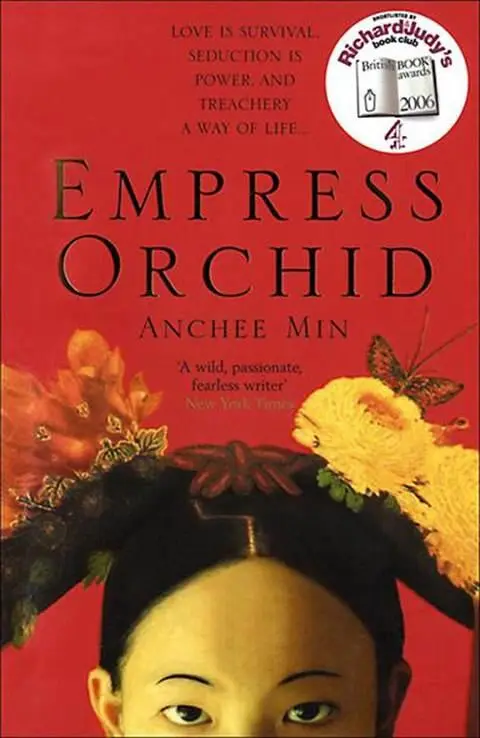
- Название:Empress Orchid
- Автор:
- Жанр:
- Год:неизвестен
- ISBN:нет данных
- Рейтинг книги:3 / 5. Голосов: 1
-
Избранное:Добавить в избранное
- Отзывы:
-
Ваша оценка:
Empress Orchid: краткое содержание, описание и аннотация
Предлагаем к чтению аннотацию, описание, краткое содержание или предисловие (зависит от того, что написал сам автор книги «Empress Orchid»). Если вы не нашли необходимую информацию о книге — напишите в комментариях, мы постараемся отыскать её.
To rescue her family from poverty and avoid marrying her slope-shouldered cousin, seventeen-year-old Orchid competes to be one of the Emperor's wives. When she is chosen as a lower-ranking concubine she enters the erotically charged and ritualised Forbidden City. But beneath its immaculate facade lie whispers of murders and ghosts, and the thousands of concubines will stoop to any lengths to bear the Emperor's son. Orchid trains herself in the art of pleasuring a man, bribes her way into the royal bed, and seduces the monarch, drawing the attention of dangerous foes. Little does she know that China will collapse around her, and that she will be its last Empress.
Empress Orchid — читать онлайн бесплатно полную книгу (весь текст) целиком
Ниже представлен текст книги, разбитый по страницам. Система сохранения места последней прочитанной страницы, позволяет с удобством читать онлайн бесплатно книгу «Empress Orchid», без необходимости каждый раз заново искать на чём Вы остановились. Поставьте закладку, и сможете в любой момент перейти на страницу, на которой закончили чтение.
Интервал:
Закладка:
As I lifted myself, I felt like a big rusty carriage. My jewel-laden belts clanked as they dragged over the chair and fell to the floor.
Imperial Guards and eunuchs filled the street. Kuei Hsiang, who had been waiting by the front gate, received His Majesty’s ambassador. On his knees, Kuei Hsiang stated my father’s name and recited a brief welcome speech. As he spoke, he knocked his forehead on the ground three times and bowed nine times. A moment later I heard my name called by the ambassador. The ladies of honor quickly formed a wall on either side of me. I stepped out the door and moved slowly toward the chieh-an.
Standing before me was a rabbit-faced eunuch in heavy makeup. He was the ambassador, dressed in a glittering yellow gown. On his hat was a peacock feather and a red diamond. He avoided looking at me. After offering me three deep bows, he “invited in” three objects. One was a little yellow case from which he took a yellow silk scroll. It was the decree. The second one was the Record Book of Imperial Marriages. The last one was a stone stamp with my name and title carved on the surface.
Following the eunuch, I performed the ceremony in front of the tables. I bowed and knocked my forehead on the ground so many times that I became dizzy. I worried that things would start to fall from my hair. After this, I received blessings from my family.
My mother came first, followed by Rong, my uncle and Cousin Ping. They got down on their knees and bowed to the ambassador and then to me. Mother trembled so much that one of her headpieces began to slide from its place.
“Rise,” I quickly said, trying to stop the piece from slipping.
The eunuchs carried the record book and the stone stamp over to the incense-burner tables. The eunuchs seemed to strain under their weight.
I took off my satin cape as the etiquette instructed and bowed toward the book and the stamp. Afterward I stayed in the kneeling position and turned to face north.
The ambassador opened the scroll and began to read from the decree. He had a deep, resonant voice, but I couldn’t understand a word he said. It took me a while to realize that he was reading the decree in two languages, Manchu and Mandarin, both in stylized ancient tones. My father once told me that when he worked in his office, he usually skipped the Manchu parts of reports and moved directly to the Chinese parts to save time.
The weight on my head made me feel like I was a snail carrying a house on my back. As the reading went on I glanced toward the hallway. It was packed with guards. On the center terrace two palanquins were waiting. Why two, I wondered. Wasn’t I the only one to be picked up from this house?
When the ambassador finished his reading I discovered the reason for the second palanquin. The eunuchs put the decree, the record book and the stone stamp back into their cases. Then these objects were “invited” to “sit” in the second palanquin. The ambassador explained that these things were now considered part of me.
“The Imperial phoenix walking!” At the ambassador’s call my family fell to their knees for the last time. By now Mother’s makeup was a mess, and she wiped her tears with her hands, forgetting her appearance.
A band started to play. The sound of Chinese trumpets was so loud that my ears hurt. A group of eunuchs ran in front of me throwing firecrackers. I stepped on “cracked” red paper, yellow straws, green beans and colorful dried fruit. I tried to hold my chin up so my headwear would stay in place.
I was gently ushered into my palanquin. Now I was a real snail. With a motion that nearly knocked me from my seat, the bearers hoisted the chair.
Outside the gate the horses had begun to move. Bannermen carried dragon flags and yellow umbrellas. Among them were lady riders dressed in sixteenth-century Manchu warrior costumes. Hanging from the sides of their mounts were yellow ribbons tied to cooking ware.
Behind the ladies was a flock of animals dyed red. It seemed like a rolling river of blood. When I looked again, I saw sheep and geese. It was said that these animals symbolized fortune well kept, and the red the passion for life.
I let down the curtain to hide my tears. I was preparing myself to not see my family for a long time. This was what Mother wanted, I convinced myself. A poem she read to me when I was little came to mind:
Like a singing river
You break out to flow freely
I am the mountain behind
Happily I watch you
Memory of us Full and sweet
My memories were full and sweet indeed. They were all I had, and I was taking them with me. As soon as I felt that the palanquin was moving steadily, I opened a slit in the back curtain and looked out.
My family was no longer in sight. Dust and ceremonial guards blocked my view.
Suddenly I saw Kuei Hsiang. He was still on all fours with his head glued to the ground.
My heart betrayed me and I cracked like a Chinese lute broken in the middle of its happy playing.
Six
I DIDN’T GET TO SEE much of the celebration the day I became an Imperial concubine. I sat inside my palanquin and heard the bells struck from the towers of the Gate of Zenith.
Nuharoo was the only one who went through the Gate of Celestial Purity, the main entrance into the Imperial backyard. The rest of us were carried through courtyards from side gates. My palanquin crossed the Golden Water River on one of the five bridges that spanned it. The river marked the boundary of the forbidden landscape; the bridges each represented one of the five Confucian virtues: loyalty, tenacity, honesty, modesty and piety. I then passed through the Gate of Correct Conduct and entered another courtyard, the largest in the Forbidden City. My palanquin skirted the Throne Hall, whose enormous carved columns and magnificent tiered roof rose above the pure expanse of white marble of the Dragon Pavement Terrace.
I was let off at the Gate of Heavenly Bustling. By this time it was midafternoon. Other palanquins had arrived. They were the chairs of Ladies Yun, Li, Soo, Mei and Hui. The girls got out quietly. We acknowledged one another’s presence and then waited.
Eunuchs came to tell us that Emperor Hsien Feng and Empress Nuharoo had begun the wedding ceremony.
It felt strange. Although it had been made more than clear to me that I was only one of Emperor Hsien Feng’s three thousand ladies, I couldn’t help but wish that I were in Nuharoo’s place.
Soon the head eunuch reappeared and informed us that it was time to go to our own living quarters. Mine was called the Palace of Concentrated Beauty, where I would live for many years. It was here that I learned that Emperor Hsien Feng would never distribute his essence equally among his wives.
The Palace of Concentrated Beauty was embraced by age-old trees. When the wind blew, the leaves would roar. The sound reminded me of my favorite poetic line: “The wind shows its body through the trembling leaves.” I tried to locate the gate I had come through. It was on the west side and seemed to be the only entrance. The building in front of me was like a temple, with a wing-like roof and high walls. Under the yellow glazed tiles the beams and columns were brightly painted. The doors and window panels were carved with symbols of fertility: round-shaped fruit, vegetables, Buddha’s hand, budding flowers, ocean waves and clouds.
A group of well-dressed men and women quietly appeared in the courtyard. They threw themselves at me and got down on their knees.
I looked at them and didn’t know what was expected of me.
“The lucky moment is here, Lady Yehonala,” one of them finally said. “Please allow us to help you into your chamber.” I realized that they were my servants.
Читать дальшеИнтервал:
Закладка:
Похожие книги на «Empress Orchid»
Представляем Вашему вниманию похожие книги на «Empress Orchid» списком для выбора. Мы отобрали схожую по названию и смыслу литературу в надежде предоставить читателям больше вариантов отыскать новые, интересные, ещё непрочитанные произведения.


Обсуждение, отзывы о книге «Empress Orchid» и просто собственные мнения читателей. Оставьте ваши комментарии, напишите, что Вы думаете о произведении, его смысле или главных героях. Укажите что конкретно понравилось, а что нет, и почему Вы так считаете.