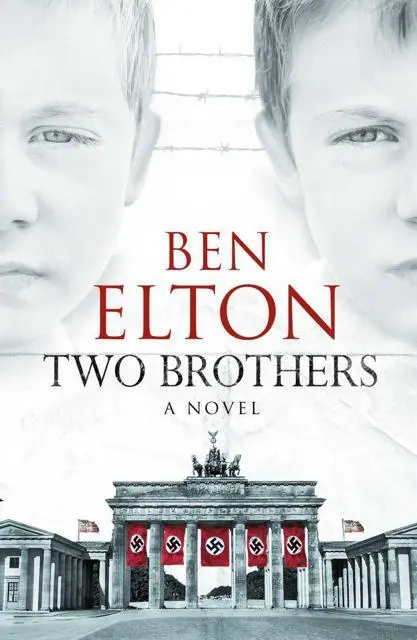
Ben Elton - Two Brothers
Здесь есть возможность читать онлайн «Ben Elton - Two Brothers» весь текст электронной книги совершенно бесплатно (целиком полную версию без сокращений). В некоторых случаях можно слушать аудио, скачать через торрент в формате fb2 и присутствует краткое содержание. Город: London, Год выпуска: 2012, ISBN: 2012, Издательство: Transworld Publishers, Жанр: Историческая проза, на английском языке. Описание произведения, (предисловие) а так же отзывы посетителей доступны на портале библиотеки ЛибКат.
- Название:Two Brothers
- Автор:
- Издательство:Transworld Publishers
- Жанр:
- Год:2012
- Город:London
- ISBN:9780593062050
- Рейтинг книги:4 / 5. Голосов: 1
-
Избранное:Добавить в избранное
- Отзывы:
-
Ваша оценка:
Two Brothers: краткое содержание, описание и аннотация
Предлагаем к чтению аннотацию, описание, краткое содержание или предисловие (зависит от того, что написал сам автор книги «Two Brothers»). Если вы не нашли необходимую информацию о книге — напишите в комментариях, мы постараемся отыскать её.
Two Brothers BEN ELTON’s career as both performer and writer encompasses some of the most memorable and incisive comedy of the past twenty years. In addition to his hugely influential work as a stand-up comic, he is the writer of such TV hits as
and
. Most recently he has written the BBC series
on the subject of young parenthood. Elton has written three musicals,
and
and three West End plays. His internationally bestselling novels include *
,
,
,
and
. He wrote and directed the successful film
based on his novel
starring Hugh Laurie and Joely Richardson. About the Author
Two Brothers — читать онлайн бесплатно полную книгу (весь текст) целиком
Ниже представлен текст книги, разбитый по страницам. Система сохранения места последней прочитанной страницы, позволяет с удобством читать онлайн бесплатно книгу «Two Brothers», без необходимости каждый раз заново искать на чём Вы остановились. Поставьте закладку, и сможете в любой момент перейти на страницу, на которой закончили чтение.
Интервал:
Закладка:
Frieda sank down on the couch.
‘It still makes me weak to think about it.’
‘Yeah, well, I’m sorry, Mum,’ Otto snapped, ‘but I just reckon it’s time somebody let these pigs know they can’t push us Jews around. We’re strong. We’re proud. We’ll settle them in the end.’
‘Us Jews?’ Paulus laughed. ‘Suddenly you’re such a Jew! You never gave a damn about being a Jew before.’
‘Yeah, well, I do now and if it hadn’t been for you being a snitch, I’d be Jew with a gun!’
‘Otto be quiet!’ Wolfgang hissed. ‘And please let’s not go over it again, eh? The thing’s at the bottom of the Spree now. Which by the look of it was where the guy you bought it from got it in the first place. But just be damned certain, Otts, that a Jew found with a gun, even a rusty old relic which probably hadn’t been fired since the Franco-Prussian war, would without doubt be hung on the spot, child or not. Do you hear me? They’d execute you on the spot.’
Otto just rolled his eyes and continued lifting his weights.
‘Listen to your father, Otto!’ Frieda demanded, fear making her voice harsh. ‘You know what these people are capable of.’
Only the week before a well-known local family of Social Democrats had been lynched in their own back garden for brandishing a hunting rifle when their house was attacked by drunken SA. A father and two sons, all hanged from the same tree in five minutes for defending their home.
‘I just wanted to do something.’
‘Getting killed isn’t doing something,’ Paulus said. ‘It’s doing nothing.’
‘Hitler says we’re cowards,’ Otto insisted. ‘One day I’ll show him just how brave a Jew can be. What are you going to do, smart arse?’
‘I don’t know what I’ll do, but, believe me, Otts, when I do do whatever it is I’m going to do, I’ll be ready to do it.’
‘Pardon?’ Otto asked, somewhat confused.
‘I’ll be prepared.’
‘Prepared? How? By studying ? What’s the point of that any more? They won’t let you have a job no matter how many exams you pass.’
‘Who knows? We might have law again one day. And if we do we’ll need lawyers.’
‘That’s right, Pauly,’ Frieda agreed. ‘You should listen to your brother, Ottsy.’
‘Mummy’s boy!’ Otto sneered.
‘What’s more,’ Pauly went on, ignoring the insult, ‘if we have to leave Germany and I’m qualified, then perhaps I’ll be able to support us. What will you say on your immigration form, Otts? “Please give me a visa, I’ve got big muscles”? They’ve got plenty of people who can lift weights in America, you know.’
‘And plenty of trumpeters,’ Wolfgang said ruefully.
‘Who knows?’ Frieda said, putting on a brave face. ‘It might not come to any of that. As Papa says, we’re all still alive, aren’t we? Now go and have a flannel, Otto. You can’t go to school all hot and sweaty like that.’
There was no doubt that from the Stengels’ point of view August 1933 was a distinct improvement on the previous spring and the legally sanctioned orgy of brutality that had culminated in the first Jewish boycott.
‘They don’t want to scare their new chums in industry and the banks,’ Wolfgang said.
Jewish businesses were no longer picketed, arbitrary public beatings and robberies were no longer tolerated on the streets and the number of people abducted from their homes and spirited away to ad hoc concentration camps had also declined dramatically.
With care, and treading softly, Jews felt safe to go about the city once again.
This is not to say that life was any fun. It may have become a little less dangerous but it was no less demeaning or irksome. The various bans and exclusions on Jews and gypsies remained in place. Access to the professions was closed to them. There would be no more Jewish judges or lawyers. Jews were banned also from the army, the police and most commerce. University places were restricted to a tiny quota and books written by Jews were not merely banned but publicly burned.
But life was not impossible.
Frieda had, to her immense surprise, even been able to resume her work at the Friedrichshain Clinic, now called the Horst Wessel Medical Centre, the whole district having been renamed after the SA’s favourite ‘martyr’, who had been a local boy. It was true that Frieda was only allowed to treat Jews, but there were plenty of them to keep her busy as Jews were no longer allowed to be treated by Aryans. Even wealthy Jews who previously would not have been seen dead in a public surgery came to her now. Sadly this did not enrich Frieda or the centre since private medical insurers were excused from reimbursing Jewish doctors, and so effectively every premium any Jew had ever paid was stolen by the state overnight.
However, to Frieda’s astonishment she herself was still paid her salary. She was discovering that the vast pre-Nazi German bureaucracy would continue to function until told otherwise, and told not just once but in writing and in triplicate. It was going to take the State a long time to get round to officially de-Jewing everything and in the meantime she remained on the public pay roll, which enabled life in the Stengel household, for the time being at least, to return to something vaguely resembling the pattern it had followed before.
Paulus and Otto still attended the same school they had during the days of the Weimar Republic, although they now had to be constantly ready to defend themselves against attack from bully gangs, and lessons had acquired a more sinister tone. The law required that each school day now begin with the National Anthem followed by the Horst Wessel song and that every classroom display a picture of the Leader. Teachers were expected to greet their classes with the ‘German greeting’, which had to be returned en masse on pain of beating. The children of Jewish families, though still tolerated, were ‘excused’ History classes during which their ‘blood race’ was systematically blamed for every wrong that had ever beset the Fatherland.
But despite the deeply unpleasant nature of all of these pressures, none of them were, for either Paulus or Otto, the principal frustration of that summer. What really bothered them was that they had not seen Dagmar for months.
The object of their mutual obsession had almost completely disappeared since her terrible experience at the hands of the SA. The boys had heard that she scarcely attended school now and she had certainly not turned up for her Saturday music lessons at the Stengel apartment. Apart from the occasional note in response to the boys’ regular letters, poems and gifts, the twins heard nothing from Dagmar at all.
‘I’m afraid that poor girl will never entirely get over what happened to her on that dreadful morning,’ Frieda said.
‘But she wasn’t badly hurt, Mum,’ Otto protested. ‘We saved her before they could do anything.’
‘It’s not the physical violence, dear. It’s the shock of it. It’s what a man called Freud calls trauma , which is something that affects the psyche . Something so powerful as to actually change it. Perhaps damage it permanently.’
‘Psyche, Mum,’ Paulus asked, ‘what’s that?’
‘Well, I suppose you might say it’s the soul.’
‘Soul!’ Otto gasped with deep concern. ‘You think Dags has got a damaged soul?’
‘Yes, in a way. Certainly a very badly bruised one and it’s going to take a long long time and a lot of love and care for it to be better again.’
The two boys exchanged glances. Instinctively aware of what the other was thinking. If Dagmar needed love and care then it must be they who supplied it. If her soul was bruised and damaged then the brave and noble Stengel twins would make it better.
Читать дальшеИнтервал:
Закладка:
Похожие книги на «Two Brothers»
Представляем Вашему вниманию похожие книги на «Two Brothers» списком для выбора. Мы отобрали схожую по названию и смыслу литературу в надежде предоставить читателям больше вариантов отыскать новые, интересные, ещё непрочитанные произведения.





Обсуждение, отзывы о книге «Two Brothers» и просто собственные мнения читателей. Оставьте ваши комментарии, напишите, что Вы думаете о произведении, его смысле или главных героях. Укажите что конкретно понравилось, а что нет, и почему Вы так считаете.