Mingmei Yip - The Nine Fold Heaven
Здесь есть возможность читать онлайн «Mingmei Yip - The Nine Fold Heaven» весь текст электронной книги совершенно бесплатно (целиком полную версию без сокращений). В некоторых случаях можно слушать аудио, скачать через торрент в формате fb2 и присутствует краткое содержание. Город: New York, Год выпуска: 2013, ISBN: 2013, Издательство: Kensington Publishing Corp., Жанр: Историческая проза, на английском языке. Описание произведения, (предисловие) а так же отзывы посетителей доступны на портале библиотеки ЛибКат.
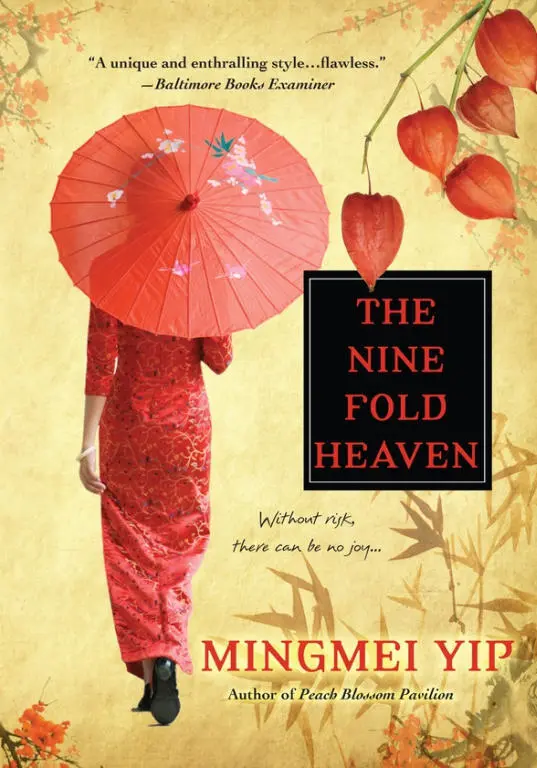
- Название:The Nine Fold Heaven
- Автор:
- Издательство:Kensington Publishing Corp.
- Жанр:
- Год:2013
- Город:New York
- ISBN:9780758273543
- Рейтинг книги:4 / 5. Голосов: 1
-
Избранное:Добавить в избранное
- Отзывы:
-
Ваша оценка:
The Nine Fold Heaven: краткое содержание, описание и аннотация
Предлагаем к чтению аннотацию, описание, краткое содержание или предисловие (зависит от того, что написал сам автор книги «The Nine Fold Heaven»). Если вы не нашли необходимую информацию о книге — напишите в комментариях, мы постараемся отыскать её.
, and into the lives of the unforgettable Camilla, Shadow, and Rainbow Chang.
When Shadow, a gifted, ambitious magician, competed with the beautiful Camilla for the affections of organized crime leader Master Lung, she almost lost everything. Hiding out in Hong Kong, performing in a run-down circus, Shadow has no idea that Camilla, too, is on the run with her lover, Jinying—Lung’s son.
Yet while Camilla and Shadow were once enemies, now their only hope of freedom lies in joining forces to eliminate the ruthless Big Brother Wang. Despite the danger, Shadow, Camilla, and Jinying return to Shanghai. Camilla also has her own secret agenda—she has heard a rumor that her son is alive. And in a city teeming with spies and rivals—including the vengeful Rainbow Chang—each battles for a future in a country on the verge of monumental change.
The Nine Fold Heaven — читать онлайн бесплатно полную книгу (весь текст) целиком
Ниже представлен текст книги, разбитый по страницам. Система сохранения места последней прочитанной страницы, позволяет с удобством читать онлайн бесплатно книгу «The Nine Fold Heaven», без необходимости каждый раз заново искать на чём Вы остановились. Поставьте закладку, и сможете в любой момент перейти на страницу, на которой закончили чтение.
Интервал:
Закладка:
“Son, what have you been doing?”
“Eating, sleeping, playing, and learning.”
“What have you learnt?’
“Some words.”
“Can you tell me what they are?”
“Love and karma. Mama, I am not sure you know what love means, but probably you know what karma is. I know what love means, because when I think of you and Baba, I feel warmth in my heart. So, can you tell me about karma?”
I didn’t want to answer his question, but I also didn’t want him to be unhappy.
“Jinjin, karma is because we all do good and bad things.”
“But, Mama, I hear you only do bad things.”
“Where do you hear this?”
“You know, what you read in the newspapers.”
“It’s not all true. Maybe before, but not anymore. I miss you and your father terribly. Recently, I also saved your Uncle Gao’s life… Jinjin, I hear you’re still alive, so stop teasing your mother! I can’t take this anymore!”
My baby retorted, “Sometimes I can’t take you anymore!”
“Jinjin, stop it!”
“Mama, you stop it! Or I won’t come back to see you in your dreams anymore. And I’ll stay with Mama Lewinsky!” Then his voice softened. “Remember, Mama, I’m your son, whether in hell, heaven, or the Red Dust.”
And with this, he vanished.
I sat up in bed, more troubled than ever. Despite what she had done, I felt sad about Madame Lewinsky’s death. I decided I should visit her grave to pay my respects and bid her a final farewell. She’d stolen my baby to raise as her own, but she had cared for him, after all. She had delivered him and, most important, through her singing lessons, she had taught me how to feel.
PART FOUR
13
The Cemetery
So the next day I bought a bouquet of white orchids, my teacher’s favorite flower, and took a car to the graveyard a few miles north of Shanghai. The cemetery had a sentimental name: Returning Home. The phrase, though trite, stirred up deep feelings in me. The Chinese say, “Falling leaves return to their roots,” meaning that regardless of our situation, eventually we wish to find our way home. But I didn’t really have an earthly home to go back to and, of course, I was not ready to return to my heavenly home!
Unfortunately, having to live as a spy among gangsters meant that I was always aware that the door to the eternal home might open for me at any moment. And I had almost gone through that door when I impulsively jumped into the Seine. The suicidal thought had been triggered by Puccini’s opera Madame Butterfly, when Cio-Cio San’s husband, Captain Pinkerton, came back from America, but with a new American wife. Heartbroken, Cio-Cio San sent her young son to another room, then plunged a knife into her own heart. Imagine how great her pain that she would step onto the path from which no one returns, despite her son playing innocently next door, oblivious that he was now an orphan….
Bracing myself, I pushed open the iron gate and walked in. Graves laid peacefully, yet portentously, in rows, marked by the inevitable stone tablet. The dead wait patiently and uncomplainingly for us who are still living to pay our respects and burn paper offerings. But as I looked around, I was the only one of the living here to honor these invisible beings of the other realm.
I walked up to a tiny booth by the entrance and saw a puny man slumping on the desk.
I lowered my voice like a ghost’s. “Sir?”
No response. Was he imitating his neighbor’s silence?
So I projected my heavenly songbird’s high soprano voice. “Good day, sir!”
Still no response. I put a finger underneath his nose to feel his breath. Yes, this corpse looked like he was still breathing. I used the same finger to dig hard into his shoulder. Suddenly, like a vampire awoke from the other world, he jumped up from his chair.
“Help heaven! I never did anything wrong. Leave me alone!”
I could not help but laugh. He must have thought I was one of the neighbors, angry at having died a terrible death, now coming back for revenge.
“Relax, sir, I’m here to pay respect to a friend. Could you give me a little help?”
He stared at me intensely before the color finally crept back to his cheeks.
“Miss, you scared me halfway to hell! What do you want?”
“I need to find a friend’s grave.”
He sat up straight, adjusted his jacket’s collar, and smoothed his hair. Then he poured tea from his thermos, took a sip, cleared his throat, and gave me a once-over.
“All right, what’s the name of the deceased?”
“Madame Julie Lewinsky.”
He chuckled. “So a foreign ghost? Ha, so she was a ghost, then died to become a real ghost?”
Chinese refer to foreigner as gweilo, “ghost people,” because of their strangely colored eyes, and their pale, colorless, or ghostlike complexion.
He took out a book, flipped the pages till his skeletal, mud-rimmed finger landed on a page. “Here! Julie Lewinsky! The third to the fifth row. Go out here, turn right, walk about five minutes and you’ll see. Good luck.”
“Thank you.” But I didn’t ask what the “good luck” was for. Was it to find a ghost, or not find one?
Outside his little “office,” I heard him shout to my back. “Miss, take your time. I’ll be off duty soon. So when you leave, just close the gate. It’s never locked anyway. Nobody comes here and no one comes out, ha, ha, ha!”
I did not share his amusement, so I nodded to him and continued walking.
I passed gravestones to which were attached pictures of the deceased and descriptions of their life. I finally reached the one I’d been looking for, Lewinsky’s marked only with a small tablet with the inscription:
Now I am mute, but once sang with such a powerful voice that I could lure birds down from the trees, and the fish up from the sea.
Though I was sad when my dear husband, Sergi, left me without a good-bye, now I am glad, for we sing together in our heavenly life.
Someday we will all join in heaven when our baby, Anton Lewinsky’s, life is done.
Until then we await our happy reunion on the other side.
My first thought, upon reading this, was how come my former teacher had never mentioned that she had a son here in Shanghai? She’d always told me how sad she was being childless. Then I suddenly realized, Anton Lewinsky was my own son, Jinjin, whom she’s taken from me to raise as her own! She must have written this epitaph herself and then asked the nuns to have it inscribed on her grave after her passing.
I sighed, but then I thought, at least now I have a name to look for, even if it wasn’t Jinjin’s right one. Just then I realized I hadn’t even set down the flowers that I’d brought for my teacher. So I laid down the bouquet and, according to traditional Chinese customs, swept the grave—wiping dust from the tablet, pulling out weeds, and arranging the flowers I’d bought.
After that, I said to my teacher’s grave as if she were alive in front of me, “Madame Lewinsky, of course I am bitterly angry that you stole from me what a mother values more than her own life. But now you can’t hear me because you’re dead. I won’t forgive you. But instead of spitting on your grave, I’ll say a prayer to help send your soul to the Western Paradise so you can live in peace. But there will be no reunion with him for you. I will find Jinjin—who is not your Anton Lewinsky—and he’ll know his real mother.”
I was about to recite a prayer for my former teacher, when I suddenly realized I didn’t know any. Growing up in an orphanage, I was never a religious person and, never bothered to learn any prayers or sutras. So finally I just recited the ubiquitous Namo Ami-tuofo, Hail to the Buddha, as the best I could do to aid her soul.
Читать дальшеИнтервал:
Закладка:
Похожие книги на «The Nine Fold Heaven»
Представляем Вашему вниманию похожие книги на «The Nine Fold Heaven» списком для выбора. Мы отобрали схожую по названию и смыслу литературу в надежде предоставить читателям больше вариантов отыскать новые, интересные, ещё непрочитанные произведения.









Обсуждение, отзывы о книге «The Nine Fold Heaven» и просто собственные мнения читателей. Оставьте ваши комментарии, напишите, что Вы думаете о произведении, его смысле или главных героях. Укажите что конкретно понравилось, а что нет, и почему Вы так считаете.