Jay Parini - The Last Station
Здесь есть возможность читать онлайн «Jay Parini - The Last Station» весь текст электронной книги совершенно бесплатно (целиком полную версию без сокращений). В некоторых случаях можно слушать аудио, скачать через торрент в формате fb2 и присутствует краткое содержание. Город: London, Год выпуска: 2007, ISBN: 2007, Издательство: Canongate Books, Жанр: Историческая проза, на английском языке. Описание произведения, (предисловие) а так же отзывы посетителей доступны на портале библиотеки ЛибКат.
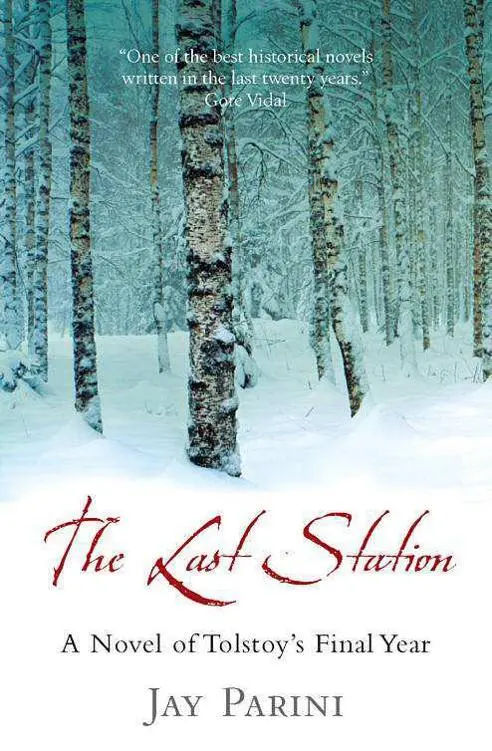
- Название:The Last Station
- Автор:
- Издательство:Canongate Books
- Жанр:
- Год:2007
- Город:London
- ISBN:978-1-84767-394-7
- Рейтинг книги:4 / 5. Голосов: 1
-
Избранное:Добавить в избранное
- Отзывы:
-
Ваша оценка:
The Last Station: краткое содержание, описание и аннотация
Предлагаем к чтению аннотацию, описание, краткое содержание или предисловие (зависит от того, что написал сам автор книги «The Last Station»). Если вы не нашли необходимую информацию о книге — напишите в комментариях, мы постараемся отыскать её.
Jay Parini moves deftly between a colorful cast of characters to create a stunning portrait of one of the world’s most treasured authors. Dancing between fact and fiction,
is a brilliant and moving literary performance.
The Last Station — читать онлайн бесплатно полную книгу (весь текст) целиком
Ниже представлен текст книги, разбитый по страницам. Система сохранения места последней прочитанной страницы, позволяет с удобством читать онлайн бесплатно книгу «The Last Station», без необходимости каждый раз заново искать на чём Вы остановились. Поставьте закладку, и сможете в любой момент перейти на страницу, на которой закончили чтение.
Интервал:
Закладка:
4. If my relations with Chertkov upset you too much at present, I am willing to give him up, though I must say that to do so would be more unpleasant, even painful, for him than for me. But if you demand this of me, I shall comply.
5. If you do not accept these terms for a quiet and decent life, I shall withdraw my promise not to leave you. I shall simply go away, and not to Chertkov, you can rest assured! In fact, I would lay down as an absolute condition that he must not follow and settle near me. But go I certainly shall, for I simply can’t continue to live like this. I might well have continued with this life had I been able to look at all your sufferings unmoved, but I’m not capable of that.
Stop, my dove, tormenting not only those around you but yourself, for you suffer a hundred times more than they do. That is all.
26
Chertkov
Dr Nikitin brought the infamous Rossolimo down from Moscow to examine Sofya Andreyevna. Her attempts at suicide have upset the household, and Leo Nikolayevich insists that Makovitsky’s advice be followed. Makovitsky puts considerable store in these head doctors, and Rossolimo is accounted the best of them; he has made excursions into the minds of every grand duke and duchess in Russia. Even the Dowager Empress Maria Fyodorovna, an intimate of my mother, has consulted him over a matter of some peculiar dreams. Rossolimo is what he is: an Italian and a mountebank. I distrust anyone who affects a waxed mustache with twirled ends or who dresses like the head waiter of a Roman trattoria.
Rossolimo examined Sofya Andreyevna for two hours, peering into her eyes with instruments like sextants, tapping her joints with a tiny wooden hammer, asking her improbable questions. Leo Nikolayevich looked on in awe. He has on occasion expressed what I consider an inordinate faith in doctors, but Rossolimo is the limit. Leo Nikolayevich took me aside. ‘Rossolimo is astonishingly stupid,’ he said, ‘in the way of all scientists.’ I listened intently as he paced the floor but offered no comment. I tread lightly these days. ‘I don’t know why Dushan brought him down here.’
‘Perhaps they are old friends,’ I said.
Before tea, Rossolimo talked with Leo Nikolayevich. ‘I have determined the causes of her mental illness,’ he said. ‘The countess is suffering from double degeneracy: paranoiac and hysterical, chiefly the former.’ He went on to cite the economic, cultural, physiological, and biological sources of her problem, while Leo Nikolayevich drummed his fingers on his desk, yawning violently.
‘What about lack of faith? Surely that has some bearing on her condition?’
‘Indeed,’ Rossolimo said. ‘The want of a fulcrum is often a source of instability.’
‘A metaphor, Doctor!’ Leo Nikolayevich cried. ‘This is much to your credit.’
Rossolimo seemed quite happy now, having been praised by the greatest author in all of Russia. ‘Indeed, a ship without a rudder is no ship, is it?’
‘Certainly not,’ Leo Nikolayevich said. ‘Nor is a windmill without the wind.’
Rossolimo was not sure what Leo Nikolayevich meant by this, but he agreed that wind is essential for all windmills and quickly changed the subject to hot-air balloons, a topic of some interest to him but none to us. After a big meal, he left Yasnaya Polyana quite pleased with himself.
Leo Nikolayevich has been feeling guilty ever since he signed the new will, but at least he has been brought around. It galls him that the countess still controls the rights to everything published before 1881. He cannot bear that works written for the love of God should be used to support the lavish style of life to which his wife and children have grown accustomed. He is convinced that Sofya Andreyevna’s greed on behalf of the family will only increase with the years, and that she is capable of getting her hands on all of his copyrights after his death.
Now the complete works of Leo Tolstoy will, upon his death, make their way into the public domain, though I shall edit and reissue everything first. In order to safeguard the will from Sofya Andreyevna’s intervention, he has assigned the copyright to Sasha, with strict instructions to let the public have free access to the material. If Sasha – whose health has been fragile in recent months – should die, the copyright devolves on Tanya, with the same proviso.
Leo Nikolayevich came secretly to Telyatinki to revise the will in his own hand, but, maddeningly, a crucial phrase was omitted, one that is needed to ensure the will’s validation in a future court of law: ‘I, Leo Tolstoy, being of sound mind and in full possession of my memory.’ Our lawyer insisted that this phrase be included, and we could not risk being in possession of a flawed will. So a final draft was composed for recopying by Tolstoy.
Yesterday we met in the wood outside Grumond. Leo Nikolayevich frequently rides Delire in the afternoons, so such a meeting did not draw his wife’s suspicion. I did not tell Bulgakov about our plans. He lives in Sofya Andreyevna’s pocket, though the poor lad does not realize it. I would prefer to acquire a new secretary, but Leo Nikolayevich admires Bulgakov. ‘He is headstrong,’ he says, ‘but he reminds me of myself when I was younger.’
To be sure, I rather enjoy the spectacle of Bulgakov’s ‘friendship’ with young Masha. They purr and prance about like kittens. I don’t approve, but in the country one looks for entertainment in unlikely places.
‘If they wish to conduct themselves like rabbits, they should go live in the woods,’ Sergeyenko said to me last week, asking me to get rid of Masha. I summoned her with a note. We talked about her future at Telyatinki, and I – somewhat gently – suggested that she spend some time withour new group in Petersburg. She may come back whenever she chooses, of course. I made that clear to her. She is an intelligent girl who speaks and writes several languages, and her usefulness as a translator increases every day.
I was accompanied on our little excursion into Grumond by Sergeyenko, Goldenweiser, and Sergeyenko’s new secretary, Anatol Radinsky, to witness the signing. I felt elated by the prospect of victory. It has been a long time coming.
Leo Nikolayevich, who had arrived before us, was nobly seated on Delire with a white hat on his head, his beard visible from the distance and fanning out over a blue linen blouse. As ever, the sight of him took my breath away.
We greeted each other solemnly and dismounted, spreading the will before us on a writing board fetched especially for this occasion. Leo Nikolayevich sat with his legs crossed as he read the will once again, his hands shaking, his lips moving. He held the pages close to his eyes. I was terrified that, at any moment, he might declare the whole thing a breach of faith with Sofya Andreyevna.
‘This is an important moment for the Russian people,’ I said. ‘They will have the access to your work they deserve.’
He looked at me quizzically, then uncapped his pen, an old English one that had been sent by Aylmer Maude, who ingratiates himself by shipping a constant flow of bric-a-brac and mementos. Leo Nikolayevich had remembered to bring a jar of black India ink, which he sniffed before using, pausing to say how much he enjoys the smell of ink! Sergeyenko handed him a blotter and the paper. Meticulously, he began to form the letters, copying everything in his famously illegible hand.
‘I feel like a conspirator,’ he said, looking up.
We all laughed, but the laughs were hollow.
Get on with it , I thought.
It was cool, almost icy, beneath those trees. A wind blew up from the woods, carrying a swampy smell. Delire whinnied, rippling her coat, as sunlight flickered across the pages of the will. We heard a strange cry and looked up to see a black-capped kingfisher flash from a branch, a whir of blue and orange feathers.
Читать дальшеИнтервал:
Закладка:
Похожие книги на «The Last Station»
Представляем Вашему вниманию похожие книги на «The Last Station» списком для выбора. Мы отобрали схожую по названию и смыслу литературу в надежде предоставить читателям больше вариантов отыскать новые, интересные, ещё непрочитанные произведения.








Обсуждение, отзывы о книге «The Last Station» и просто собственные мнения читателей. Оставьте ваши комментарии, напишите, что Вы думаете о произведении, его смысле или главных героях. Укажите что конкретно понравилось, а что нет, и почему Вы так считаете.