Jay Parini - The Last Station
Здесь есть возможность читать онлайн «Jay Parini - The Last Station» весь текст электронной книги совершенно бесплатно (целиком полную версию без сокращений). В некоторых случаях можно слушать аудио, скачать через торрент в формате fb2 и присутствует краткое содержание. Город: London, Год выпуска: 2007, ISBN: 2007, Издательство: Canongate Books, Жанр: Историческая проза, на английском языке. Описание произведения, (предисловие) а так же отзывы посетителей доступны на портале библиотеки ЛибКат.
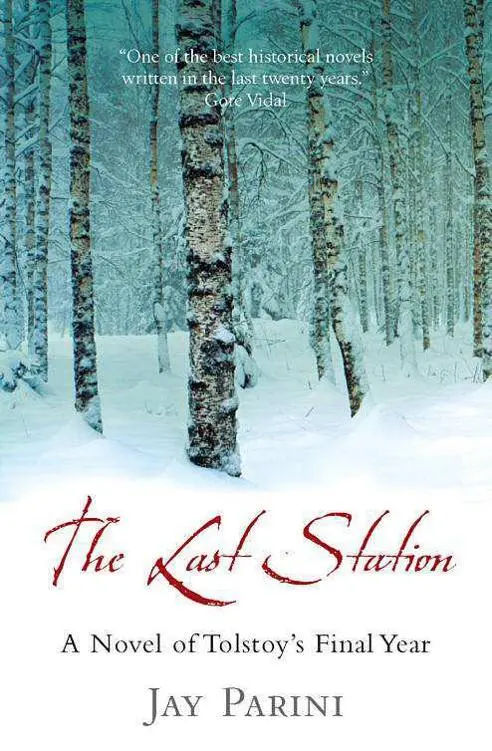
- Название:The Last Station
- Автор:
- Издательство:Canongate Books
- Жанр:
- Год:2007
- Город:London
- ISBN:978-1-84767-394-7
- Рейтинг книги:4 / 5. Голосов: 1
-
Избранное:Добавить в избранное
- Отзывы:
-
Ваша оценка:
The Last Station: краткое содержание, описание и аннотация
Предлагаем к чтению аннотацию, описание, краткое содержание или предисловие (зависит от того, что написал сам автор книги «The Last Station»). Если вы не нашли необходимую информацию о книге — напишите в комментариях, мы постараемся отыскать её.
Jay Parini moves deftly between a colorful cast of characters to create a stunning portrait of one of the world’s most treasured authors. Dancing between fact and fiction,
is a brilliant and moving literary performance.
The Last Station — читать онлайн бесплатно полную книгу (весь текст) целиком
Ниже представлен текст книги, разбитый по страницам. Система сохранения места последней прочитанной страницы, позволяет с удобством читать онлайн бесплатно книгу «The Last Station», без необходимости каждый раз заново искать на чём Вы остановились. Поставьте закладку, и сможете в любой момент перейти на страницу, на которой закончили чтение.
Интервал:
Закладка:
What could I say? Sofya Andreyevna knows far more than I do about the sexual history of Leo Tolstoy, although the general pattern of his life is familiar. He has never troubled to hide the facts of his early life. ‘I was a sinful young man,’ he once told me. ‘Obsessed with sexual longings, overcome by animal desire. Only a long struggle has rid me of these things.’ That’s what he says, though I have noticed his eyes grow lively whenever a young servant girl enters the room.
This afternoon I spent several hours in the Remington room with Sasha, answering letters. Leo Nikolayevich is so upset that he does not even want to sign, let alone revise, our responses. I feel strange, occasionally, as I write letters in his name. It’s as though I am Leo Tolstoy. Somehow, the letters don’t seem like forgeries. When I write as Tolstoy, I am Tolstoy. His spirit, like that of other men and women, is simply a demarcation of the human spirit, which in itself is a demarcation of the larger spirit, the God-spirit; in death, the demarcations end. We become, to use Emerson’s phrase, part of the Oversoul. We touch this God-spirit in daily life, too, during blessed moments, moments of affection, of peculiar insight, of fierce candor. The spirit of Leo Tolstoy is capacious, allowing easy entry. I left Yasnaya Polyana tonight feeling more like Tolstoy than myself.
I gradually reentered the spirit of Bulgakov as I approached Telyatinki. The sun burned on the hay fields, flamed in the elms, and turned the red earth redder under my horse’s gallop. I saw Masha standing in the back garden, alone, her shadow long on the grass. My groin began to ache, to swell before I could even see her face.
We said nothing to each other but walked, hand in hand, into the balsam wood behind the house. The forest was like a flame ball, with the sunset shattering through a thousand needles. The ground smelled cool, rich but cool, with its mauve mat of pine.
Standing between the tall and immensely thick trunks of two red pines, we looked at each other for a long time, saying nothing.
But there was something I wanted to say to her. I didn’t know how to say it. I was afraid to say it, since once it got said, we were stuck with it. It would either flap there in the wind like a loose shutter, an annoyance, or something definite and palpable would happen.
‘I love you, Masha,’ I said.
The words floated in the air, like a balloon, a bright, shimmering bubble. I waited for it to pop into nothingness, to disappear. For a terrible moment, I felt as though I hadn’t said it aloud, that the words had formed, cloudlike, in my head without condensing into utterance.
‘I’m glad,’ she replied.
But there was an aloofness there. She wasn’t glad. Not entirely.
‘Are you really?’
‘If I weren’t glad, I wouldn’t have said that, would I?’
‘It’s just that… you had to respond.’
‘I don’t have to do anything.’
I felt a twinge of panic. Masha has this cool edge, a blade of Damascus steel, which she flashes on occasion.
‘Valya,’ she said. ‘I don’t know what to say. I don’t want to hurt you. Do you know that?’
‘You hurt me when you say nothing. I dislike it when I can’t tell what you’re thinking. When I can’t seem to find you.’
Was she weeping? Slightly. Her eyes caught the evening sun and absorbed its redness. They were watery, as many-sided as a gem. Her blond hair, too, turned a little pink in the strange, beautiful light. I wanted to touch that hair. I let my palm graze the delicate substance. I could feel the roundness of her head, its solid, gourdlike shape, beneath the long strands. I kissed her. I let myself breathe what came before me, the barely fathomable presence of another human being. It seemed impossibly magical. I lifted my hands onto her small shoulders, and I pulled her close.
‘I’ve got to return to Petersburg,’ she said finally. ‘Soon.’
‘For good?’
‘Perhaps not.’
‘I don’t understand, Masha… now that we–’
‘I know that you love me, Valya.’
‘I do.’
‘It’s difficult for me to respond to you. We’ve only just begun to know each other.’
‘That’s true, but–’
‘You seem young to me.’
‘I’m older than you are!’
‘Our pasts are what matter. I feel like I’ve lived so many lives already.’
‘Masha, that’s nonsense. Your life is just beginning.’
‘In other circumstances, I think I’d have been much… warmer. I feel my own coolness, and I don’t like it. I hate it, in fact. It’s not what I mean to happen.’
Her honesty overwhelmed me. And the exact, riveting way she spoke. I felt mute, stupid, even silly beside her. I could hardly hope to respond in kind. It wasn’t that I couldn’t be honest with her. Rather, I had almost nothing to be honest about .
‘I love you,’ I said. ‘You can’t go away.’
She smiled at me.
‘Perhaps I’ll go away for a brief while. I can return to Telyatinki whenever I want. I spoke to Chertkov last night, and he was sympathetic. He was actually kind.’
Chertkov remains incomprehensible to me. Whatever Masha or Leo Nikolayevich think, I would never trust him.
Masha touched my hair. It was the first gesture from her that I could really take as an expression of natural and unaffected love.
Her head fell against my shoulder.
‘I need you,’ I said.
‘I know you do,’ she said. ‘I know.’
25
L. N.
LETTER TO SOFYA ANDREYEVNA
YASNAYA POLYANA, 14 JUNE 1910
My dear Sonya,
1. I promise to give nobody the diary I am writing at this time. I shall keep it with me.
2. I shall ask for the return of my previous diaries from Chertkov, then I shall keep them, probably in a bank.
3. If it worries you that unfriendly biographers will, in the future, make use of those pages written in the heat of the moment registering our conflicts and struggles, I would remind you, first, that these expressions of passing emotion, in my diary as in yours, cannot pretend to present an accurate portrait of our relations. Nevertheless, if it still worries you, I shall happily take this opportunity to say, in my diary or in this letter, what my relations with you were really like and what your life has been, as I have seen it.
My relations with you and view of your life are as follows: just as I loved you when you were young, I have never stopped loving you in spite of the many causes of alienation between us. And so I continue to love you. Putting aside the issue of our sexual relations, which have ceased (a fact that can only add to the sincerity of our expressions of love), those causes were as follows: first, my growing need to withdraw from society, something which you neither would nor could follow me in, since the principles that led me to adopt my convictions opposed yours in quite basic ways. This seems, to me, perfectly natural and I cannot hold it against you. Further, in recent years, you have become increasingly irritable, even despotic and uncontrollable. This could hardly help but inhibit any display of feeling on my part, even cut off those feelings themselves. That is my second point. Third, the chief and fatal cause was something of which we are both innocent: our completely opposing ideas of the significance and purpose of life. For me, property is a sin, for you it is a necessary condition. In order not to have to separate myself from you, I have forced myself to accept circumstances that I find painful. Yet you saw my acceptance as a concession to your point of view, and this only increased our misunderstanding.
As for my view of your life, here it is:
I, a debauched person by nature, deeply depraved in my sexual appetite, and no longer in my first youth, married you, a girl of eighteen who was spiritually pure, good, and intelligent. In spite of my dreadful past, you stayed with me for nearly fifty years, loving me, living a life full of worry and anguish, giving birth to children, raising them, caring for them, and nursing me, without succumbing to any of the temptations that a beautiful, solid, and healthy woman is always exposed to; indeed, your life has been such that I have absolutely nothing to reproach you with. As for the fact that your moral development did not run parallel to mine, which has been unique, I cannot hold this against you, since the inner life of any person is a secret between that person and God, and nobody else can call that person to account in any way. I have been intolerant of you. I was deeply mistaken, and I confess my error.
Читать дальшеИнтервал:
Закладка:
Похожие книги на «The Last Station»
Представляем Вашему вниманию похожие книги на «The Last Station» списком для выбора. Мы отобрали схожую по названию и смыслу литературу в надежде предоставить читателям больше вариантов отыскать новые, интересные, ещё непрочитанные произведения.





Обсуждение, отзывы о книге «The Last Station» и просто собственные мнения читателей. Оставьте ваши комментарии, напишите, что Вы думаете о произведении, его смысле или главных героях. Укажите что конкретно понравилось, а что нет, и почему Вы так считаете.