Stewart Binns - Conquest
Здесь есть возможность читать онлайн «Stewart Binns - Conquest» весь текст электронной книги совершенно бесплатно (целиком полную версию без сокращений). В некоторых случаях можно слушать аудио, скачать через торрент в формате fb2 и присутствует краткое содержание. Город: London, Год выпуска: 2011, ISBN: 2011, Издательство: Penguin Books, Жанр: Историческая проза, на английском языке. Описание произведения, (предисловие) а так же отзывы посетителей доступны на портале библиотеки ЛибКат.
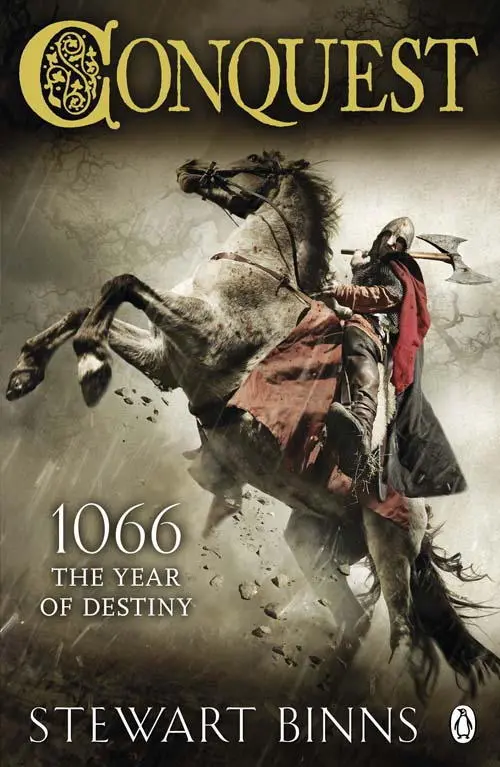
- Название:Conquest
- Автор:
- Издательство:Penguin Books
- Жанр:
- Год:2011
- Город:London
- ISBN:978-0-141-96059-3
- Рейтинг книги:5 / 5. Голосов: 1
-
Избранное:Добавить в избранное
- Отзывы:
-
Ваша оценка:
Conquest: краткое содержание, описание и аннотация
Предлагаем к чтению аннотацию, описание, краткое содержание или предисловие (зависит от того, что написал сам автор книги «Conquest»). Если вы не нашли необходимую информацию о книге — напишите в комментариях, мы постараемся отыскать её.
The battle is hard fought and bloody, the lives of thousands have been spent, including that of King Harold. But England will not be conquered easily, the Anglo-Saxons will not submit meekly to Norman rule.
Although his heroic deeds will nearly be lost to legend, one man unites the resistance. His name is Hereward of Bourne, the champion of the English. His honour, bravery and skill at arms will change the future of England. His is the legacy of the noble outlaw.
This is his story.
Conquest — читать онлайн бесплатно полную книгу (весь текст) целиком
Ниже представлен текст книги, разбитый по страницам. Система сохранения места последней прочитанной страницы, позволяет с удобством читать онлайн бесплатно книгу «Conquest», без необходимости каждый раз заново искать на чём Вы остановились. Поставьте закладку, и сможете в любой момент перейти на страницу, на которой закончили чтение.
Интервал:
Закладка:
The cry ‘Hail William, rightful King of England and Duke of Normandy’ rose in unison from the nobles.
Across the Channel, England stood alone. Previous forays into the lands of its Celtic neighbours had created anger and bitterness. It also had long-standing enemies in Scandinavia, in both Norway and Denmark. Other European powers were either allies of Normandy or were embroiled in their own local disputes. The Pope, Alexander II, who had succeeded Nicholas II in 1061, needed Norman support in southern Italy and readily sanctified William’s claim to the English throne.
Harold had only one significant bulwark: the English Channel, which could be capriciously dangerous for even the most experienced seafarer. If nothing else, it would buy him crucial time to prepare while the Normans built their fleet. If the Channel could not keep William at bay, it would fall to the sturdiness of England’s backbone to save the day – the redoubtable English housecarls.
Day after day and long into the nights of early spring 1066, Hereward and Harold talked tactics and strategy. They concluded that a dual invasion was possible, even a triple one, especially after news arrived that Tostig was travelling from his base in Flanders to court favour not only with William in Normandy, but also with Hardrada in Norway and even Svein Estrithson, King of Denmark.
Much of their discussions focused on the use of cavalry in battle and whether, if attacked on different fronts, the army should use horses to move around the country. They decided to eschew the use of horses, concluding that the great strength of the housecarl was his ability as an infantryman and that the powerful bulwark of the army was its shield wall. Speed would be of the essence to confront a two-pronged or three-pronged attack, and therefore the army should travel as lightly as possible. Horses needed much more care than men, and their fodder was more onerous to transport.
With Hereward setting their tasks and the King at their head, the English housecarls spent the long months of spring 1066 crossing vast tracks of southern England on forced marches, each one culminating in the army assembling in full battle order. Special lightweight baggage trains were prepared, which would keep pace with the rapid movement of the infantry and offer rest and treatment for any stragglers.
With careful planning and preparation, the English infantry could be made all but indestructible.
Harold applied himself to the task like a man possessed.
Harold’s recalcitrant brother Tostig moved on from his missions to Duke William in Normandy and Svein Estrithson in Denmark, to attend a gathering at the court of Harald Hardrada, King of the Norwegians.
Hardrada had assembled the entire aristocracy of Norway in his Great Hall in the Viken. He knew what Tostig wanted, and he knew he would need the full support of his warriors if Tostig’s wish was to be fulfilled. Hardrada recognized that Tostig had the potential to be the power-broker in the unfolding drama, so the full panoply of the Norwegian royal court was unveiled for the English lord.
Tostig’s opening address was eloquent and succinct. It needed to be, as Hardrada was a ferocious character who did not suffer fools easily.
Hardrada had fought his first battle at the age of fifteen, barely escaping with his life. Immensely tall at six and a half feet, he was strong of arm like his adversaries, Harold of England and William of Normandy, and had lived his life as a warrior. He had fought with great distinction for Yaroslav, Prince of Kiev, in his campaigns against the Poles, before journeying south to Byzantium to join the Emperor’s fabled Varangian Guard. Manned by formidable Scandinavians, the Varangians were known throughout the civilized world for their military prowess and loyalty. He served the Guard with great distinction, both as a marine in the Imperial Fleet and as an infantryman in Palestine, North Africa, Armenia and Sicily. He emerged as Captain of the Varangians, before leaving Byzantium with a fortune in gold and silver from the booty of war. Still only twenty-eight years of age, he returned to Norway as the most illustrious warrior of his day.
As Tostig stood before Hardrada, he was staring into the face of a legend. Not only was he the subject of the great sagas, he was often their author, rightfully acknowledged as an epic poet on a par with his reputation as an exceptional warrior. Now over fifty years of age, he still had the bearing of a mythical hero.
‘My lord King, I come to Viken to pay homage to a great tradition. This land has given birth to famous warriors whose descendents hold sovereignty over vast lands in the north, in Russia and in the Mediterranean. Vikings are feared wherever they tread. In my own country, the Viking tradition is strong. I am of Norse blood through my Danish mother, Gytha, daughter of Earl Thorkils, and proud of it. Sire, England is in turmoil. The North is in revolt and William, Duke of Normandy, is building a fleet with all speed to mount an invasion. England will soon be lost to the Normans.’
Tostig was interrupted by Vik Ospakson, Hardrada’s loyal Earl Marshal, who had fought with him in the Varangian Guard. Ospakson rose and stood in silence, waiting in the Viking tradition for Tostig to yield the floor, which he did with a bow.
‘Earl Tostig, you speak well. It is to your credit that you address this gathering with such composure. But you failed to mention that Vikings also hold sway over much of Europe as well. Is not William of Normandy a Viking, directly descended from William Longsword, son of Rolf?’
‘He is, my Lord. But he is no longer a Scandinavian. He, like King Edward, has been seduced by the trappings of Rome and the soft life of the learned cloister. The Normandy he governs is turning to Paris, to Rome and to Aachen for its wisdom; it has forgotten its northern roots.’
This time a younger warrior stood up, Skule Konfrostre, a close friend of the King’s son, Olaf.
‘Earl Tostig, noble lord of the English, if you are contemptuous of the Normans, why were you at William’s court recently? Were you not also at the court of Estrithson? How many allies do you seek?’
There were hoots of derision in support of the young warrior’s caustic remarks.
He continued his barracking. ‘Also, is it not true that your own wife, Judith, is kinswoman of the midget Matilda, Duke William’s wife?’
More laughter ensued, amid derisory yells from the warriors. Tostig seemed to be losing his audience.
He turned squarely to Hardrada. ‘I was at William’s court in January to ask him his intentions. He told me he would invade as soon as his fleet was ready. I told him that the Saxons would fight him to the death until Edgar the Atheling, the true Cerdician King of England, was on the throne and I was reinstalled to my Earldom in Northumbria. My brother Harold has made himself King, but Harold is a general of armies, not a king. He has seen an opportunity and taken it; it is an ignoble act. I asked William to support the Atheling as King, and to act as guarantor against any threat to Edgar from my brother, but the Duke rejected my suggestion.’
Hardrada spoke for the first time. ‘Tell me of your brother, the new King Harold. Is he liked?’
‘He has support, especially in the South, and the army is loyal to him. It is well trained, but it numbers only a few thousand. In the North he is weak; that is where fealty is shown to me.’
Whether or not Hardrada realized Tostig was being disingenuous about loyalty to him in the North, it seemed not to matter. The King, who had listened carefully to all that had been said, stood and regarded the grand gathering of his kinsmen. He made eye contact with many, trying to gauge their mood.
‘Since the treaty of the Goda River with King Svein of the Danes, we have been at peace. Our battles with Denmark are over, but the years of peace have blunted our axes. England is rich; its maidens are fair. Are we not Vikings?’
Читать дальшеИнтервал:
Закладка:
Похожие книги на «Conquest»
Представляем Вашему вниманию похожие книги на «Conquest» списком для выбора. Мы отобрали схожую по названию и смыслу литературу в надежде предоставить читателям больше вариантов отыскать новые, интересные, ещё непрочитанные произведения.








Обсуждение, отзывы о книге «Conquest» и просто собственные мнения читателей. Оставьте ваши комментарии, напишите, что Вы думаете о произведении, его смысле или главных героях. Укажите что конкретно понравилось, а что нет, и почему Вы так считаете.