Stewart Binns - Conquest
Здесь есть возможность читать онлайн «Stewart Binns - Conquest» весь текст электронной книги совершенно бесплатно (целиком полную версию без сокращений). В некоторых случаях можно слушать аудио, скачать через торрент в формате fb2 и присутствует краткое содержание. Город: London, Год выпуска: 2011, ISBN: 2011, Издательство: Penguin Books, Жанр: Историческая проза, на английском языке. Описание произведения, (предисловие) а так же отзывы посетителей доступны на портале библиотеки ЛибКат.
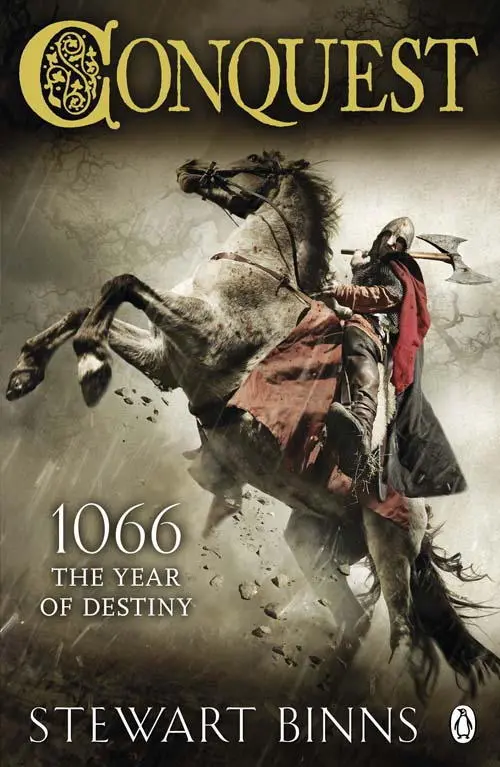
- Название:Conquest
- Автор:
- Издательство:Penguin Books
- Жанр:
- Год:2011
- Город:London
- ISBN:978-0-141-96059-3
- Рейтинг книги:5 / 5. Голосов: 1
-
Избранное:Добавить в избранное
- Отзывы:
-
Ваша оценка:
Conquest: краткое содержание, описание и аннотация
Предлагаем к чтению аннотацию, описание, краткое содержание или предисловие (зависит от того, что написал сам автор книги «Conquest»). Если вы не нашли необходимую информацию о книге — напишите в комментариях, мы постараемся отыскать её.
The battle is hard fought and bloody, the lives of thousands have been spent, including that of King Harold. But England will not be conquered easily, the Anglo-Saxons will not submit meekly to Norman rule.
Although his heroic deeds will nearly be lost to legend, one man unites the resistance. His name is Hereward of Bourne, the champion of the English. His honour, bravery and skill at arms will change the future of England. His is the legacy of the noble outlaw.
This is his story.
Conquest — читать онлайн бесплатно полную книгу (весь текст) целиком
Ниже представлен текст книги, разбитый по страницам. Система сохранения места последней прочитанной страницы, позволяет с удобством читать онлайн бесплатно книгу «Conquest», без необходимости каждый раз заново искать на чём Вы остановились. Поставьте закладку, и сможете в любой момент перейти на страницу, на которой закончили чтение.
Интервал:
Закладка:
They were his final words.
He fell into a deep coma and died seven days later, on 5 January 1066.
In that tortured week between the King’s last words and his death, Stigand, Edith and Harold spoke many times about his verba novissima. They decided to take his words literally: Harold would be declared Protector of England and, as all the earls were still in London, a Witan would be called immediately upon the King’s death, to decide who should succeed.
Edward’s wishes would be made clear to the nobles but, in accordance with hundreds of years of Anglo-Saxon tradition, the assembled nobility would take the decision.
Every man who spoke at the Witan understood the gravity of the proceedings and the importance of his contribution. Some spoke for Edgar the Atheling, mainly out of a sense of loyalty to the Cerdician line, but most were firmly for Harold, despite Edward’s wishes. Harold was questioned directly about the oath in Rouen. He acknowledged the question, but asked that his answer be deferred until the Witan was ready to vote on the succession.
By the time Harold spoke, he was King in all but name. Almost to a man, Harold was their choice. They all knew that England faced a perilous future, and that the only man who could lead England was the Earl of Wessex. When Harold got to his feet, there was a hush of expectation.
‘My Lords of England, leaders of our noble race, I stand before you humbled by the circumstances of this gathering. A good and learned King has died. He was a Saxon of the royal blood, who did many great things for his realm, and he deserves our gratitude and respect.’ He paused as ripples of concurrence went around the gathering. ‘But there is a part of his legacy which we should reject without hesitation. He believed that our Saxon ways will hinder our future and said many times that our future lies with, in the King’s words, “Europe’s empires and kingdoms of learning and sophistication”. But do we not have our own ways?’
Harold’s rhetorical question was met by yells of agreement.
‘Europe is beset by bitter rivalries and dominated by the vagaries of Rome and its henchmen, the Normans. And I will have no part of it!’
A great roar exploded from the Witan as Harold paused for breath.
‘Almost two years ago, I swore an oath before papal witnesses affirming that I would serve as Earl Marshal of this land for its future King, William, Duke of Normandy. I swore that oath at King Edward’s bidding in a moment of weakness.’
Harold was interrupted by several cries of ‘No!’
‘I will not be weak again. On his deathbed, King Edward made me Protector of England and his final testament surpasses my oath to William. He said that God had shown him what we all fear: the destruction of this land in a terrible fight, as the people resisted the rule of Normandy. I am now the guardian of this ancient kingdom and its people. They face the gravest of threats to their safety and prosperity. I now ask you to make your choice. The late King’s request was that I ask you, the wise men of England, to accept William as your King. How do you say?’
‘No! No! No!’ was the unanimous response, as the Witan, to a man, rose to its feet.
‘So be it. Therefore, will you permit me to fulfil my duty to England and confirm me, Harold, Earl of Wessex, as your King?’
A great chorus of ‘Aye!’ filled the hall.
‘I am not of royal Cerdician blood. My pedigree is that of a warrior, descended from ancient Saxon and Danish champions of arms. I will serve as your loyal King for one purpose only – to protect this country from those who would destroy our way of life, lay waste our lands and murder our people. If you will lend me your strength, together we can defeat Hardrada and William. So help me God!’
At this, the earls rushed to Harold and raised him on to their shoulders.
The doors of the Great Hall at Westminster were flung open and King Harold II of England was carried into the midst of the rapturous crowd gathered outside.
The old King was buried the next day and Harold was crowned within hours.
Time was of the essence, for Harold had inherited many problems. Not only did he have William and Hardrada’s looming presence, but he also had a disgruntled brother festering in Flanders. In addition, the whole of the northern aristocracy, led by the earls Morcar and Edwin, were plotting to secede their provinces from the English realm.
Harold had no hesitation in making Hereward Senior Captain of his personal hearthtroop of housecarls. He and Torfida journeyed to Glastonbury to plan the quartering of the army, which would be called to arms as soon as the grip of winter had loosened.
Duke William was out hunting when news of Harold’s succession and coronation arrived. He flew into a terrible rage and demanded the presence of the entire nobility of Normandy at an assembly in Rouen within two days. Apart from the thwarting of his own ambitions, the news nullified the promises he had made to a large group of avaricious relatives and supporters, all of whom wanted one thing: land. Hemmed in by the English Channel on their northern flank and the lands of the French to the south, Normans had been leaving their homeland for decades in search of territory to conquer. Now, the English prey that had been whetting their voracious appetites for years had been snatched from their jaws.
Throughout history, there can have been few gatherings of men as fearsome as the group that stood before Duke William at his noble conclave. Robert of Mortain, William Fitzborn, Odo of Bayeux, Richard of Evreux, Roger of Beaumont, Hugh of Grandmesnil, Roger of Montgomery, Walter Gifford, Hugh of Montfort and William of Warrene were the most prominent members of a warrior elite based on rigid rules of hierarchy and military prowess. The mood was as solemn as the faces of the assembled warlords. They listened, seething, as William spat out his disdain for Harold – a usurper who had defied the wishes of his predecessor, a liar who had broken his holy oath and a fraud who had misled a weak and frightened people.
As William described his plan for an audacious invasion of England and outlined the massive resources he needed, some murmurings of dismay could be heard.
William identified the doubters and addressed them directly. ‘My noble friend, Richard, Count of Evreux, you seem disconcerted by the task.’ His sarcasm was not in any way disguised.
‘My Lord Duke, I fear no man, nor do I flinch in the face of any army, but Harold is not a weakling and his army is a match for any in Europe. We would need to put many thousands of men on to the battlefield to best him. More importantly, we have no fleet to carry such a force to England.’
William could see that the Count of Evreux’s doubts were shared by many.
‘Your battle-axe is across your shoulder, my friend. Sharpen it; many mighty oaks shall soon fall across this land. We shall build a grand fleet, the like of which has never been seen before!’
Cheering replaced whispers of discontent, as William’s single-mindedness began to rouse his nobles.
‘Helmsmen are easily bought, as are ship’s constables for our war horses. I need two thousand vessels by Midsummer’s Day. We shall sail with eight thousand infantry and bowmen, and two thousand knights and their destriers.’
There were looks of amazement around the room at the scale of William’s ambition.
‘Remember our Viking ancestors – they feared nothing, least of all the sea. They crossed oceans far bigger than the Sleeve to win legendary victories and vast wealth. Glorious conquest and hordes of treasure await us in England. Go to your lands and prepare for war! Prepare for victory!’
The proposed size of William’s armada astonished everyone, but they all knew that such a force would be necessary to defeat Harold. They also knew that nothing on earth would thwart the Duke’s determination.
Читать дальшеИнтервал:
Закладка:
Похожие книги на «Conquest»
Представляем Вашему вниманию похожие книги на «Conquest» списком для выбора. Мы отобрали схожую по названию и смыслу литературу в надежде предоставить читателям больше вариантов отыскать новые, интересные, ещё непрочитанные произведения.









Обсуждение, отзывы о книге «Conquest» и просто собственные мнения читателей. Оставьте ваши комментарии, напишите, что Вы думаете о произведении, его смысле или главных героях. Укажите что конкретно понравилось, а что нет, и почему Вы так считаете.