Stewart Binns - Conquest
Здесь есть возможность читать онлайн «Stewart Binns - Conquest» весь текст электронной книги совершенно бесплатно (целиком полную версию без сокращений). В некоторых случаях можно слушать аудио, скачать через торрент в формате fb2 и присутствует краткое содержание. Город: London, Год выпуска: 2011, ISBN: 2011, Издательство: Penguin Books, Жанр: Историческая проза, на английском языке. Описание произведения, (предисловие) а так же отзывы посетителей доступны на портале библиотеки ЛибКат.
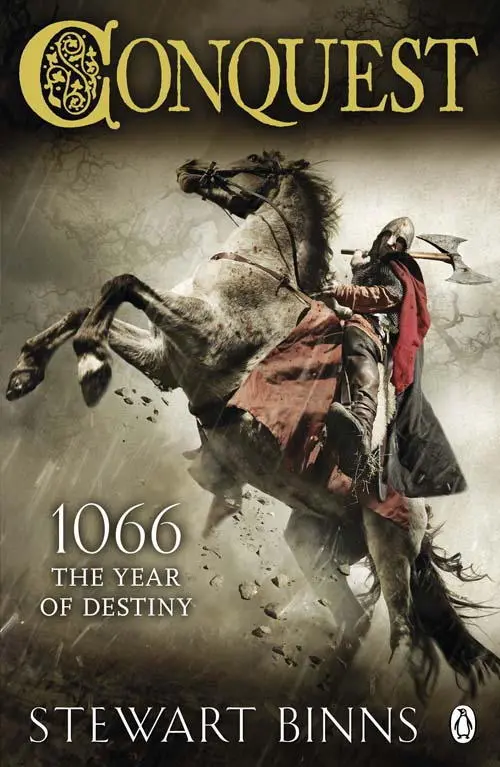
- Название:Conquest
- Автор:
- Издательство:Penguin Books
- Жанр:
- Год:2011
- Город:London
- ISBN:978-0-141-96059-3
- Рейтинг книги:5 / 5. Голосов: 1
-
Избранное:Добавить в избранное
- Отзывы:
-
Ваша оценка:
Conquest: краткое содержание, описание и аннотация
Предлагаем к чтению аннотацию, описание, краткое содержание или предисловие (зависит от того, что написал сам автор книги «Conquest»). Если вы не нашли необходимую информацию о книге — напишите в комментариях, мы постараемся отыскать её.
The battle is hard fought and bloody, the lives of thousands have been spent, including that of King Harold. But England will not be conquered easily, the Anglo-Saxons will not submit meekly to Norman rule.
Although his heroic deeds will nearly be lost to legend, one man unites the resistance. His name is Hereward of Bourne, the champion of the English. His honour, bravery and skill at arms will change the future of England. His is the legacy of the noble outlaw.
This is his story.
Conquest — читать онлайн бесплатно полную книгу (весь текст) целиком
Ниже представлен текст книги, разбитый по страницам. Система сохранения места последней прочитанной страницы, позволяет с удобством читать онлайн бесплатно книгу «Conquest», без необходимости каждый раз заново искать на чём Вы остановились. Поставьте закладку, и сможете в любой момент перейти на страницу, на которой закончили чтение.
Интервал:
Закладка:
This was Torfida’s moment. ‘Is that why you want Duke William to succeed you, my Lord King?’
‘Yes.’
‘Do you know what kind of man he is, sire?’
‘I remember him when he was a boy in Normandy. He was a strong and forceful child and had all the makings of a leader of men.’
‘Oh, he is that, sire. You talk of Saxon brutes, but he is a brute beyond mercy; a tyrant beyond all others in a tyrannical world.’
‘I have heard all the accounts, and I know he has a dark side; as do we all. But there is much Saxon propaganda about William that emanates from the Godwinsons. You are now in the lien of the Earl of Wessex, and Harold is ambitious to be king. Do you speak for him now?’
‘I do not, sire; I speak for England. I plead for a tradition and a way of life. You speak of the value of European culture, but is that what the Saxons want?’
The King’s mood darkened. ‘What the Saxons want is what I say they ought to have!’
Torfida was alarmed by the King’s sudden change of mood. His considered and balanced tone had been replaced by the ferocity of a tyrant.
‘Does that shock you, Torfida? My conviction explains why I don’t need amulets to help me decide what to do.’ Edward glanced towards his retinue. ‘I will not favour Harold. He is neither a Saxon of the royal blood, nor a man who would move England into a new age. He is a fine warrior who would have been a magnificent king of an ancient tribe. But I do not want England to be a tribal kingdom; I want it to be a part of the new order of Europe.’
‘I don’t think the Earl of Wessex wants to be king. He would prefer you to name Edgar the Atheling. Harold would pledge himself as his Regent until he gained his majority.’
The King’s tone darkened once again. ‘Edgar is a boy. Hardrada sits in Norway, William in Normandy. If Edgar becomes king, both will invade – and possibly the Dane, Estrithson. If Harold defeats them by force of arms he will be persuaded by popular acclaim to supplant Edgar, and the boy will be lost. If Hardrada wins, we will become Scandinavian again, something that would put me in Purgatory for time immemorial. If William wins, we will have the outcome I prefer, but many thousands will have died in achieving it. So, the answer is clear: nominate William, force Harold and the earls to accept it, and pray for the future.’
The King nodded to Torfida before summoning his servants. She curtsied back and watched him shuffle out of the Chapter House.
As he left, she turned to Harold. ‘My Lord Godwinson, your cause is lost. The King will not be swayed.’
Later that day, when Harold joined Edith and Torfida at Ludgate Hill, he expressed his bitter disappointment that William remained the King’s nominated successor.
‘Well, that’s an end to it. I’ll tell the King that I am returning to Glastonbury to be with my men. He won’t like it, but he will have little choice in the matter. We will join Hereward at Glastonbury. There is much to be done.
‘Edith, you should not stay in London. Close the house, pack anything of value and bring your household with you. We may be gone for some time.’
Two days later, the Earl of Wessex, with a large contingent behind him, was heading west. When they arrived in Glastonbury, the burgh and the surrounding countryside resembled an armed camp. Hereward and Earl Gyrth had almost a thousand men in readiness, new weapons were being forged, armour was being made, supply carts were being loaded and the oxen to pull them were grazing in the fields nearby.
Harold called an assembly of his thegns in the Great Hall of Glastonbury. He proclaimed an end to their hope of the King accepting Edgar the Atheling as his successor, or of him revoking his nomination of the Duke of Normandy as the next king. Everyone, to a man, said that they would reject William as successor and accepted Harold’s view that unless William brought an army of unheralded size and materiel, it was unlikely that he could secure the throne by force of arms.
The Earl of Wessex was an imposing figure as he stood before the assembled throng of warriors. He was candid about the personal dilemma he would face upon the King’s death, but asked them to believe that he was not engaged in a devious plot to claim the throne for himself. However, he was firm in saying that circumstances were conspiring to put England in great danger,
‘Whatever perils come our way, I will face them. With you at my side, you noble men of England, we will repel any invader, whether he is Scandinavian or Norman – and even if both hordes fall upon us at once!’
A huge roar rose into the roof of the hall, a cry that turned to a thunderous echo as the warriors thumped their shields with their battle-axes and swords.
Later that day, Hereward offered Harold his assessment of the qualities of England’s fighting men. The general level of discipline and fighting skills, both among the levies of the Fyrd and among the housecarls, was on a par with any he had seen, including Byzantines, Saracens and even Scandinavians and Normans. However, there was one area where the Saxon housecarl was beyond comparison. Their close-quarters, highly coordinated battle techniques, especially their shield wall, were without equal. Hereward’s only area of concern was the cavalry. The Saxons were adept horsemen, but they eschewed the use of horses in major set-piece battles. On the other hand, Normandy’s cavalry with its heavy destriers was the Norman equivalent of the Saxon shield wall: it was their greatest asset.
Hereward put it very plainly for Harold. ‘If it comes to a major battle against the Normans, it will be the Saxon shield wall against the Norman destrier.’
Harold thought about Hereward’s report for a while. ‘What of their bowmen? They have both longbow and crossbow.’
‘It is an added advantage for them, and one that we need to combat. While I was in the service of the Duke, I saw some of the finest bowmen in Europe; they could be dangerous for us.’
During the searingly hot summer of 1065 Harold drove his housecarls hard. The messages coming from London told of a King who was becoming more and more irascible and who suffered from frequent ‘maladies’, where he would temporarily lose consciousness. His speech had become slurred and his balance unsure.
Despite the tension created by the unfolding of great events, time passed slowly.
Harold completed the summer of training with his men, but in early September had to stand down the greater part of his army so that they could return to their homes to gather the harvest.
Then, in October of 1065, just when it needed to be stable, England was thrown into turmoil, and by Harold’s own brother, Tostig.
The King had made Tostig Earl of Northumbria in 1055, in acknowledgement of the growing influence of the sons of Earl Godwin. However, Northumbria had been the domain of the Bamburgh family for many generations and Tostig’s arrival was not welcome; nor did his punitive rule and high taxes endear him to his vassals.
After ten years of resentment, the Northumbrian thegns eventually rose in revolt against Tostig’s rule and called a gemot at York. There, after pledging their loyalty to King Edward, they repudiated Tostig’s rule and declared him an outlaw. Mayhem ensued. Tostig’s hearthtroop were slaughtered and his treasury plundered until it was bare. The rebels chose a Mercian, Morcar, as their new earl. Anyone within Northumbria loyal to Tostig was ruthlessly purged before the rebels moved south, with Morcar and his followers marauding across the English heartland. Lincoln, Nottingham, and Derby were sacked and the rebellion descended into a rampage of murder, rape and looting. When they arrived at Northampton, they joined a large force of allies led by Morcar’s brother, Edwin, Earl of Mercia; hundreds were killed, the burgh was destroyed, the crops in store for the winter were burned and the livestock stolen.
Читать дальшеИнтервал:
Закладка:
Похожие книги на «Conquest»
Представляем Вашему вниманию похожие книги на «Conquest» списком для выбора. Мы отобрали схожую по названию и смыслу литературу в надежде предоставить читателям больше вариантов отыскать новые, интересные, ещё непрочитанные произведения.









Обсуждение, отзывы о книге «Conquest» и просто собственные мнения читателей. Оставьте ваши комментарии, напишите, что Вы думаете о произведении, его смысле или главных героях. Укажите что конкретно понравилось, а что нет, и почему Вы так считаете.