Stewart Binns - Conquest
Здесь есть возможность читать онлайн «Stewart Binns - Conquest» весь текст электронной книги совершенно бесплатно (целиком полную версию без сокращений). В некоторых случаях можно слушать аудио, скачать через торрент в формате fb2 и присутствует краткое содержание. Город: London, Год выпуска: 2011, ISBN: 2011, Издательство: Penguin Books, Жанр: Историческая проза, на английском языке. Описание произведения, (предисловие) а так же отзывы посетителей доступны на портале библиотеки ЛибКат.
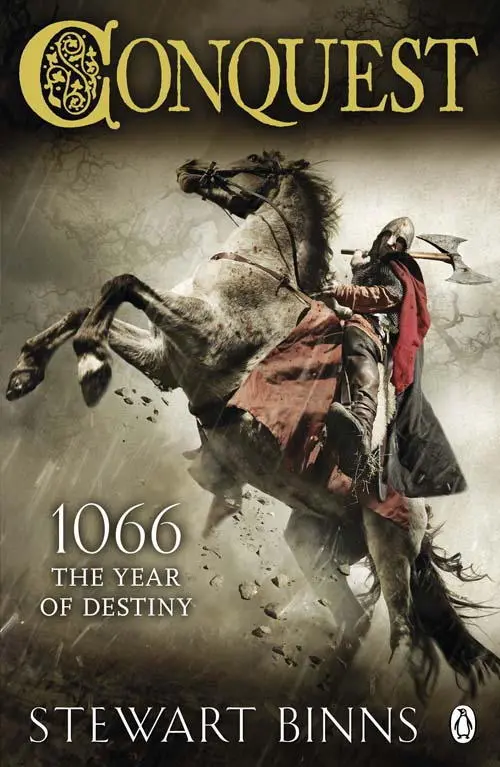
- Название:Conquest
- Автор:
- Издательство:Penguin Books
- Жанр:
- Год:2011
- Город:London
- ISBN:978-0-141-96059-3
- Рейтинг книги:5 / 5. Голосов: 1
-
Избранное:Добавить в избранное
- Отзывы:
-
Ваша оценка:
Conquest: краткое содержание, описание и аннотация
Предлагаем к чтению аннотацию, описание, краткое содержание или предисловие (зависит от того, что написал сам автор книги «Conquest»). Если вы не нашли необходимую информацию о книге — напишите в комментариях, мы постараемся отыскать её.
The battle is hard fought and bloody, the lives of thousands have been spent, including that of King Harold. But England will not be conquered easily, the Anglo-Saxons will not submit meekly to Norman rule.
Although his heroic deeds will nearly be lost to legend, one man unites the resistance. His name is Hereward of Bourne, the champion of the English. His honour, bravery and skill at arms will change the future of England. His is the legacy of the noble outlaw.
This is his story.
Conquest — читать онлайн бесплатно полную книгу (весь текст) целиком
Ниже представлен текст книги, разбитый по страницам. Система сохранения места последней прочитанной страницы, позволяет с удобством читать онлайн бесплатно книгу «Conquest», без необходимости каждый раз заново искать на чём Вы остановились. Поставьте закладку, и сможете в любой момент перейти на страницу, на которой закончили чтение.
Интервал:
Закладка:
The King sent the rebels a royal command to lay down their weapons and submit their grievances to a Witan of the whole of England. Their response was defiant: they would agree only if the King confirmed the banishment of Tostig and recognized Morcar as Earl of Northumbria.
England was on the brink of civil war.
Edward chose to ignore the ultimatum and called a Witan to meet at Oxford on 28 October 1065. Harold travelled to Oxford without Hereward or Torfida. The issue of the succession was, as things stood, an irrelevance. If a successful outcome was not reached at the Witan, there would not be much of a kingdom left to rule. Edward’s authority was ebbing away as quickly as his life, and he knew he could only bring the rebels to heel with Harold at the head of the army.
But Harold needed to keep his soldiers away from the battlefield until it was time to repulse England’s external enemies. He knew that civil war would deal a mortal blow to English defences, especially if the King were to die in the middle of it.
The King was in a rage throughout the Witan because none of the earls would support any attempt to crush the rebels by force without Harold’s leadership and his housecarls. Tostig was in a similar rage because he had been usurped and neither the King nor his Godwin clan had rushed to his aid. Tostig was so forceful in the Witan in accusing Harold of plotting against him that Harold eventually took an oath in front of the entire nobility of England, swearing that he had played no part in the rebellion.
Tostig’s cause was lost and Morcar was confirmed as Earl of Northumbria. Tostig, with his wife, Judith, retreated to Bruges to seek refuge with her father, Count Baldwin of Flanders. Edward was so angry at the outcome that he suffered another succession of ‘maladies’ and was rushed back to London.
Harold returned to Glastonbury, relieved that the crisis had been averted and that civil war had been avoided, but concerned that England’s almost insurmountable problems were now compounded by internal rivalries. In alienating Tostig, England had created yet another enemy – one of its own sons and one of Harold’s own kin.
Harold’s mind raced as he rode across Salisbury Plain, pondering one potential outcome after another. He made camp at the Great Henge of stones at Amesbury, a place he often visited when he needed to think. Many people feared the Great Henge, particularly at night. There were many legends about the ancient peoples who had built the giant stone circles, especially the rituals of the Celtic Druids, whose influence was still strong in many parts of the country. However, for Harold it was a place of eternal peace and serenity.
Tostig’s father-in-law, Baldwin, was one of the most powerful men in Europe and an ally of the Duke of Normandy. Was it possible that Tostig, bitter and angry, could throw in his lot with Duke William and support his succession in return for being reinstalled as Earl of Northumbria, or even as Earl Marshal?
Every new thought made Harold more and more anxious. He broke camp before dawn the next morning and kicked hard into the Blackmore Vale, in the bosom of his beloved Wessex, and on to Glastonbury.
Harold recalled the army in early November of 1065, but heavy snows later in the month made it difficult for the housecarls to train. With over 3,000 men in camp, Harold’s coffers were depleting rapidly. Reluctantly, as November became December, he issued the order that all but his hearthtroop were to return home; at least during the dark days of winter, there was little chance of rebellion or invasion.
Braving one of the coldest winters in living memory, the great and good of the land travelled to London for the celebration of Christmastide 1065 in the new abbey church of Westminster. The entire English nobility, both secular and clerical, was summoned, and Harold and Edith decided to open Edith’s house at Ludgate Hill for the celebration.
The King, increasingly incapacitated, held on to life and continued his plans for his Christmas consecration.
14. Circling Vultures
It was a minor miracle that King Edward arrived at his church for his Christmastide Court on Christmas Day, 1065.
He had suffered yet another malady on Christmas Eve and had collapsed into his bed in a state of semi-consciousness. However, the next morning he was there on his throne, sceptre in hand, to preside over the proceedings. The occasion had all the ostentation appropriate for a gathering of England’s finest, yet it was a sombre affair. All eyes darted from a stricken King, barely coherent and unable to stand, to a sturdy Earl of Wessex, the anticipated successor and putative saviour of a threatened land.
The ceremony was conducted quickly, so that Edward could return to his bed. Three days later, Edward rose one last time – a tribute to the King’s obstinate determination to see his emblematic creation consecrated.
As Edward, King of England, looked around his abbey on the twenty-eighth day of December 1065, he declared himself satisfied. The power of God had been reaffirmed throughout the land; the Celts of the west and the Scandinavians of the north were held at bay by the most powerful army in northern Europe; the throne of England was respected by all nations; and scholarship flourished in the abbeys and monasteries in every part of the realm. Most importantly of all, despite not having a direct heir, he had identified a man who would continue his legacy and that man was waiting patiently in Normandy. It had been a difficult task, but his life’s work was done.
The consecration, splendid, pompous and protracted, took a heavy toll on Edward and within moments of its end, he had to be rushed from the church straight to his bed.
It would prove to be his deathbed.
Stigand, Archbishop of Canterbury, Queen Edith, Earl Harold and several senior courtiers assembled as the King lapsed into a deep coma, from which it seemed he would not recover. However, unexpectedly, he suddenly sat bolt upright with a look of torment on his face. In a rasping but clear voice, he called for pillows to keep him upright and demanded that the room be cleared, except for Stigand, Edith and Harold.
With eyes staring wildly into the distance, he spoke in a trembling and menacing tone. ‘I have seen the apocalypse! The Lord in His mercy has granted me a vision of a terrible fate that awaits the good people of this land.’
He paused for some time, shook his head and gave little whimpers of anguish, as if reliving the vision.
He then took a deep breath. ‘They rejected Duke William as King! God punished them by sword and pestilence; they perished in their thousands. My Lord of Wessex, come close to me.’
Harold stepped forward and the King grasped him firmly by his sleeve, his bony knuckles made white by the powerful grip of a frightened man.
‘Harold, you are the strongest man in England, the people need you.’ He pulled Harold even closer and stared at him like a man possessed. ‘I make you their protector. You must do this for me. Convince the earls and the thegns, the burghers and the townspeople and the peasants of the land; tell them that their future lies with the Duke of Normandy. He is strong; he will keep Hardrada at bay and put the fear of God into the Scots and the Welsh. He respects you and will let you lead his army as Earl Marshal.’
‘My Lord King, you ask too much. Don’t ask this of me.’
The King continued, undaunted. ‘You must do this for England.’
Harold made one final attempt to dissuade him. ‘Sire, it is the Atheling, Edgar, who should be King, not William.’
Edward bellowed so loudly in reply, it echoed throughout Westminster. ‘I will not hear of it! Do you heed me? I will not have it!’ He then turned to Stigand. ‘You have heard my testament, Archbishop, it is my verba novissima. Mark my words well, as God is my witness.’
Читать дальшеИнтервал:
Закладка:
Похожие книги на «Conquest»
Представляем Вашему вниманию похожие книги на «Conquest» списком для выбора. Мы отобрали схожую по названию и смыслу литературу в надежде предоставить читателям больше вариантов отыскать новые, интересные, ещё непрочитанные произведения.









Обсуждение, отзывы о книге «Conquest» и просто собственные мнения читателей. Оставьте ваши комментарии, напишите, что Вы думаете о произведении, его смысле или главных героях. Укажите что конкретно понравилось, а что нет, и почему Вы так считаете.