Stewart Binns - Crusade
Здесь есть возможность читать онлайн «Stewart Binns - Crusade» весь текст электронной книги совершенно бесплатно (целиком полную версию без сокращений). В некоторых случаях можно слушать аудио, скачать через торрент в формате fb2 и присутствует краткое содержание. Город: London, Год выпуска: 2012, ISBN: 2012, Издательство: Penguin Books, Жанр: Историческая проза, на английском языке. Описание произведения, (предисловие) а так же отзывы посетителей доступны на портале библиотеки ЛибКат.
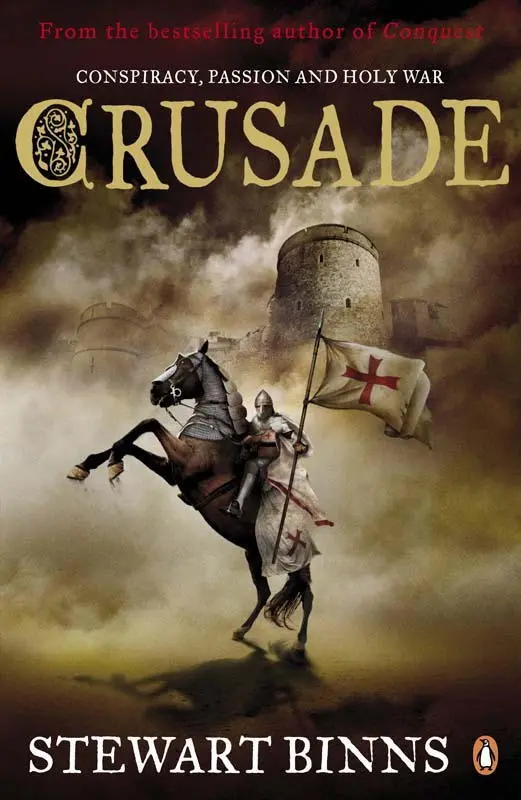
- Название:Crusade
- Автор:
- Издательство:Penguin Books
- Жанр:
- Год:2012
- Город:London
- ISBN:978-0-241-95758-5
- Рейтинг книги:3 / 5. Голосов: 1
-
Избранное:Добавить в избранное
- Отзывы:
-
Ваша оценка:
Crusade: краткое содержание, описание и аннотация
Предлагаем к чтению аннотацию, описание, краткое содержание или предисловие (зависит от того, что написал сам автор книги «Crusade»). Если вы не нашли необходимую информацию о книге — напишите в комментариях, мы постараемся отыскать её.
In the face of chaos and death, Edgar and his allies form a secret brotherhood, pledging to fight for justice and freedom wherever they are denied. But soon they are called to fight for an even greater cause: the plight of the Holy Land. Embarking on the epic First Crusade to recapture Jerusalem, together they will participate in some of the cruellest battles the world has ever known, the savage Siege of Antioch and the brutal Fall of Jerusalem, and together they will fight to the death.
Crusade — читать онлайн бесплатно полную книгу (весь текст) целиком
Ниже представлен текст книги, разбитый по страницам. Система сохранения места последней прочитанной страницы, позволяет с удобством читать онлайн бесплатно книгу «Crusade», без необходимости каждый раз заново искать на чём Вы остановились. Поставьте закладку, и сможете в любой момент перейти на страницу, на которой закончили чтение.
Интервал:
Закладка:
I took it as a mark of our friendship that Estrith was able to speak frankly to me.
‘It came as a bit of a shock to hear the Count denouncing the English from his bedchamber; we were in the next chamber, and Bertrand was terrified of him. He had to smuggle me out before his father discovered us. I heard all the details from Adela this morning. He’s a dangerous man.’
‘So, now you’ve bedded a Count; the social standing of your conquests is improving.’
‘As I feared, you don’t approve. You know I can’t resist a sturdily constructed roof – and Bertrand’s a well-put-together structure with strong timbers and a king-post that bears a good load under stress.’
Estrith’s frank architectural analogy made me smile, but I was concerned about her.
‘Estrith, be serious… it’s not that I don’t approve, but I don’t want you to come to any harm. You’ve only just met Bertrand – he could be as dangerous as his father, who’s not only mad, he’s also delusional.’
‘I’m sorry, Edgar, we’ve always been honest with one another. You’re right. It was a bit foolish, but he’s a handsome young brute and… we had had too much wine. In my heart, I cannot believe what we did was wrong. But thank you, I will be more careful.’
I was still concerned about Estrith’s evident fondness for Bertrand; the father’s behaviour made me very wary of the son. Besides which, deep down, I was a little jealous of the young man.
By the time we returned to Normandy, the winter of 1094 beckoned and we decided to stay in Rouen until early the next year. It was a frustrating time for all of us. Although we were privileged to be under the benign eye of Duke Robert, none of us was any nearer to discovering our destiny.
Edwin became older and wiser, Sweyn and Adela honed their fighting skills relentlessly, to the point where it did not seem possible for them to get any better, and I continued to admire Estrith from afar.
Sweyn’s latest accolade was to become the victor ludo-rum in Rouen’s annual test of knightly skills and be all but unbeatable in the joust, while Adela persuaded more and more men to adopt the Mos Militum – so much so that it started to be called ‘Adela’s Code’.
Meanwhile, I was fascinated by Estrith’s new project. She had been sketching it for days and her outline was immediately recognizable, even to a layman, as the timber frame for the roof of a large building. She showed it to me with the glee of a child with a new toy.
‘It’s a cat’s cradle in wood in three ascending layers, closing at the apex, with the whole structure supported by the twenty-four “feet” made of timber. At each of the two tiers above the bottom level there are also twenty-four smaller feet, each one throwing the structure further into the void.’
Estrith explained that not only was the geometry of the roof vital, the precise construction of the joints was also essential to the strength of the structure.
‘It is not just a matter of mortising and tenoning them, it is a matter of the angle at which you cut them! The twenty-four supports, twelve on each side, act like the head of a mason’s hammer, pulling the weight downwards through the wall rather than outwards against it. They are the key to a more elegant roof and much higher walls. I’ve decided to call them “hammer beams”, each of which will sit on a stone corbel projecting from the top of the wall of the building. The roof won’t need any other support.’
I could see the main point: the twelve feet on either side of the structure did not have cross-beams connecting them to the twelve feet on the other side – a feature of all rectangular roofs I had ever seen. As far as I knew, only domed roofs could be constructed without connecting beams, so I remained sceptical.
‘How can it work? How will it take the weight of the laths for the thatch, and the thatch itself?’
‘Oh no, this is not for a thatched roof – it is for a lead or tiled roof, or even a stone one.’
‘Surely not, it will collapse under the weight.’
‘It will not!’
Estrith was furious that I should doubt her.
‘I have been careful in my calculations; it is simply a matter of arithmetic. I now need someone to build one. To prove it to you!’
After much debate through the spring of 1095, we had decided to return to Sicily. Count Roger had asked Robert for help to launch a campaign to add Malta to his fiefdom, and we all relished the thought of returning to the Mediterranean and renewing our friendship with him.
However, events elsewhere were destined to take us in another direction.
For months, much of the idle talk among knights had been dominated by Raymond of Toulouse’s calls for an end to Muslim rule in the Holy Land. Then, in March of 1095, Pope Urban II, a clever and ambitious pontiff, was holding an ecclesiastical council in Piacenza in northern Italy when a lightning bolt struck from out of the blue.
The Emperor of Byzantium, Alexius I, sent an emissary to the Pope asking for help in his fight against the Turks, his troublesome neighbours in Anatolia. Although the Turks were far from being the lords of Jerusalem, they were Muslims; Raymond of Toulouse and many others used this to promote a wave of anti-Islamic sentiment. The Pope replied with a call to arms, asking Christians everywhere to promise, by taking an oath, ‘to aid the Emperor most faithfully against the pagans’.
What started as a typical request for military support to overcome an opponent, issued by the leader of one version of Christianity to another, escalated like wildfire. Oaths were taken everywhere, and thousands enlisted to become ‘Soldiers of Christ’ – young and old, men and women, clerics and laypeople, soldiers and civilians.
With Raymond and Bertrand urging him on, the Pope, having unleashed the beast, tried to harness its power, but it was already too potent for any one man to control. Many men of violence convinced themselves that they could be redeemed by more acts of violence, but this time perpetrated against those who defiled God. Even poor people thought that salvation would follow from joining the cause to cleanse the Sacred Places.
We kept our counsel, not wanting to commit to a campaign that seemed dubious at best, while realizing that a major test for all of us was unfolding.
In November 1095, we travelled to Clermont in the Auvergne to hear the Pope address the great and good of Normandy, France and Aquitaine. His speech added fuel to the bellicose mood of an audience that already had the fire of vengeance in its belly.
‘Your brethren who live in the East are in urgent need of your help, and you must hasten to give them the aid which has often been promised them. For, as most of you have heard, the Turks and Arabs have attacked them. They have occupied more and more of the lands belonging to those Christians; they have killed and captured many, and have destroyed their churches and devastated their empire. On this account I, in the name of the Lord, beseech you as Christ’s heralds to publish this everywhere and to persuade all people of whatever rank – foot soldiers and knights, poor and rich – to carry aid promptly to those Christians and to destroy that vile race from the lands of our friends.’
He went on to describe in appalling detail the atrocities committed by the Turks and Arabs against Christians – rape, murder, torture, mutilations – such that by the time he had finished even noble archbishops were baying for blood. The Pope called for an ‘armed pilgrimage’ a ‘crusade’ to ‘free Christians from the brutal oppression of heathens’.
The holy war that Themistius had predicted had begun.
By the time we returned to Rouen, the five of us had made a decision about our future.
Читать дальшеИнтервал:
Закладка:
Похожие книги на «Crusade»
Представляем Вашему вниманию похожие книги на «Crusade» списком для выбора. Мы отобрали схожую по названию и смыслу литературу в надежде предоставить читателям больше вариантов отыскать новые, интересные, ещё непрочитанные произведения.





Обсуждение, отзывы о книге «Crusade» и просто собственные мнения читателей. Оставьте ваши комментарии, напишите, что Вы думаете о произведении, его смысле или главных героях. Укажите что конкретно понравилось, а что нет, и почему Вы так считаете.