Stewart Binns - Crusade
Здесь есть возможность читать онлайн «Stewart Binns - Crusade» весь текст электронной книги совершенно бесплатно (целиком полную версию без сокращений). В некоторых случаях можно слушать аудио, скачать через торрент в формате fb2 и присутствует краткое содержание. Город: London, Год выпуска: 2012, ISBN: 2012, Издательство: Penguin Books, Жанр: Историческая проза, на английском языке. Описание произведения, (предисловие) а так же отзывы посетителей доступны на портале библиотеки ЛибКат.
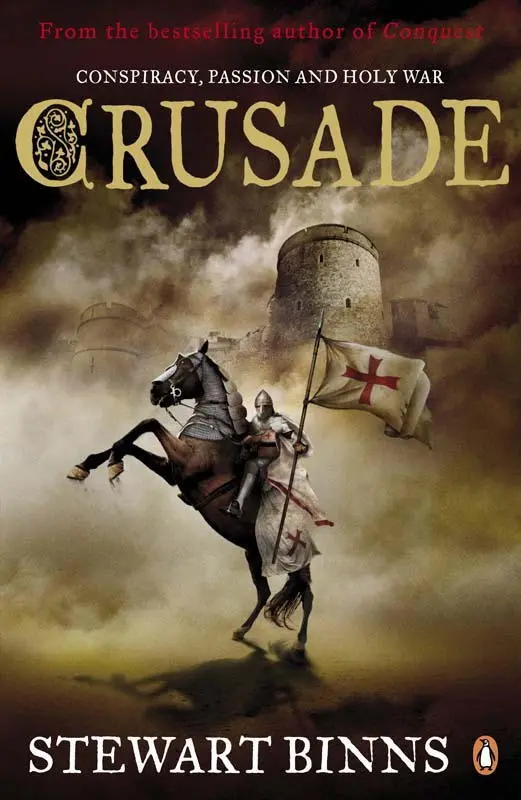
- Название:Crusade
- Автор:
- Издательство:Penguin Books
- Жанр:
- Год:2012
- Город:London
- ISBN:978-0-241-95758-5
- Рейтинг книги:3 / 5. Голосов: 1
-
Избранное:Добавить в избранное
- Отзывы:
-
Ваша оценка:
Crusade: краткое содержание, описание и аннотация
Предлагаем к чтению аннотацию, описание, краткое содержание или предисловие (зависит от того, что написал сам автор книги «Crusade»). Если вы не нашли необходимую информацию о книге — напишите в комментариях, мы постараемся отыскать её.
In the face of chaos and death, Edgar and his allies form a secret brotherhood, pledging to fight for justice and freedom wherever they are denied. But soon they are called to fight for an even greater cause: the plight of the Holy Land. Embarking on the epic First Crusade to recapture Jerusalem, together they will participate in some of the cruellest battles the world has ever known, the savage Siege of Antioch and the brutal Fall of Jerusalem, and together they will fight to the death.
Crusade — читать онлайн бесплатно полную книгу (весь текст) целиком
Ниже представлен текст книги, разбитый по страницам. Система сохранения места последней прочитанной страницы, позволяет с удобством читать онлайн бесплатно книгу «Crusade», без необходимости каждый раз заново искать на чём Вы остановились. Поставьте закладку, и сможете в любой момент перейти на страницу, на которой закончили чтение.
Интервал:
Закладка:
At first light the next morning, we began the gruesome task of burying the dead.
Estrith conducted a short service and recited the Twenty-third Psalm:
‘The Lord is my shepherd; I shall not want.
He makes me lie down in green pastures,
He leads me beside still waters,
He restores my soul.
He guides me in paths of righteousness for his name’s sake…’
She ended with the comforting lines:
‘Surely goodness and mercy will follow me
All the days of my life,
And I will dwell in the house of the Lord for ever.’
She then added a few words of her own.
‘Dearest Ingigerd and Maria, may you rest in peace. Those of us who remain will continue to live our lives as we always have, in the noble tradition of Hereward and Torfida and all their brave companions.’
After an hour or so of quiet reflection, we then went into the forest to retrieve the family chest and the deeds to the land. It was where Ingigerd had said it would be, two feet below the ground in the middle of a pretty glade which, in years to come, would be shaded by the two fine oaks planted in memory of Hereward and Torfida.
Edwin opened the heavy chest and took out the deeds. Beneath them was a surprisingly deep layer of silver coin. There were Frankish sous and deniers, German marks, English and Norman shillings, a few pieces struck with Muslim inscriptions and even some with images of Byzantine emperors – all in all, it must have added up to several pounds of silver.
‘Edwin, that’s a lot of silver.’
‘Ingigerd and Maria were very frugal, and the estate made a good profit. But there’s also money in there from Hereward and Torfida’s day. They hardly ever spent anything on themselves. A quarter part of it now belongs to you, Estrith.’
‘Nuns are not allowed to have any money.’
In response to Estrith’s words, Adela initiated a general discussion about our future.
‘What are we going to do with St Cirq Lapopie? There is no one left to work the land, and everything else has gone.’
Sweyn offered a solution.
‘Let’s sell the land to the merchants of Toulouse; they are always looking for sound investments. It is still productive and, with a few families to work it, could soon be a thriving community again. We could make it a stipulation of the sale that we retain the small plot where Mahnoor and the others are buried. We could then add the money from the sale, extract what we need to live on for a while, and deposit the balance with one of the Jewish or Lombardian moneylenders.’
The others nodded their approval, and I threw in my lot with them.
‘I have a few pounds of silver. I will add my coin to the deposit and we will all be partners in the investment. Edwin can be our chancellor and hold our purse; he is very careful with money. Agreed?’
Everyone agreed in a chorus, and there were embraces all round before we mounted our horses to leave St Cirq Lapopie for what we assumed was the last time.
Edwin, ever watchful of disciplines and routines, reminded us that even accounting for Duke Robert’s slower progress, he was likely to be close to St Cirq Lapopie. We looked forward to his company on our journey back down the Lot to Cahors, although none of us relished imparting our grim news.
Adela took a short detour via Old Simon’s shelter to leave a small purse of silver for him. I doubted that he had ever had the need for money, but it was a kind thought all the same.
Although I had spent only a day and a night in the home that Hereward’s family had made their own, I felt I belonged to it – as if it was now part of my heritage and my legacy.
23. Soldiers of Christ
We met Duke Robert and his retinue downstream only about an hour after our departure. When we told him what we had found at St Cirq Lapopie, he reported back to us on the discoveries his scouts had made regarding how widespread the epidemic was. People were stricken all the way to Bordeaux in the west, where thousands had died, and the fever had reached Angoulême in the north. But it had not spread as far as Toulouse in the east, which Robert ordered should be our next destination.
Everyone’s mood was sombre. Robert had issued strict commands that no contact be made with any of the local people; there was to be no hunting, no food was to be purchased and no water to be taken from wells. A combination of the meagre diet and the fear of a slow and painful death cast a pall over everybody.
When we reached the River Tarn at Montauban, we found that the Count of Toulouse had been able to contain the epidemic by closing all the bridges across the river. He had issued the same order for the Garonne beyond Moissac, using the two wide waterways to create a physical barrier all the way from the Central Massif to the sea. Crossing over either river was on pain of instant execution. It was an astute public ordinance, but presented us with the inconvenience that we were also denied entry to the County of Toulouse.
When we tried to cross the ancient wooden bridge, the Count’s men, to their credit, remained steadfast in denying us, even though they were commanded to let us pass by a sovereign duke. Sadly, a brief skirmish was the only way to get them to relent, during which several of the Count’s men were killed, as well as two of Robert’s hearthtroop.
Sweyn played a significant role in the skirmish by using his prowess as a horseman to gallop across the bridge and leap the makeshift barricade on the southerly side. It was a dangerous manoeuvre; he was an easy target for the several archers who unleashed their arrows at him, two of which struck his shield while one glanced off the lamellar mail protecting his horse’s chest. He then turned and used his lance to stunning effect, impaling one of the sentries and creating a major diversion which allowed more of Robert’s men to storm the barricade. With Edwin at her side, Adela was in the thick of the supporting assault, hacking her way over the barrier in harmony with the best of Robert’s knights.
When we reached Toulouse, Count Raymond rode out to intercept us, less than pleased that we had breached his cordon sanitaire against the putrid fever. He was at the head of a body of men at least 500 strong.
When our two parties had approached within ten yards of one another, he halted his advance and bellowed a warning.
‘I am Raymond St Gilles, Count of Toulouse, Duke of Narbonne and Margrave of Provence. You are not welcome here. Our land is under dire threat from an epidemic of a deadly fever. I order you to turn round and go back north of the Tarn at Montauban.’
Robert shifted slightly in his saddle, clearly annoyed at such an inhospitable reception, but he chose not to respond in kind – and, specifically, not to recite his many lordly titles.
‘My Lord Count, I am Robert of Normandy. I am here with Prince Edgar of the royal house of Wessex and England. I am afraid we had no choice but to breach your cordon at Montauban. Your men did you great service, but we had to force the issue.’
‘I know who you are. In all other circumstances my welcome would be fulsome and my table yours, but you have travelled through the heart of the plague and I cannot permit you to enter Toulouse.’
Robert, resigned to the impasse, sat back in his saddle. In his way stood a large body of men with a leader who, by the look of him, was not often bested.
‘Very well, I understand your concerns. No one in our camp is ill; nevertheless, we will retreat into the forest and forage there for two weeks. If, at the end of that time, we remain clear of the fever, I will petition you once more to enter your city.’
Raymond of Toulouse was disarmed by Robert’s diplomatic compromise.
Читать дальшеИнтервал:
Закладка:
Похожие книги на «Crusade»
Представляем Вашему вниманию похожие книги на «Crusade» списком для выбора. Мы отобрали схожую по названию и смыслу литературу в надежде предоставить читателям больше вариантов отыскать новые, интересные, ещё непрочитанные произведения.








Обсуждение, отзывы о книге «Crusade» и просто собственные мнения читателей. Оставьте ваши комментарии, напишите, что Вы думаете о произведении, его смысле или главных героях. Укажите что конкретно понравилось, а что нет, и почему Вы так считаете.