Stewart Binns - Crusade
Здесь есть возможность читать онлайн «Stewart Binns - Crusade» весь текст электронной книги совершенно бесплатно (целиком полную версию без сокращений). В некоторых случаях можно слушать аудио, скачать через торрент в формате fb2 и присутствует краткое содержание. Город: London, Год выпуска: 2012, ISBN: 2012, Издательство: Penguin Books, Жанр: Историческая проза, на английском языке. Описание произведения, (предисловие) а так же отзывы посетителей доступны на портале библиотеки ЛибКат.
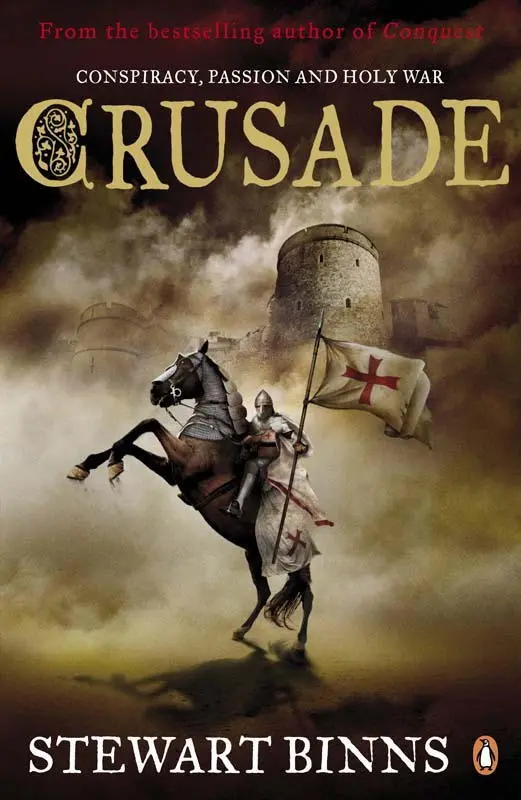
- Название:Crusade
- Автор:
- Издательство:Penguin Books
- Жанр:
- Год:2012
- Город:London
- ISBN:978-0-241-95758-5
- Рейтинг книги:3 / 5. Голосов: 1
-
Избранное:Добавить в избранное
- Отзывы:
-
Ваша оценка:
Crusade: краткое содержание, описание и аннотация
Предлагаем к чтению аннотацию, описание, краткое содержание или предисловие (зависит от того, что написал сам автор книги «Crusade»). Если вы не нашли необходимую информацию о книге — напишите в комментариях, мы постараемся отыскать её.
In the face of chaos and death, Edgar and his allies form a secret brotherhood, pledging to fight for justice and freedom wherever they are denied. But soon they are called to fight for an even greater cause: the plight of the Holy Land. Embarking on the epic First Crusade to recapture Jerusalem, together they will participate in some of the cruellest battles the world has ever known, the savage Siege of Antioch and the brutal Fall of Jerusalem, and together they will fight to the death.
Crusade — читать онлайн бесплатно полную книгу (весь текст) целиком
Ниже представлен текст книги, разбитый по страницам. Система сохранения места последней прочитанной страницы, позволяет с удобством читать онлайн бесплатно книгу «Crusade», без необходимости каждый раз заново искать на чём Вы остановились. Поставьте закладку, и сможете в любой момент перейти на страницу, на которой закончили чтение.
Интервал:
Закладка:
Robert was not offended, nor did he pull away. He placed his hand over hers, and the son of England’s conqueror and the daughter of his nemesis embraced. It was as if they were playing out the final act in the drama that was Ely. Tears ran down Estrith’s cheeks and Adela put her hand to her face to hold back her sobs; all of us had tears in our eyes and lumps in our throats.
Robert took a deep breath and, with a fidget of mild embarrassment, changed the subject.
‘What are your plans?’
‘Estrith would like to go south to St Cirq Lapopie. She hasn’t seen her surrogate aunts, Ingigerd and Maria, in over twenty years.’
‘Do you think I could come with you?’
Robert’s response was like a bolt from the blue, leaving all of us shocked – not unpleasantly so, but certainly surprised that a sovereign duke would want to travel with a small and insignificant band such as ours.
‘But what about your dukedom and your quarrelsome brothers?’
‘Normandy more or less runs itself these days, and I’ve got the powerful barons nicely balanced in a kind of harmony, which they accept through gritted teeth. Most of them dislike Odo so much, they are mainly preoccupied with keeping him at bay. As for my brothers, Rufus needs Henry if he’s to be strong enough to unseat me in Rouen, but Henry is content building his strength in the Cotentin. He may ultimately have eyes for Normandy, but he’ll want England first, so Rufus is the one in his way, not me – at least, not yet.’
We all looked at one another and nodded our approval and, as head of the St Cirq Lapopie household, Edwin made the formal response.
‘My Lord, it would be our honour to receive you at our humble home on the Lot. But, sire, it is only a modest farmhouse.’
‘That is of no consequence, I will bring only a small retinue and we will make camp in your fields. Perhaps I’ll go and see that firebrand Raymond of Toulouse, who has been causing turmoil among the knights of Europe with his campaign to free the Holy Land from Islam.’
While Duke Robert made his plans to join us on our journey, we brooded on the news about Raymond of Toulouse’s cause.
We all thought back to the words of Themistius, the Thracian strategoi we had listened to in Sicily, when he talked about a looming holy war between Christians and Muslims. It was a worrying prospect for all of us and particularly unedifying for Sweyn, who had fallen in love with a Muslim girl only for her to be slaughtered by a fanatical father. The fact that we were about to depart for St Cirq Lapopie, the site of her grave, only added to his dismay.
That night, over dinner, he made his feelings clear.
‘I would like to visit the Holy Land, but I don’t want to fight the Muslims; some of them are brother knights and began our code of chivalry, the Mos Militum.’
Adela was also troubled.
‘As far as I know, the Muslim lords of the Holy Land allow pilgrims to visit the sacred sites freely and permit freedom of worship for Christians and Jews. Why would we want to fight them?’
Edwin, as always, was happy to do what Sweyn and Adela wanted to do, and his view was measured and wise.
‘I have no quarrel with the Muslims. We were well treated by Ibn Hamed and his knights, and I have great respect for their culture and learning. To provoke a holy war, just because the lords of the Holy Places are Muslims, is dangerous talk. Isn’t the Holy Land sacred to Muslims too?’
I was also concerned, but tried to allay their fears.
‘Let’s make the journey to St Cirq Lapopie – and, if Duke Robert wants to go and see the Count of Toulouse, then we’ll hear from the horse’s mouth what his campaign is trying to achieve.’
The journey south was as enjoyable as ever. It was the height of spring and nature was at her most fecund. We travelled well; Duke Robert was not only good company, he brought a small retinue of soldiers and a vast corps of cooks, stewards and butlers with enough provisions to feed a glut of dukes. We progressed like the grand entourage of a Byzantine emperor with all the trappings of a papal convoy.
The huntsmen went out every day to kill fresh meat, and the stewards bought local vegetables along the way. The butts of wine never seemed to empty, no matter how hard we tried to drain them, and the minstrels sang us to sleep every night.
It was on one such typically blissful evening that we discovered that Estrith had the most stunning singing voice. Duke Robert was spellbound.
‘Where did you learn to sing?’
‘My father’s oldest companion was Martin Lightfoot, a man from the land of the Welsh princes. He had a fine voice and would sing to us all the time. He taught me the songs of his homeland and how to sing lullabies. During my novitiate, I learned plainchant and the music of the mass.’
‘You have a beautiful voice.’
‘Thank you, my Lord.’
Every night thereafter, at Robert’s insistence, Estrith became the highlight of the post-prandial entertainment; she always sang unaccompanied and brought a heavenly calm to the entire camp. Even the cooks and stewards stopped what they were doing and sat on the ground to listen. Her songs about the delights of young love and the chivalrous deeds of heroes brought moments of dewy-eyed reflection to even the most redoubtable of Robert’s soldiers. Only the sentries on watch kept their backs to her, but they smiled to themselves as they stood sentinel.
My thoughts during those precious moments were always of Hereward and Torfida. Their lives were the perfect inspiration for a songwriter, and I felt sure that in the villages of England, far away from Norman ears, songs were being sung that very night about the noble deeds of Hereward of Bourne and his beguiling bride, Torfida of the Wildwood.
Robert’s fascination for Estrith was all too obvious to everyone – but, like most besotted men, he was sure his feelings had gone unnoticed. At the end of one of her most charming performances, he confided in me.
‘Edgar, I want to tell you something in confidence.’
‘Of course, I shall be the soul of discretion.’
‘I am very fond of Estrith.’
‘We all are; she is wonderful.’
‘No, I mean, I’m very fond of her! I have been ever since you introduced her to me in Rouen.’
I decided to stop teasing him.
‘Yes, I know.’
‘How do you know?’
‘Well, the clues are well hidden, of course, but there are some small hints: hanging on her every word; staring at her like a lovesick boy; beaming at her with your head tilted to one side like an imbecile whenever she appears; and generally following her around like an unweaned pup would follow its mother… And these are just some of the less noticeable ones!’
‘Oh… is it that bad?’
‘Yes, I’m afraid it is.’
‘I make no excuses; I can’t get her out of my mind.’
‘Robert, she’s a nun.’
‘I know, but will you speak to her for me?’
‘No, I will not, she’s a nun and that’s all there is to it.’
‘But she only became a nun so that she could be accepted by the masons.’
‘I’m sure there’s more to it than that.’
‘Please speak to her for me. If she’s a committed bride of Christ, then so be it, but I have a feeling she isn’t… I can hear it in her voice.’
‘The answer is still no.’
‘I can’t sleep at night!’
‘Robert, you’re the Duke of Normandy and she’s a nun. You could be excommunicated!’
Robert was in no mood to listen to my objections, and continued to press his cause.
‘Just ask her about her feelings for me! That’s what friends are for.’
I tried to think of a way to distract him from his feelings for Estrith,
‘Look, when we get to Cahors, we’ll spend a few days whoring. They’ve got dusky beauties from the south there, and big, blonde, Germans – you can fill several beds with a selection of them.’
Читать дальшеИнтервал:
Закладка:
Похожие книги на «Crusade»
Представляем Вашему вниманию похожие книги на «Crusade» списком для выбора. Мы отобрали схожую по названию и смыслу литературу в надежде предоставить читателям больше вариантов отыскать новые, интересные, ещё непрочитанные произведения.










Обсуждение, отзывы о книге «Crusade» и просто собственные мнения читателей. Оставьте ваши комментарии, напишите, что Вы думаете о произведении, его смысле или главных героях. Укажите что конкретно понравилось, а что нет, и почему Вы так считаете.