Stewart Binns - Crusade
Здесь есть возможность читать онлайн «Stewart Binns - Crusade» весь текст электронной книги совершенно бесплатно (целиком полную версию без сокращений). В некоторых случаях можно слушать аудио, скачать через торрент в формате fb2 и присутствует краткое содержание. Город: London, Год выпуска: 2012, ISBN: 2012, Издательство: Penguin Books, Жанр: Историческая проза, на английском языке. Описание произведения, (предисловие) а так же отзывы посетителей доступны на портале библиотеки ЛибКат.
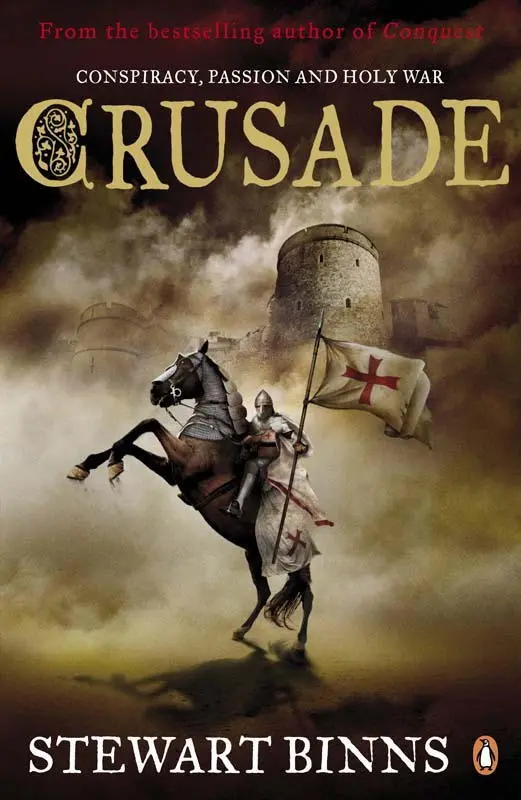
- Название:Crusade
- Автор:
- Издательство:Penguin Books
- Жанр:
- Год:2012
- Город:London
- ISBN:978-0-241-95758-5
- Рейтинг книги:3 / 5. Голосов: 1
-
Избранное:Добавить в избранное
- Отзывы:
-
Ваша оценка:
Crusade: краткое содержание, описание и аннотация
Предлагаем к чтению аннотацию, описание, краткое содержание или предисловие (зависит от того, что написал сам автор книги «Crusade»). Если вы не нашли необходимую информацию о книге — напишите в комментариях, мы постараемся отыскать её.
In the face of chaos and death, Edgar and his allies form a secret brotherhood, pledging to fight for justice and freedom wherever they are denied. But soon they are called to fight for an even greater cause: the plight of the Holy Land. Embarking on the epic First Crusade to recapture Jerusalem, together they will participate in some of the cruellest battles the world has ever known, the savage Siege of Antioch and the brutal Fall of Jerusalem, and together they will fight to the death.
Crusade — читать онлайн бесплатно полную книгу (весь текст) целиком
Ниже представлен текст книги, разбитый по страницам. Система сохранения места последней прочитанной страницы, позволяет с удобством читать онлайн бесплатно книгу «Crusade», без необходимости каждый раз заново искать на чём Вы остановились. Поставьте закладку, и сможете в любой момент перейти на страницу, на которой закончили чтение.
Интервал:
Закладка:
‘The English earls will support whoever is made King of England; they are my father’s men. The Norman bishops and counts will support William’s choice as Duke of Normandy; they are loyal Normans and, mostly, less ambitious than those who went to England.’
‘And what about your support? Who can you count on?’
‘My friends only – no political allies – but they are a powerful bunch; most of them are the sons of my father’s biggest supporters.’
Robert had revealed his naivety. In saying he counted on his friends, not on political allies, he had exposed his lack of tactical cunning – not a sin for any man but, in the position he was in, it was innocent at best, gullible at worst.
In early September 1087, William’s demise appeared imminent. His pain had not subsided, and his bouts of consciousness were shorter and less frequent. He summoned his entire family and senior acolytes to his bedchamber and proceeded to announce his Verba Novissima.
To his relief, Robert was granted the Duchy of Normandy. But, to his horror, the Kingdom of England was bestowed on William Rufus. His father did not give reasons – he did not have to. He had left his legacy, and that was the end of it. Henry Beauclerc, the youngest of the three siblings, was granted no titles but the sum of 5,000 pounds of silver, enough money to make him one of the richest men in Europe and thus very dangerous.
William Rufus grabbed the parchments attesting his kingship of England and struck north for the Channel within an hour of his father stamping his seal on them. He was at Canterbury within three days, ready to have his sovereignty confirmed by Lanfranc, the Archbishop of all England.
Henry summoned his father’s chancellor immediately, so that preparations could begin for the extraction of the 5,000 pounds of sterling for his windfall. So vast was Henry’s inheritance that the carts lined up outside the treasuries at Rouen and Caen resembled the caravan of wagons used to carry the legendary dowries of Babylonian princesses.
Robert immediately travelled to see King Philip at Melun. Now that he was to be confirmed as Duke of Normandy, he was keen to heal whatever rift had been created by his father’s brutal behaviour at Mantes.
The result of the rapid departure of the three sons was to prove disastrous. The old King died suddenly, early on the morning of the 9th of September 1087. Before his death, he ordered that all his political prisoners be released and begged forgiveness for his many excesses. He apparently hesitated about the release of his half-brother, Odo, but then relented. Morcar, the former Earl of Northumbria and survivor of Ely, was released – but, sadly, Rufus immediately ordered his re-arrest. William’s regalia was sent to his parish church and his cloak to the foundation he had established at Senlac Ridge.
Chaos soon reigned in Rouen; rumours spread that the three sons had gone to raise armies and that Normandy was about to descend into civil war. All the nobles and bishops at William’s deathbed dispersed to their homes to secure them against the expected mayhem, leaving the King alone. His chamber and body were plundered by servants and outsiders, and his corpse abandoned on the floor.
It was left to a minor local landowner from St Gervais to rescue the body and prepare it. A barge was ordered and the royal remains were floated down the Seine for burial in Caen, where more ignominy befell the greatest ruler of his era.
There were many clergy present for the funeral, but only Henry of the immediate family; neither Robert nor Rufus made the journey. Very few of his magnates were in attendance; they were too busy plotting how to maximize their position under the new regime. Would they support Rufus, be Robert’s men, or back neither and ally themselves with one of William’s many enemies?
I was given a formal invitation as a prince of the household and was able to secure positions close to the altar for the four of us.
The senior member of the family who was present, William’s aged first cousin, Abbot Nicolas of St-Ouen, son of Duke Richard III, presided over the funeral in Caen Abbey. As the Bishop of Évreux rose to give the address, a local man, Ascelin, son of Arthur of Caen, stepped forward and demanded that William not be interred in the abbey because the land it stood on had been stolen from him by the Duke many years earlier. Most of the local congregation agreed with the heckler and pandemonium ensued. Calm was restored only when Count Henry agreed to pay compensation out of the funds his father had just left him.
The incident reflected all that was true about William’s tenure. The sense of dread he embodied, which had guaranteed subservience, was only superficial – now that his presence was no more than a haunch of flesh, the aura had been dissolved. Those once cowed were emboldened to speak their mind.
Greater indignity was to follow. When the casket was brought forward for the body to be lowered into it, it was too small. With everyone turning away in embarrassment, the funeral attendants tried to force the issue by attempting to prise the King’s quart-sized frame into a pint-pot of a coffin. At this point, the bungling of the embalmers proved to have been as monumentally inept as that of the coffin-makers.
Still rotting on the inside, the bloated corpse burst open like the putrid carcass of an animal, splattering those nearby with its rancid contents. The smell was so unbearable that the abbey emptied within minutes. The only saving grace for those lowly clerics left to clear up the mess was that the suddenly deflated corpse could now be squeezed into its resting place, allowing the task to be hurriedly completed and the coffin sealed.
The era of William, Duke of Normandy, conqueror of England, was over.
Like so many others, I was not sorry to see him go. His ambitions had brought death to tens of thousands and pain and suffering to many more. He had killed the noble Harold and destroyed the mighty English army at Senlac Ridge; he had cut down the Brotherhood of St Etheldreda – the bravest of the brave – at the Siege of Ely and taken Hereward from us. In doing all of that, he had denied me the throne that would, one day, have been mine. I no longer resented that, but I did feel bitter about all the other things he had done.
Adela spoke for the others over dinner that night, a meal that was much more like a celebration than a wake.
‘A lot of people will rest easier in their beds now that he’s gone. Good riddance to the bastard!’
While I shared her sentiments about his passing, I feared that her prediction about people sleeping more comfortably in the future would prove to be wrong. William had changed all our lives for ever. I pondered how profoundly our lives would yet be changed in the lengthening shadow of his legacy.
18. The Anointing
William Rufus became William II of England in a grand ceremony in Westminster Abbey on the 26th of September 1087. He had required my attendance to kiss his ring at the appointed time, thus adding authority to his succession, and Robert was happy to give his blessing for me to travel to England with my small band of brothers-in-arms.
The saintly King Edward’s most celebrated building was crowded with the great nobles of the realm, dressed in their heraldic finery, their ladies in fine silks and jewels. Horns saluted, drums beat the rhythm of the procession and the monks chanted in homage as Rufus became King of England.
Perversely, there were not many Englishmen there; I guessed that not more than one in ten was a native of our island. I performed my role and knelt before our new lord and kissed his ring, thus anointing him on behalf of my kith and kin. It was a strange sensation, not helped by the contemptuous smirk which met my eyes as I looked up at him. I had a lingering sense of betrayal, a sin I could have redeemed there and then by plunging my seax deep into his chest. But it would have been merely a gesture, and a futile one at that; there were legions of Normans to take his place.
Читать дальшеИнтервал:
Закладка:
Похожие книги на «Crusade»
Представляем Вашему вниманию похожие книги на «Crusade» списком для выбора. Мы отобрали схожую по названию и смыслу литературу в надежде предоставить читателям больше вариантов отыскать новые, интересные, ещё непрочитанные произведения.







Обсуждение, отзывы о книге «Crusade» и просто собственные мнения читателей. Оставьте ваши комментарии, напишите, что Вы думаете о произведении, его смысле или главных героях. Укажите что конкретно понравилось, а что нет, и почему Вы так считаете.