Stewart Binns - Crusade
Здесь есть возможность читать онлайн «Stewart Binns - Crusade» весь текст электронной книги совершенно бесплатно (целиком полную версию без сокращений). В некоторых случаях можно слушать аудио, скачать через торрент в формате fb2 и присутствует краткое содержание. Город: London, Год выпуска: 2012, ISBN: 2012, Издательство: Penguin Books, Жанр: Историческая проза, на английском языке. Описание произведения, (предисловие) а так же отзывы посетителей доступны на портале библиотеки ЛибКат.
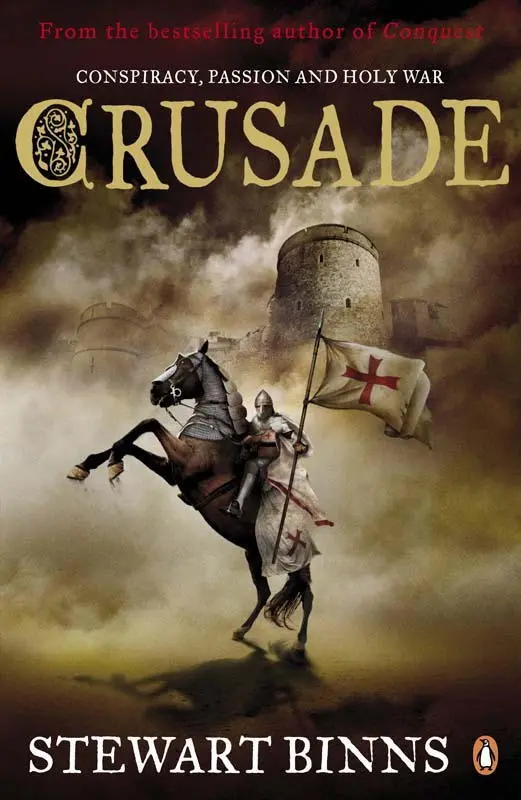
- Название:Crusade
- Автор:
- Издательство:Penguin Books
- Жанр:
- Год:2012
- Город:London
- ISBN:978-0-241-95758-5
- Рейтинг книги:3 / 5. Голосов: 1
-
Избранное:Добавить в избранное
- Отзывы:
-
Ваша оценка:
Crusade: краткое содержание, описание и аннотация
Предлагаем к чтению аннотацию, описание, краткое содержание или предисловие (зависит от того, что написал сам автор книги «Crusade»). Если вы не нашли необходимую информацию о книге — напишите в комментариях, мы постараемся отыскать её.
In the face of chaos and death, Edgar and his allies form a secret brotherhood, pledging to fight for justice and freedom wherever they are denied. But soon they are called to fight for an even greater cause: the plight of the Holy Land. Embarking on the epic First Crusade to recapture Jerusalem, together they will participate in some of the cruellest battles the world has ever known, the savage Siege of Antioch and the brutal Fall of Jerusalem, and together they will fight to the death.
Crusade — читать онлайн бесплатно полную книгу (весь текст) целиком
Ниже представлен текст книги, разбитый по страницам. Система сохранения места последней прочитанной страницы, позволяет с удобством читать онлайн бесплатно книгу «Crusade», без необходимости каждый раз заново искать на чём Вы остановились. Поставьте закладку, и сможете в любой момент перейти на страницу, на которой закончили чтение.
Интервал:
Закладка:
In the burning of the town, two revered anchorites who had chosen Mantes for their devout seclusion had been burned alive. To salve his conscience, William had granted a large sum to the church and Robert had generously added to it in order to pay for the building of a new cathedral to replace the chapel that had been burned to the ground in the sacking of the town.
‘Do you like my new regalia?’
‘It’s very impressive.’
‘It’s all new and very expensive. I’ve got rid of that ridiculous baculus my father used to carry around and locked it away in the treasury; the damn thing used to terrify me.’
I told Robert about Odo’s plan and its conditions.
‘That’s typical of him. Rufus should never have freed him. He thinks I’m more pliant than Rufus and that, if I rule from here, I’ll be King in name only and he’ll be able to do as he pleases.’
‘His ambition is the papacy, so he’ll want Canterbury first, then your support for a bid to be Pope.’
‘He’s very cunning. By appearing to promote me as King, he also hopes to gain favour with Philip, who would be vital to his papal campaign.’
‘So, what will you do?’
‘What do you think his chances are of unseating Rufus?’
‘He’s got the backing of most of the old guard, but the younger men don’t like him and neither do the English. He can raise a strong force from the elite Norman garrisons but, strange as it may seem, most of the younger nobles have Englishmen in their service and they will fight for Rufus, who they accept as their King, rather than Odo, who they remember as William’s senior henchman during the Conquest. It will be a close call. Odo’s not a soldier – he’s a bishop, albeit an ambitious one. He may overplay his hand.’
‘That’s good advice. I don’t want to raise an army and secure victory for Odo so that he can make me a puppet king. I think I’ll stay in Rouen. If I go to England, I’ll become a co-conspirator. That will be unforgivable in Rufus’s eyes. Normandy is enough of a realm for me at the moment. Let’s see how Odo’s rebellion unfolds.’
‘Fine, but what exactly should I tell him?’
‘You’ll think of something, my friend. You’re good at that.’
‘Then may I make a suggestion?’
‘You may – any clever ideas are welcome.’
‘It is important that you appear to be lending support without actually committing yourself in person. If I report back that you wish Odo every success and that you will be sending some men to join the cause, Edwin, Adela and Sweyn could bring them on later, making sure that their progress was appropriately unhurried.’
‘A cunning plan, Edgar. And who would lead this squadron?’
‘Well, discretion is vital under the circumstances, so I would suggest that Edwin leads it, and Sweyn and Adela act as his aides-de-camp.’
Robert seemed amused.
‘I suppose that means a promotion and extra pay for the three of them into the bargain?’
‘Yes.’
‘Agreed. But make sure they deserve it!’
I was sure they would be pleased – especially Sweyn, who had not used his prodigious skills in combat since Mahnoor’s death.
‘I will return to England tonight. I will need some messengers – so that I can send word to Edwin about the timing of the arrival of your men.’
‘Very well, I will send eight conroi, half my personal squadron; they will be ready in two days. I will also send some Flemish infantry – they’re always keen to fight if the price is right – and four companies of archers. Edwin will be Squadron Commander; Sweyn and Adela will be your aides, with a troop of my own knights led by Hugh Percy and Ralph of Mortemer. I can’t have the entire force led by the English!’
I returned to Rochester to give Odo Duke Robert’s answer.
Again, Odo’s ominous circle of supporters stood around him like bodyguards. This time, the setting was his great hall, high in the keep of Rochester’s imposing motte and bailey, not a tiny barn in the countryside. The setting made the gathering much more imposing. It was obvious that these men meant business.
Odo’s planned rebellion was not just an idle conspiracy; he meant to seize the throne.
As soon as I told him of Robert’s support, Odo ordered his forces to launch the attack, but he was not pleased that the Duke had decided to stay in Normandy and that he was only prepared to commit a small force.
‘I suppose he’s trying to be a clever bugger and having it both ways, leaving it to me to present him with a kingdom.’
‘It is nearly 1,000 men, including the finest from his personal squadron.’
‘Don’t try to deceive me; I know exactly what his game is.’
‘I think you both understand one another’s tactics. The field is yours; Duke Robert lends his support.’
‘I was told you were clever with words. I know the field is mine. But as you know only too well, kingdoms are won by men who are prepared to fight for them, not by sitting back and waiting to see how the tide is turning.’
‘My Lord Bishop, Robert will throw himself into the fray when the time is right. If he came here with a large army and took the throne, he would, understandably, want to rule both England and Normandy from here, something I think you would prefer not to happen. You were very clear that you hoped Robert would spend most of his time in Normandy.’
I had countered Odo’s initial gambit, and he knew it. He did not want Robert in England, interfering with his plans to be England’s sub-regulus and to use it as his stepping stone to the papacy.
‘I know my nephew is not cunning enough to have thought all this through, so it must be you. You should have been a cardinal. They’re all like you – very clever and very devious.’
Odo meant his comment as a compliment, one that I was happy to accept.
I took my leave, musing on Odo’s bold words. I was sorely tempted to comment that he was about to make his bed and was going to have to lie in it.
19. Revolt at Rochester
The main centres of the uprising were in Northumbria, the south-west and in Kent and Sussex. Instigated by the rebels, raiding parties from the Welsh tribes also crossed into the Marches to loot and plunder, and Malcolm of Scotland seized the opportunity to attack in the north-west.
It was the middle of a particularly warm spring, and the country appeared prosperous and serene. The burghs were flourishing and the farmers busy in their fields. The uprising caught Rufus completely by surprise. He was hunting in the New Forest when news of the rebellion reached him, and he returned to Winchester immediately.
He summoned his council and ordered half his treasury in Winchester and a quarter of his London bullion to be made available to pay for a counter-attack.
England was soon in chaos. The Norman hierarchy was split almost down the middle; in many places, earls and bishops who supported Rufus were neighbours of those who supported Odo. Sometimes the fighting was a small local skirmish, but there were also large pitched battles involving hundreds of men.
There were many Englishmen in the service of their Norman masters and many minor English landowners whose land had not been lost to Normans; all were caught up in the fighting. The bloodshed was wholesale and affected almost every corner of the land. Families were divided; brother fought brother, and lifelong friends became mortal enemies.
My assessment of Odo as a wily and ambitious bishop, but a less competent general, proved to be accurate. Instead of using both the element of surprise and his superior numbers to press home his advantage, he dithered. The rebellion was well supported but concentrated around the strongholds of the rebels. Rather than riding out to coordinate the separate groups and take the fight to Rufus, he sat in Rochester waiting for the King to come to him. Robert of Mortain did the same in Pevensey.
Читать дальшеИнтервал:
Закладка:
Похожие книги на «Crusade»
Представляем Вашему вниманию похожие книги на «Crusade» списком для выбора. Мы отобрали схожую по названию и смыслу литературу в надежде предоставить читателям больше вариантов отыскать новые, интересные, ещё непрочитанные произведения.








Обсуждение, отзывы о книге «Crusade» и просто собственные мнения читателей. Оставьте ваши комментарии, напишите, что Вы думаете о произведении, его смысле или главных героях. Укажите что конкретно понравилось, а что нет, и почему Вы так считаете.