Stewart Binns - Crusade
Здесь есть возможность читать онлайн «Stewart Binns - Crusade» весь текст электронной книги совершенно бесплатно (целиком полную версию без сокращений). В некоторых случаях можно слушать аудио, скачать через торрент в формате fb2 и присутствует краткое содержание. Город: London, Год выпуска: 2012, ISBN: 2012, Издательство: Penguin Books, Жанр: Историческая проза, на английском языке. Описание произведения, (предисловие) а так же отзывы посетителей доступны на портале библиотеки ЛибКат.
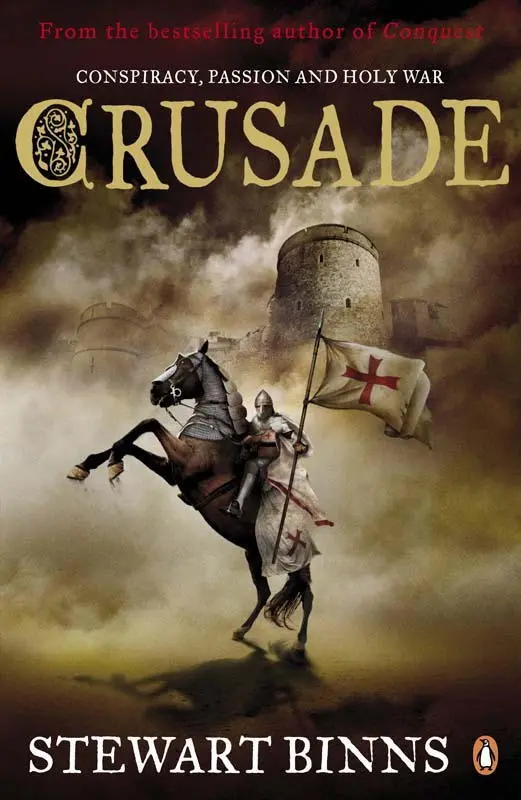
- Название:Crusade
- Автор:
- Издательство:Penguin Books
- Жанр:
- Год:2012
- Город:London
- ISBN:978-0-241-95758-5
- Рейтинг книги:3 / 5. Голосов: 1
-
Избранное:Добавить в избранное
- Отзывы:
-
Ваша оценка:
Crusade: краткое содержание, описание и аннотация
Предлагаем к чтению аннотацию, описание, краткое содержание или предисловие (зависит от того, что написал сам автор книги «Crusade»). Если вы не нашли необходимую информацию о книге — напишите в комментариях, мы постараемся отыскать её.
In the face of chaos and death, Edgar and his allies form a secret brotherhood, pledging to fight for justice and freedom wherever they are denied. But soon they are called to fight for an even greater cause: the plight of the Holy Land. Embarking on the epic First Crusade to recapture Jerusalem, together they will participate in some of the cruellest battles the world has ever known, the savage Siege of Antioch and the brutal Fall of Jerusalem, and together they will fight to the death.
Crusade — читать онлайн бесплатно полную книгу (весь текст) целиком
Ниже представлен текст книги, разбитый по страницам. Система сохранения места последней прочитанной страницы, позволяет с удобством читать онлайн бесплатно книгу «Crusade», без необходимости каждый раз заново искать на чём Вы остановились. Поставьте закладку, и сможете в любой момент перейти на страницу, на которой закончили чтение.
Интервал:
Закладка:
After his crowning, Rufus dutifully carried out his father’s wishes and distributed money to all the churches of England. He freed Bishop Odo, but had Earl Morcar re-arrested. However, he was moderately well treated in a manner befitting an earl of the realm. The people of England appeared to grudgingly accept Rufus as the legitimate heir to the throne, although resentment at the Norman lordship still ran deep.
The plots that had been hatching within the Norman hierarchy regarding the successions – both in England and in Normandy – soon began to unfold.
Odo was at the centre of it all and had recruited the powerful Robert of Mortain to the cause. By Christmas, they had been joined by Geoffrey, Bishop of Coutances, and his nephew, the Earl of Northumbria, as well as by Roger, Earl of Shrewsbury, and Count Eustace of Boulogne. By March 1088, they were strong enough to make their move.
We had returned to Rouen earlier in the year, where a messenger arrived just after Easter summoning me to Rochester to meet Odo and his co-conspirators. I told Duke Robert about the summons.
He agreed that I should go, but warned me to be extremely careful.
‘Odo is ruthless and ambitious and will do anything to further his own cause. He is not my father’s half-brother for nothing.’
‘I presume he thinks that by usurping Rufus and offering you the throne, he can become your regent in England.’
‘Exactly! He still wants the throne of Rome – and de facto rule of England from Westminster would go a long way to securing that. He would have the money and the influence to buy himself the papacy. But don’t worry, Edgar, you are just the messenger.’
‘Thank you for that reassuring crumb of comfort. I suppose I have done worse things in life.’
I decided it was wise to travel with Edwin and Adela and leave Sweyn behind, given that he had already crossed swords with Odo six years earlier when he arrested him at Rochester. We arrived at our clandestine rendezvous in Upchurch, a small settlement near the Medway, one of Odo’s many manors in Kent. With guards all around and the local peasants dismissed to their fields, we met in a small barn, hardly big enough and certainly not grand enough for the elite of the Norman aristocracy.
The Bishop was in his pomp, clearly overjoyed at playing the role of kingmaker. His entourage – big, burly men who could easily have been mistaken for housecarls had they not been wearing their fine armour and gleaming weapons – stood around him in a brooding arc that made the three of us seem like a tiny morsel about to be snapped up in the jaws of a huge beast.
Odo wasted no time in telling us of his intent.
‘Your loyalty to Duke Robert is well known. Carry this message to him. We will raise a rebellion here in England to install him as King. The only condition is that during his reign he rules from Rouen, where he will continue as Duke of Normandy. He will come here for only four crown-wearings every year – at York, Winchester, Gloucester and Westminster.’
‘My Lord Bishop, do you expect him to accept that?’
‘I expect you to carry my message.’
With that I was dismissed like a pageboy.
Our journey to England had been uneventful – not so the return to Rouen.
It was May and the weather had been mild but, in mid-Channel, our ship suddenly hit a wall of heavy mist. Our captain, one of Robert’s most experienced sailors, tried to stay calm, but I could see that he was concerned. From the helmsman’s position it was only just possible to see the curve of the prow; beyond it was a void.
The captain ordered our sail to be lowered, a torch lit and our horn sounded, but it was too late. We heard the wash of the other ship before we saw it, only seconds before it hit us. I saw the serpent prow first, high above my head. Seconds later, it rammed us amidships. A large Norman merchantman, fully laden, low in the water in full sail, she split us almost in half.
We were all in the water in an instant. Thankfully, spring had warmed the sea sufficiently so that our lives were not under imminent threat, but it was vital that we look for something to cling to and then try to retrieve our armour and weapons.
We were carrying little cargo so, although badly holed, we did not sink immediately. Two of the captain’s crew were killed in the impact and Edwin seemed badly dazed. With our captain’s help Adela and I managed to pull him on to the merchantman, which, apart from some sprung timbers along her prow, seemed seaworthy.
Adela then jumped into the water again and swam back to our ship, now sitting very low in the water. The captain of the merchantman steered his ship alongside our stricken vessel and Adela started to throw our armour, weapons and anything else she could find on to its deck. But I soon became alarmed as our ship began to list to port and rapidly take on water.
‘Adela, get off the ship! She’s going down – you must swim for it!’
‘Not without my seax!’
She dived beneath the waves just as the ship slipped quietly beneath the surface. I immediately dived in after her, knowing that she could easily become entangled in the rigging or be enveloped by the sail. The sea was calm but I was not a strong swimmer and, still wearing my leather jerkin and heavy boots, I soon began to flounder.
I swallowed water and was fighting for air when I saw Adela’s shiny seax within inches of my face. Its blade was catching the light of a torch that had been lit to help search for us. Adela had found her weapon at the last moment and was now holding it in her teeth as she pulled me towards the safety of the merchantman.
Once aboard, she turned to me. ‘You can’t swim, can you?’
Somewhat embarrassed, I had to confess that it had been many years since I had tried to swim – and that was only in a shallow pond in Hungary.
‘Then you are very brave. Thank you for trying to help me. You nearly drowned!’
‘It should be me thanking you. I would have drowned had you not appeared from the depths!’
Adela smiled at me before marching purposefully towards the captain of the merchantman. When she arrived within a foot of him, despite the fact that he towered over her, she threw a prodigious punch with her right hand, catching the captain square on his jaw. The leather glove of her hand was still sopping wet with seawater, so the impact of the punch produced a plume of spray that followed the captain’s descent to the deck of the ship, splashing over him moments after he landed.
He lay there, dazed for a moment, before rousing himself and reaching for his battle-axe. As he did so, he felt that Adela already had the point of her seax under his chin. The angry face of our own captain was glaring down at him.
‘I should let this knight kill you – I know she’d like to. It’s what you deserve! How can you have been in full sail in these conditions? You had no beacon and sounded no horn.’
Realizing that he was in no position to argue, the prostrate man relented.
‘I am sorry, the mist comes and goes. I thought we would soon be clear.’
I then intervened, partly to make our progress to Normandy as swift as possible and partly to save the beleaguered captain from being filleted alive by Adela’s blade.
‘We are on Duke Robert’s business. This ship is requisitioned until we reach the coast. After that, I will leave it to you and our captain to decide how you settle your differences.’
We made our way to Rouen as quickly as we could and told Sweyn of our adventure in the Channel before reporting back to Robert. He seemed happy and comfortable in his new ducal guise. He had placated Philip of France and made recompense to as many of those with a grievance against his father as he could find, including the people of Mantes.
Читать дальшеИнтервал:
Закладка:
Похожие книги на «Crusade»
Представляем Вашему вниманию похожие книги на «Crusade» списком для выбора. Мы отобрали схожую по названию и смыслу литературу в надежде предоставить читателям больше вариантов отыскать новые, интересные, ещё непрочитанные произведения.










Обсуждение, отзывы о книге «Crusade» и просто собственные мнения читателей. Оставьте ваши комментарии, напишите, что Вы думаете о произведении, его смысле или главных героях. Укажите что конкретно понравилось, а что нет, и почему Вы так считаете.