Stewart Binns - Crusade
Здесь есть возможность читать онлайн «Stewart Binns - Crusade» весь текст электронной книги совершенно бесплатно (целиком полную версию без сокращений). В некоторых случаях можно слушать аудио, скачать через торрент в формате fb2 и присутствует краткое содержание. Город: London, Год выпуска: 2012, ISBN: 2012, Издательство: Penguin Books, Жанр: Историческая проза, на английском языке. Описание произведения, (предисловие) а так же отзывы посетителей доступны на портале библиотеки ЛибКат.
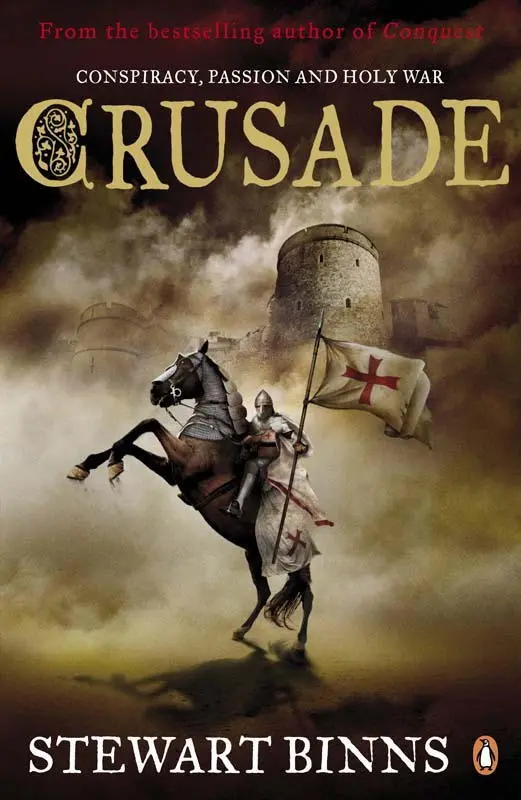
- Название:Crusade
- Автор:
- Издательство:Penguin Books
- Жанр:
- Год:2012
- Город:London
- ISBN:978-0-241-95758-5
- Рейтинг книги:3 / 5. Голосов: 1
-
Избранное:Добавить в избранное
- Отзывы:
-
Ваша оценка:
Crusade: краткое содержание, описание и аннотация
Предлагаем к чтению аннотацию, описание, краткое содержание или предисловие (зависит от того, что написал сам автор книги «Crusade»). Если вы не нашли необходимую информацию о книге — напишите в комментариях, мы постараемся отыскать её.
In the face of chaos and death, Edgar and his allies form a secret brotherhood, pledging to fight for justice and freedom wherever they are denied. But soon they are called to fight for an even greater cause: the plight of the Holy Land. Embarking on the epic First Crusade to recapture Jerusalem, together they will participate in some of the cruellest battles the world has ever known, the savage Siege of Antioch and the brutal Fall of Jerusalem, and together they will fight to the death.
Crusade — читать онлайн бесплатно полную книгу (весь текст) целиком
Ниже представлен текст книги, разбитый по страницам. Система сохранения места последней прочитанной страницы, позволяет с удобством читать онлайн бесплатно книгу «Crusade», без необходимости каждый раз заново искать на чём Вы остановились. Поставьте закладку, и сможете в любой момент перейти на страницу, на которой закончили чтение.
Интервал:
Закладка:
The hunting party returned the next day, by which time, mercifully for Sweyn, all trace of the barbarism had been removed and Mahnoor’s remains buried. He hid his immediate reaction from everyone by turning his back when Maria and Ingigerd told him what had happened and walking away to the forest, a place he always returned to in times of stress. It was, after all, the place where he had found refuge after the massacre at Bourne.
He asked just one rhetorical question as he left, which was to say that he presumed the band of assassins had spoken Arabic? When Maria confirmed that they had, he hesitated for a moment before continuing his desolate trudge into the wilderness.
It is impossible to imagine what thoughts went through his head in those dark minutes and hours that followed but, just before dusk, he returned and asked to spend time alone at the side of Mahnoor’s grave.
Maria and Ingigerd took him food and a cloak later in the evening, and a fire was built nearby to warm him against the chill of winter. He politely resisted all attempts to comfort him and spent the night huddled next to the grave of his beloved wife, the mother of his unborn child.
The women took it in turns to check on him during the night, but on each occasion he was still in the same position, numb to all entreaties and to everything around him. Just before dawn it started to snow and, within minutes, he was covered in a shroud of snow, but still he did not move. They took him a bowl of game soup and a beaker of mulled wine at sunrise, which he consumed without seeming to taste or savour it.
Then he smiled a mournful, weak smile; for the first time, there were tears in his eyes.
‘I have to go. I know who did this terrible thing. I will avenge my wife and make him pay for what he did here.’
He said nothing more, other than to ask that one of the enclave of Arab merchants in Toulouse be paid to come and read from the Quran over Mahnoor’s grave. By the middle of the day he had loaded a small boat and was rowing himself down the Lot to Cahors.
When Ingigerd and Maria had finished their dreadful account, we immediately began to make a plan. We knew precisely where Sweyn was going and exactly who the culprit was whom he intended to slay. We assumed he would not go to Count Roger, but would want to exact his own revenge, and thus would need all the help we could offer him. Unfortunately, he had a four-day start on us. Ironically, we had almost certainly passed him somewhere on our journey, but on the busy road from Cahors to Toulouse it was easy to pass people unnoticed.
Adela was understandably impatient.
‘We must leave immediately! If we ride like the wind, we can catch him. He will want to get to Sicily as quickly as possible, but not as quickly as we want to catch up with him.’
Adela was probably wrong; a four-day head start for a man with only a single objective in his mind was a lot to make up, but it was worth a try. And she certainly tried.
We bought a string of horses in Cahors and rode them as hard as was humane. She did not want to stop and so, when the horses could do no more, we walked. It was the hardest task I had ever undertaken and my admiration for her grew by the minute. She never seemed to tire.
She was counting the miles and checking them off against the formula she had worked out to measure our progress against his. By the time we got to Narbonne, she had calculated that we were only a day behind him. She was right; we reached the quayside late in the afternoon and were told that an English knight had boarded a Cypriot dhow bound for Palermo that morning. We immediately commissioned a ship of our own at an exorbitant price and just caught the evening tide. We were then only twelve hours adrift.
Our vessel, a modified Norse knaar, rigged for speed – for whatever dubious cargo, we decided it was wise not to enquire – was owned by a Maltese merchant. Adela spent most of the crossing standing at its tall curved prow, peering expectantly out into the Mediterranean, hoping, at any moment, to see Sweyn’s ship.
We reached our destination only two hours after Sweyn, but by then he had disappeared into the warren of markets and narrow thoroughfares of a bustling Palermo morning. We immediately went to Count Roger’s palace to alert him. He sent out patrols on to the streets to search for Sweyn, while we went to secrete ourselves close to Suleiman’s wharf – in the hope of intercepting Sweyn before he could come to harm.
We had no intention of preventing Suleiman from meeting his fate; we just wanted to be sure that Sweyn did not throw his life away in a futile gesture.
However, we had underestimated him.
When we reached the pier where Suleiman traded, there was a major commotion. A large crowd of people had gathered, many of whom were clamouring to peer inside one of Suleiman’s many warehouses. A detachment of the Count’s guard was trying to restore order and, at my command, cleared the way for us.
What we saw was a gruesome spectacle. Sweyn had his back to us, his head bowed. He was standing with his legs apart, his sword held limply in his hand with its tip resting gently on the ground. On the floor around him were three dead men, Suleiman’s henchmen, blood seeping from several wounds to their bodies. A little further away, bound by the wrists, ankles and chest to an ornately carved chair, was the corpulent frame of Sweyn’s main prey.
Suleiman’s body sat bolt upright, but shorn of its head. His kaftan was crimson, no longer pale blue, and blood flowed copiously into the dust of the warehouse floor. The head, smeared in blood, lay in the grime some feet away, where it had rolled against a bale of silk. Sweyn would never give the details of what had transpired in that warehouse, but the fact that his victim’s turban sat neatly on a nearby sack suggested that it had been a cold and calculated execution. Whatever had taken place only moments ago, it was done very quickly and carried out without mercy. So should it have been.
Adela added the final touch. She picked up the fat Saracen’s head, carried it through a rapidly retreating crowd with its blood splattering the dockside, and threw it as far as she could into the sea.
‘Let the fish gnaw at your bones, you filthy bastard!’
She then hurried back to Sweyn, who was still standing in his mesmerized pose, and tried to pull him away. Edwin and I helped, but Sweyn was transfixed and the three of us struggled to get him to move. Eventually, he breathed more easily, let his blade fall to the floor and sank to his knees in convulsions of grief.
The Captain of Count Roger’s guard then appeared. He arrested Sweyn, placed him into our custody and required us to deliver him to the palace early the next morning.
‘As you know, I insist on justice being administered according to the law in my domain.’
Sweyn was standing before Count Roger, looking as morose as he had done the night before. He had spent the night in a foetal embrace in the arms of Adela; neither of them appeared to have had much sleep. He did not respond to Count Roger, so I tried to defend what he had done.
‘Roger, the crime committed in Aquitaine was truly bestial and there is no doubt that Suleiman ordered Mahnoor’s murder. The other men Sweyn killed were almost certainly part of the group who carried out the attack.’
‘I agree, but now we will never know.’
Adela spoke up softly.
‘My Lord, the important thing is that Suleiman is dead and that Sweyn was his executioner. That’s what the man deserved.’
‘Yes, but if we had put him on trial we could have discovered the rest of the perpetrators and perhaps found a punishment for him that would have been much more painful and long-lasting.’
Finally, Sweyn spoke.
‘Sire, I am sorry that my act of vengeance happened in your realm, but I had no choice. The others are of no consequence; Suleiman was the devil responsible for Mahnoor’s death, and I had to be the one to kill him. No other outcome would have brought this to an end. Now it is over; do with me what you must.’
Читать дальшеИнтервал:
Закладка:
Похожие книги на «Crusade»
Представляем Вашему вниманию похожие книги на «Crusade» списком для выбора. Мы отобрали схожую по названию и смыслу литературу в надежде предоставить читателям больше вариантов отыскать новые, интересные, ещё непрочитанные произведения.







Обсуждение, отзывы о книге «Crusade» и просто собственные мнения читателей. Оставьте ваши комментарии, напишите, что Вы думаете о произведении, его смысле или главных героях. Укажите что конкретно понравилось, а что нет, и почему Вы так считаете.