Stewart Binns - Crusade
Здесь есть возможность читать онлайн «Stewart Binns - Crusade» весь текст электронной книги совершенно бесплатно (целиком полную версию без сокращений). В некоторых случаях можно слушать аудио, скачать через торрент в формате fb2 и присутствует краткое содержание. Город: London, Год выпуска: 2012, ISBN: 2012, Издательство: Penguin Books, Жанр: Историческая проза, на английском языке. Описание произведения, (предисловие) а так же отзывы посетителей доступны на портале библиотеки ЛибКат.
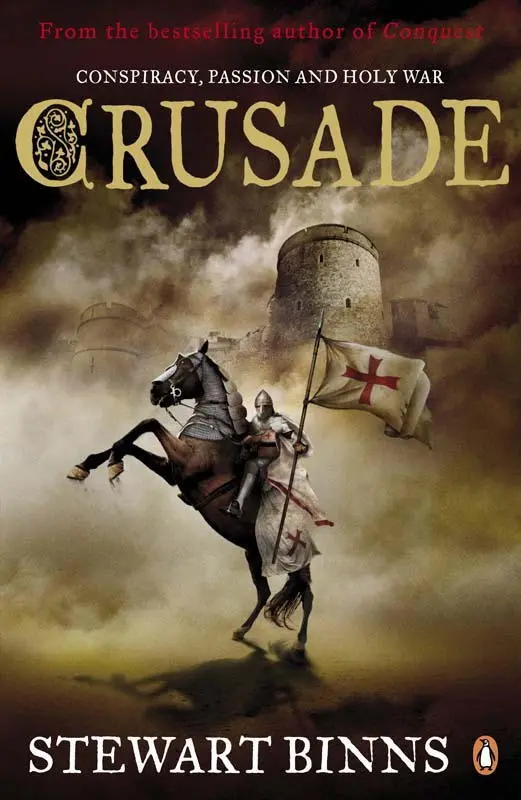
- Название:Crusade
- Автор:
- Издательство:Penguin Books
- Жанр:
- Год:2012
- Город:London
- ISBN:978-0-241-95758-5
- Рейтинг книги:3 / 5. Голосов: 1
-
Избранное:Добавить в избранное
- Отзывы:
-
Ваша оценка:
Crusade: краткое содержание, описание и аннотация
Предлагаем к чтению аннотацию, описание, краткое содержание или предисловие (зависит от того, что написал сам автор книги «Crusade»). Если вы не нашли необходимую информацию о книге — напишите в комментариях, мы постараемся отыскать её.
In the face of chaos and death, Edgar and his allies form a secret brotherhood, pledging to fight for justice and freedom wherever they are denied. But soon they are called to fight for an even greater cause: the plight of the Holy Land. Embarking on the epic First Crusade to recapture Jerusalem, together they will participate in some of the cruellest battles the world has ever known, the savage Siege of Antioch and the brutal Fall of Jerusalem, and together they will fight to the death.
Crusade — читать онлайн бесплатно полную книгу (весь текст) целиком
Ниже представлен текст книги, разбитый по страницам. Система сохранения места последней прочитанной страницы, позволяет с удобством читать онлайн бесплатно книгу «Crusade», без необходимости каждый раз заново искать на чём Вы остановились. Поставьте закладку, и сможете в любой момент перейти на страницу, на которой закончили чтение.
Интервал:
Закладка:
However, in the autumn of 1086 matters in Normandy and England loomed prominently in our lives once more. It was October and I had – as always, when the leaves began swirling to the ground – been thinking of Senlac Ridge. It was now a full twenty years since the battle, but it was no distant memory. Like every Englishman, I thought about it constantly; every day brought fresh reminders of how irrevocably things had changed and how so many of our kin were unable to witness them because they lay rotting in the ground.
It was on typically Sicilian autumn day, warm and sunny with a fresh breeze off the sea, that a messenger from Count Robert in Normandy arrived in Palermo. He brought news of dramatic developments to the north. King William was still not at peace with his neighbours, or with himself. He was still tireless in pursuit of his enemies and in his determination to establish a unique legacy in history.
The King held sway over a huge domain that extended from the heartland of France in the south to his lordship of Malcolm Canmore’s Scotland in the far north. I had been wondering whether, like his predecessor on the English throne, Cnut the Great – King of England and most of Scandinavia, who had hankered after the title ‘Emperor of the North’ – a similar accolade should be applied to William. Even now that he was approaching sixty, his warrior spirit still burned as brightly as it had done when, as a boy-duke half a century ago, he first wielded a sword.
The Danes were being particularly restless and threatening a huge invasion, while William was still fighting to retain control of Maine. To meet the challenge of the Danes, he had, we were told, undertaken a great audit of England to find every piece of land, each property of substance and all potential taxpayers, English or Norman, in order to fund an army the scale of which had never been seen before. The inventory was likened to the imperial levies of Rome – so exacting and methodical that every person, beast and acre in the land was counted.
Norman bureaucrats in their hundreds were sent to every burgh and village in the realm to undertake the census: no chore was left unaccounted for, no piece of thatch (even as small as the width of a man’s arm) left unmeasured, and no crop, creature or artefact omitted from the national reckoning.
The result of the great stocktaking, the like of which was beyond contemporary comparison, made William far richer than he had imagined – so rich, in fact, that it emboldened his avarice. Not only was he prepared to fund an immense standing army in England, of over 11,000 men, to meet the Danish threat, but he was also willing to commit 8,000 men to the defence of Maine.
The messenger also carried a private parchment from Robert, sealed and addressed to me. It was a request for us to return to Normandy. His father’s belligerence had led him to plan an attack for the following summer in the Vexin, to Normandy’s south, where Philip of France had installed provosts in Mantes and Pontoise. William intended to root them out and had asked Robert to prepare the army and lead the attack.
It was a typically cunning move by the King; not only was it yet another test of his son’s generalship, it was also a further test of his son’s loyalty in the face of his friend and former ally, Philip of France.
I assumed this last point accounted for Robert’s request for me to return. I anticipated that, as I had with Malcolm Canmore, I would now play the role of mediator between Robert and Philip.
It was another daunting task – but one, on reflection, that reinvigorated me. Life in Sicily had become too comfortable, and I was in danger of losing my sense of purpose. Not only that: Robert was a good friend, and I greatly admired Philip, so anything I could do to prevent war, and all that such a conflict would bring, represented a mission I was keen to accept.
Adela, Edwin and I completed our tasks for Count Roger by the end of the year and departed for mainland Europe in mid-January. We decided to take the same route as Sweyn and Mahnoor so that we could visit them at St Cirq Lapopie in Aquitaine. I had heard so much about the remote idyll in the Lot, a place so precious to Hereward and his family, and now I was keen to see it for myself. I also suspected that Sweyn may well have rediscovered his passion for adventure. Given that we were soon likely to be involved in more Norman military campaigns, I was hoping to persuade him to resume his place by my side.
St Cirq Lapopie was everything I had imagined. It was like an eagle’s nest, standing high above the gorge of the river on a rocky limestone promontory. It had had the same effect on Edwin when he first saw it, all those years ago, when he sailed up the Lot as Edith Swan-Neck’s emissary. I heard Adela whisper the word ‘home’ as she stared at the one place where she had found peace in her troubled life.
As we disembarked from the Lot barge and made our way up the steep path to the house, the greeting was not the one we had expected. No Sweyn. No Mahnoor. Only Ingigerd and Maria, in obvious and immense distress, with a trail of locals in their wake. They rushed to embrace Edwin and Adela, but their tears were not tears of joy at the return of two members of their family. I looked around and noticed that one of the barns had recently burned to the ground, but otherwise all seemed well.
Both women were in their early fifties, but looked fit and well. They had lived eventful lives and had, as the wives of the famous warriors Martin and Einar, often witnessed harrowing things. But the story they told us on our arrival was horrifying to the point of disbelief.
Sweyn had been away hunting with the estate steward and most of the men of the community, a week earlier, when the attack took place. It had begun in the middle of the night when a large gang of hooded men appeared, broke into the house and ransacked the cottages of everyone on the estate. Some of the estate men who had not gone with the hunting party resisted, but any who did were mercilessly cut down. The rest were rounded up, bound hand and foot, gagged and dragged away. The women and children were all herded into the barn, except Mahnoor.
No one could see exactly what happened next, but her suffering continued for some time. Her agonizing screams eventually turned into despairing whimpers before dwindling away to a merciful silence.
For at least another hour, everyone in the barn trembled in silence before the sound of horses signalled the attackers’ departure – but not before they had thrown torches on to the thatched roof. Only the nimbleness of one of the older boys, who had managed to climb up to the eaves and kick a hole in the straw before clambering down the outside wall to unbar the door, saved the occupants from being burned alive.
Mahnoor was nowhere to be found and everyone assumed she had been taken by her assailants. But the men were found, dashed on the rocks below, eleven good men of Aquitaine, husbands, sons and brothers, all innocent victims of a vicious assault.
The most grisly discovery was made at dawn when the son of the pigman went to check on his herd. Mahnoor’s head had been impaled on a lance and stuck in the ground in one of the sties. Her luxuriant jet-black hair now fell in blood-soaked threads down her face, her jaw hung open hideously and trails of dried blood ran from her mouth, nose, ears and eye sockets. Her once captivating eyes had been gouged from her. What was left of her body was strewn around among the pigs, parts of which were still being consumed.
Of course, being fed to swine, the creature most reviled by Muslims, was a horrifying fate to one of her faith, as was the insult daubed in her own blood on the wall of the sty – ‘infidel’.
The most wretched part of it all was the fact that Mahnoor had just discovered she was pregnant. Sweyn’s hunting trip had been intended to put fresh meat and game on the table of a grand feast to celebrate the news.
Читать дальшеИнтервал:
Закладка:
Похожие книги на «Crusade»
Представляем Вашему вниманию похожие книги на «Crusade» списком для выбора. Мы отобрали схожую по названию и смыслу литературу в надежде предоставить читателям больше вариантов отыскать новые, интересные, ещё непрочитанные произведения.









Обсуждение, отзывы о книге «Crusade» и просто собственные мнения читателей. Оставьте ваши комментарии, напишите, что Вы думаете о произведении, его смысле или главных героях. Укажите что конкретно понравилось, а что нет, и почему Вы так считаете.