Nicola Griffith - Hild
Здесь есть возможность читать онлайн «Nicola Griffith - Hild» весь текст электронной книги совершенно бесплатно (целиком полную версию без сокращений). В некоторых случаях можно слушать аудио, скачать через торрент в формате fb2 и присутствует краткое содержание. Город: New York, Год выпуска: 2013, ISBN: 2013, Издательство: Farrar, Straus and Giroux, Жанр: Историческая проза, на английском языке. Описание произведения, (предисловие) а так же отзывы посетителей доступны на портале библиотеки ЛибКат.
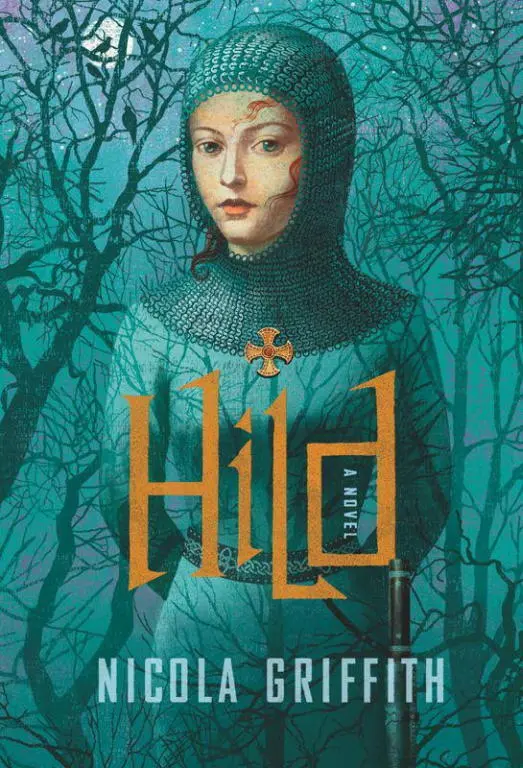
- Название:Hild
- Автор:
- Издательство:Farrar, Straus and Giroux
- Жанр:
- Год:2013
- Город:New York
- ISBN:978-0-374-28087-1
- Рейтинг книги:5 / 5. Голосов: 1
-
Избранное:Добавить в избранное
- Отзывы:
-
Ваша оценка:
Hild: краткое содержание, описание и аннотация
Предлагаем к чтению аннотацию, описание, краткое содержание или предисловие (зависит от того, что написал сам автор книги «Hild»). Если вы не нашли необходимую информацию о книге — напишите в комментариях, мы постараемся отыскать её.
But now she has only the powerful curiosity of a bright child, a will of adamant, and a way of seeing the world—of studying nature, of matching cause with effect, of observing her surroundings closely and predicting what will happen next—that can seem uncanny, even supernatural, to those around her.
Her uncle, Edwin of Northumbria, plots to become overking of the Angles, ruthlessly using every tool at his disposal: blood, bribery, belief. Hild establishes a place for herself at his side as the king’s seer. And she is indispensable—unless she should ever lead the king astray. The stakes are life and death: for Hild, for her family, for her loved ones, and for the increasing numbers who seek the protection of the strange girl who can read the world and see the future.
Hild is a young woman at the heart of the violence, subtlety, and mysticism of the early Middle Ages—all of it brilliantly and accurately evoked by Nicola Griffith’s luminous prose. Working from what little historical record is extant, Griffith has brought a beautiful, brutal world—and one of its most fascinating, pivotal figures, the girl who would become St. Hilda of Whitby—to vivid, absorbing life.
Hild — читать онлайн бесплатно полную книгу (весь текст) целиком
Ниже представлен текст книги, разбитый по страницам. Система сохранения места последней прочитанной страницы, позволяет с удобством читать онлайн бесплатно книгу «Hild», без необходимости каждый раз заново искать на чём Вы остановились. Поставьте закладку, и сможете в любой момент перейти на страницу, на которой закончили чтение.
Интервал:
Закладка:
“I am queen.” Æthelburh laid her hand on her stomach. For those who knew to look, she was beginning to show. “The question is, what are you? A maid without a mother.”
“I have a mother. Your aunt.”
“Yes.” There was a world of complication in that one word. “You really don’t feel the cold, do you? Like my brothers. Perhaps you will teach me that trick.”
Hild couldn’t imagine this queen in her beaver furs riding rough over half the north, starving and harried, thrusting spears into the brains of the enemy.
“I miss my brothers. Perhaps you miss your sister.”
“Your cousin.”
“My cousin. But she’s with the East Angles now, and you are here.”
Hild couldn’t disagree.
“You prophesied her doom.”
“Not hers. Æthelric’s.”
“Paulinus would say a woman’s doom is her husband’s.”
“Why?”
The queen, startled, laughed. “It probably comforts him to think so.” They walked quietly for a while. “You learnt your letters from the Irish priest, Fursey.”
Hild nodded.
“You will introduce him to me. You will not speak of it to anyone.”
Hild glanced at her.
“You must learn to speak those thoughts of yours sometimes, child, or those who watch—like those gesith hounds of yours—will decide for themselves what you think, who you are, whose side you’re on. For there are sides. Though I don’t know which is yours.”
If Hild thought of sides, she thought of plots, of her mother, of Lindsey, its blood, its stink, and the world began to dissolve in a white hiss so that she wanted to step from her body and become the marble maid again. She breathed slowly, carefully. She was in York, by the river, with the queen, her cousin. Or aunt. Who had offered her a gift of perfume. Who was trying to be her friend. Maybe.
She would offer a gift in return, and an answer of sorts. “I shall sew with your women.”
“Thank you. We’d be glad to have you.”
It hadn’t occurred to Hild that they might not be. She pretended to watch a pair of swans gliding by.
“And your mother, do you think she would sew with us? When she returns?”
Hild thought of the old queen dying in a pool of blood and the world began to turn cold around the edges.
“Never mind. We’ll leave that for another time.”
She introduced Fursey to Æthelburh, but what discussion they had Fursey didn’t share.
The ice came early. An illness swept the city, racking old and young alike with wet coughs. The fingers and toes of wealh and then even of royal Anglisc grew red and shiny with chilblains. Hild offered the parsley in her pots for the royal table, but suggested privately to the queen that she might not want to eat it, in her condition. The queen declared that all, even wealh, would get cheese as well as barley bread or oats for breakfast.
Hild sewed with the queen’s women in the morning, when the light was good. In the afternoon twilight she walked along the river, and at night she listened to the music with one ear and to the gesiths as they boasted and drank, and the thegns who manoeuvred for favour, with the other. The men drank gallons of beer and as much white mead as the women of the household could freeze out overnight from the yellow mead poured into the special tall barrels—all men but Paulinus Crow, who drank sparingly of the wine Æthelburh provided. Hild suspected that James the Deacon—who did not eat in hall but with his boys—was not sparing. James and Fursey had become friends, though Hild did not know if it was a natural affinity or at the direction of the queen.
For a while, she enjoyed a life in which she behaved exactly as she should: a royal maid with no secrets. She sat at her place of high honour on the bench, often near the æthelings Eadfrith and Osfrith, who were now men with no time for a maid, and sipped her mead. She let the ebb and flow of the hall wash over her, much as she sometimes sat behind bracken at the edge of a clearing or by reeds at the edge of a pool. Life, death, change, they happened most at the edges of things: where forest meets clearing, air meets water. A spider has only to spin at the edge of a puddle to catch the fly that dives to drink. A shrew has only to watch in turn for the spider. For the fly must come to the edge to drink, and the spider must follow the fly. Fate goes ever as it must.
Yule approached. Breguswith returned from Arbeia, followed a day later by Osric.
In Hild’s room, mother and daughter regarded each other silently. “You’ve grown,” Breguswith said. “Your woman is taking good care of you.”
“I’ve told her to make up a bed for you next to mine.” Despite her best intentions, Hild’s voice rose in a question.
But Breguswith merely nodded.
That night, Hild didn’t sleep well. The next night, her mother didn’t come to bed. Hild made no effort to find out where she spent her time.
The high men of the isle gathered to seek favour and pay homage to Edwin and his new queen. Every evening, arriving at the beat of a drum or the ripple of a lyre, a handful of brightly cloaked men, wearing enough gold to dazzle a jay, would swing into the hall and bend their proud heads to the high table. Bryneich from the north, with their short hair, red mouths, and enamelled brooches, under Coledauc king—who bowed to Hild and gave best wishes from Prince Morcant. The piglet, Hild remembered. Men from Rheged, under Rhoedd the Lesser, Rhoedd’s sister-son and little Uinniau’s older brother, styling himself prince and bearing gifts from Rhoedd for the king and queen—and a beautiful double pin inlaid with garnet from the princess Rhianmelldt for the princess Hild. Coelgar, returned from Lindsey, with half a dozen Lindsey thegns at his back and a kinglike bearing. And Dunod, lord of Craven, whom some called king.
The hall hushed when Dunod was announced.
He and his retinue—twenty strong, defiance in their bearing, and wearing knives just a little too long for manners—strode along the benches, careless of their cloaks near the fire pit, and dropped, to a man, on one knee before Edwin. The room hummed; all knew what Cadfan’s man had told the hægtes about traitors. Dunod laid a heavy casket on the floor before him. Edwin leaned back, pretending to sniff at the mead in his goblet, but Hild saw the green glitter of his eyes.
“Edwin king!” Dunod said in a strong voice, and the hum dropped—even the housefolk paused. “Edwin king, foul lies have been visited upon my honour. I am your loyal man.” He lifted the casket; the man on either side put a hand on the lid. “I bring you a gift.” They flung the lid back with a crash. “Ceredig of Elmet.”
Even Edwin leaned forward.
The head was unrecognisable. It was the colour of the underside of a mushroom, the eyes sunken. Dark purple lips were pulled back in a snarl from black gums and long yellowing teeth. The hair was red-streaked grey, and a golden torc circled a stringy neck.
No one spoke.
Then Edwin looked down the table at Breguswith, who sat by Osric. “Cousin, is this Ceredig?”
Breguswith stood, leaned forward on both hands for a better view, and after a moment said, “It’s his torc. And it’s his hair as it might be after ten years.”
Edwin gestured for her to sit. He tapped his great ring—the garnet carved now with his boar—against his cup, thinking. “Dunod. We accept your loyalty, and we thank you for the torc.” He gestured, smiling, for Coelfrith to find places for the new guests, pleased with himself: not admitting it was Ceredig, not admitting the favour, but accepting the gift. “No,” he said to Coelfrith’s man, who bent to the casket. “Leave it there. We wish to enjoy it.”
Читать дальшеИнтервал:
Закладка:
Похожие книги на «Hild»
Представляем Вашему вниманию похожие книги на «Hild» списком для выбора. Мы отобрали схожую по названию и смыслу литературу в надежде предоставить читателям больше вариантов отыскать новые, интересные, ещё непрочитанные произведения.









Обсуждение, отзывы о книге «Hild» и просто собственные мнения читателей. Оставьте ваши комментарии, напишите, что Вы думаете о произведении, его смысле или главных героях. Укажите что конкретно понравилось, а что нет, и почему Вы так считаете.