Nicola Griffith - Hild
Здесь есть возможность читать онлайн «Nicola Griffith - Hild» весь текст электронной книги совершенно бесплатно (целиком полную версию без сокращений). В некоторых случаях можно слушать аудио, скачать через торрент в формате fb2 и присутствует краткое содержание. Город: New York, Год выпуска: 2013, ISBN: 2013, Издательство: Farrar, Straus and Giroux, Жанр: Историческая проза, на английском языке. Описание произведения, (предисловие) а так же отзывы посетителей доступны на портале библиотеки ЛибКат.
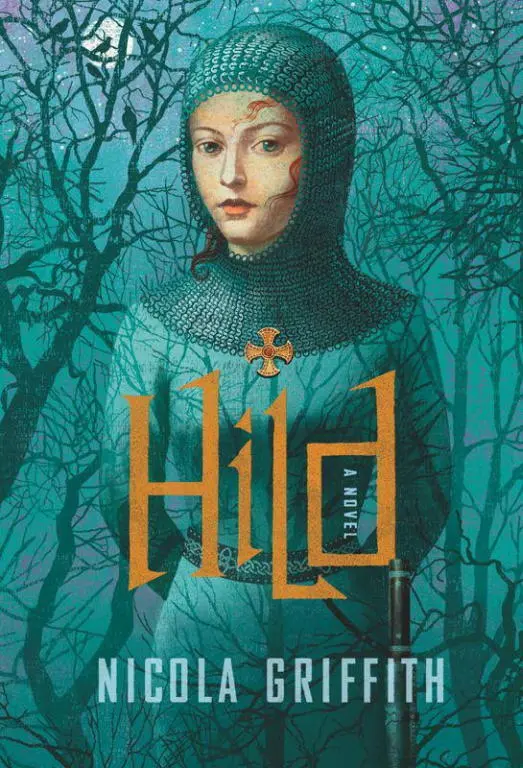
- Название:Hild
- Автор:
- Издательство:Farrar, Straus and Giroux
- Жанр:
- Год:2013
- Город:New York
- ISBN:978-0-374-28087-1
- Рейтинг книги:5 / 5. Голосов: 1
-
Избранное:Добавить в избранное
- Отзывы:
-
Ваша оценка:
Hild: краткое содержание, описание и аннотация
Предлагаем к чтению аннотацию, описание, краткое содержание или предисловие (зависит от того, что написал сам автор книги «Hild»). Если вы не нашли необходимую информацию о книге — напишите в комментариях, мы постараемся отыскать её.
But now she has only the powerful curiosity of a bright child, a will of adamant, and a way of seeing the world—of studying nature, of matching cause with effect, of observing her surroundings closely and predicting what will happen next—that can seem uncanny, even supernatural, to those around her.
Her uncle, Edwin of Northumbria, plots to become overking of the Angles, ruthlessly using every tool at his disposal: blood, bribery, belief. Hild establishes a place for herself at his side as the king’s seer. And she is indispensable—unless she should ever lead the king astray. The stakes are life and death: for Hild, for her family, for her loved ones, and for the increasing numbers who seek the protection of the strange girl who can read the world and see the future.
Hild is a young woman at the heart of the violence, subtlety, and mysticism of the early Middle Ages—all of it brilliantly and accurately evoked by Nicola Griffith’s luminous prose. Working from what little historical record is extant, Griffith has brought a beautiful, brutal world—and one of its most fascinating, pivotal figures, the girl who would become St. Hilda of Whitby—to vivid, absorbing life.
Hild — читать онлайн бесплатно полную книгу (весь текст) целиком
Ниже представлен текст книги, разбитый по страницам. Система сохранения места последней прочитанной страницы, позволяет с удобством читать онлайн бесплатно книгу «Hild», без необходимости каждый раз заново искать на чём Вы остановились. Поставьте закладку, и сможете в любой момент перейти на страницу, на которой закончили чтение.
Интервал:
Закладка:
Hild dropped the daisies and took it, hefted it in one hand then the other. She unwound the linen to reveal a hard slate-grey curl of a stone, like a frozen worm.
“A snakestone,” Fursey said. “The local legend is of some harried god turning all the snakes into stone so that he could get some peace from the peasants’ pitiful petitioning.”
Hild stroked the tight stone coils with a fingertip.
“Begu also says to tell you she found a dragon in the cliff.”
Hild lifted her eyebrows.
“The girl does like to imagine, yes. But this I saw for myself.”
“Truly?”
“Truly. A great skull and wings, entombed in the cliff in another age and showing now where some of the cliff had tumbled into the sea. The wings must have been eight ells long! The thing was still mostly buried, so I couldn’t pace it out. But the skull was”—he stretched his arms wide—“bigger than I could reach. And all of stone.”
“Bones of stone…”
“And black as the devil’s eyes.”
Hild shivered.
“Think,” he said. “It must have been a cataclysmic event: such a beast hurling itself into solid rock.” Fursey fastened his satchel. “Begu, too, begs you to come visit. She says she misses you. She said to tell you someone called Winty birthed fine fat twins this spring.”
He paused briefly, but Hild was walking her interior landscape again. Wherever it was, it seemed bleak.
“She also said she was very pleased with her comb, then she spoke of demons in worms and fish and dogs, and demons in hair and combs but became so wound about with her own mirth it was difficult to extract her meaning.”
Hild seemed to pull herself back from wherever she had been. She smiled, but it was a disturbing, hard flexing of bone and muscle. “Winty is a cow. If I’m ever to keep Begu’s messages straight she must learn to read. She must learn, Fursey.”
“I mentioned a priest to Mulstan—the man is more hairy than ever—but he laughed and said, ‘All in good time!’ and clapped me on the back hard enough to make me spit out my meat.”
“You must go again. You must make him understand.”
“Must?”
“He has to understand. Cian and Begu must learn to read. They must all learn. Hereswith in East Anglia, too. But her need isn’t so great.”
“So great as whose?”
She ignored him. “Yes. You will go back. You will tell him that I order it so.”
“And if I prefer not? If I choose to simply walk away one day and take a boat for Ireland?”
“I’ll have you brought back. And whipped.”
“Child—”
“I am not a child.” Under the ferocity Fursey heard the howling loneliness. But ferocity was winning. “Priest or not, I will have you whipped if you try to leave. Who’s to stop me, who in all the world? Only the king, and he gives me what I ask. So who is to stop me? No one.”
“Then I tell you truly, you must learn to stop yourself.”
Silence. A crow cawed, then another. She said, “That will be Gwladus with your food.”
More silence.
“I’m sorry,” she said.
“No, I don’t think so. I don’t know what’s got into you, but I don’t think you’re sorry.”
He held her gaze this time, though it made him sweat, and this time it was she who looked away. “Please,” she said. “Go to Mulstan. They must learn to read. I have no one else.”
He sighed. “I’ll go. But first I’ll take a fortnight’s rest here.”
“We leave for Brough in less than that—at the new moon. Æthelburh is coming.”
“At the new moon, then.”
“But it’ll be raining by then.”
“Nonetheless.” The weather seemed to him set for fair, but even if it rained like Noah’s flood he wanted time to talk to Gwladus, and to Lintlaf—if the idiot gesith could keep his brains out of his hose long enough to think. He must find out what the witch woman, the child’s mother, was up to with Osric, he of the kingly ambitions. He’d heard talk. And this child would soon be living in very dangerous times indeed.
10
THE DOCK AT BROUGH was almost invisible in the rain. It sheeted down, beating itself to froth on the huge wharf timbers, drumming on the roof of the great warehouse, irritating the party waiting beneath. Edwin overking was not used to sharing his presence with baled wool and sacks of grain. But Æthelburh’s ship was due, and this was the only shelter.
A half-drowned river man was shown through the side door: He had seen the red sail! They’d be in, he reckoned, by the time he got his reward, begging your pardon.
On Coelgar’s nod, Coelfrith gave the man half a silver penny. Edwin straightened his gold-crusted belt and the gold band on his forehead, which he’d taken to wearing on important occasions. Breguswith smoothed her skirts. Hild shrugged her shoulders to make sure her long mantle fell in perfect folds. She drew her hood up. The gesiths—in their most gaudy splendour, cloaks thrown back over their shoulders to show their hero-ringed arms—rolled their moustaches between their fingers so that they hung thick and manly, just so. Lilla nodded, and Forthere and a wiry red-haired man new to the household, a West Saxon by his brooch, hauled open the big warehouse doors. The æthelings and Osric and Oswine went first, walking in careful step at the corners of the great canopy that sheltered Hild and Breguswith. Edwin’s betrothed was to be met and tended only by honoured family. Æthelburh had been only four when Breguswith left but, still, she and her daughter were blood kin.
There was little wind, just the gush and runnel of rain. Hild and her mother could barely see beyond their canopy.
Even in the rain, the scent of the river and its mudflats overwhelmed her: old and cold and wide. She wondered if Fursey’s boat had crossed Æthelburh’s wake downstream. Then ropes were being thrown and a gangplank slid out, and the gesiths behind her drew taut as a dozen armed men in red cloaks marched down the plank. Then came a cluster of black-clad priests, six or seven, hunched and hidden in their wet cowls. Then came Æthelburh, escorted by five women and Paulinus Crow.
Paulinus Crow. Bishop Paulinus. Tall, stooped, and black-haired, even at his age. Black-eyed, too, with the high-bridged nose she had seen on broken statues. “Want on legs,” Gwladus said when she saw him. “Though for what, I don’t know.”
Hild did. She saw it for the first time the morning Paulinus and Stephanus stood with her in a cold room of the ruined Roman palace on the River Derwent, just a mile south of the ford.
It was the beginning of the moon of Winterfylleth, when the nights became longer than the days. Osric had finally departed for Arbeia. Hild hoped he had drowned at the mouth of the Tine. The rain had stopped days ago and the mornings had turned dry and crisp. Inside the ruined palace, sun as thin as whey seeped through the gaps under the eaves and washed over the mosaic floor. The priests looked pinched and cold, though Hild didn’t feel the chill. Even inside a broken building it was warmer than up a tree or on the brow of a hill searching for figwort.
“Here, child,” Paulinus said, and pointed with his bishop’s jewelled crook at the picture by his foot: a fish and a cup pieced together of tiny green squares. “Christ’s sign. Those who lived here were good God-fearing citizens.”
Those who died here, Hild thought, looking at the axe marks on the fresco on the wall where someone had hacked out the iron lamp brackets, at the hollowed and charred circle where they had dug out the floor and tried to build a fire.
The Crow turned to Stephanus and dictated instructions in Latin about rededicating the building as a chapel to Saint John. Stephanus lifted the wooden board covered with wax that always hung from his belt and scribbled with a stylus. Hild gave no sign she understood any of it.
Читать дальшеИнтервал:
Закладка:
Похожие книги на «Hild»
Представляем Вашему вниманию похожие книги на «Hild» списком для выбора. Мы отобрали схожую по названию и смыслу литературу в надежде предоставить читателям больше вариантов отыскать новые, интересные, ещё непрочитанные произведения.







Обсуждение, отзывы о книге «Hild» и просто собственные мнения читателей. Оставьте ваши комментарии, напишите, что Вы думаете о произведении, его смысле или главных героях. Укажите что конкретно понравилось, а что нет, и почему Вы так считаете.