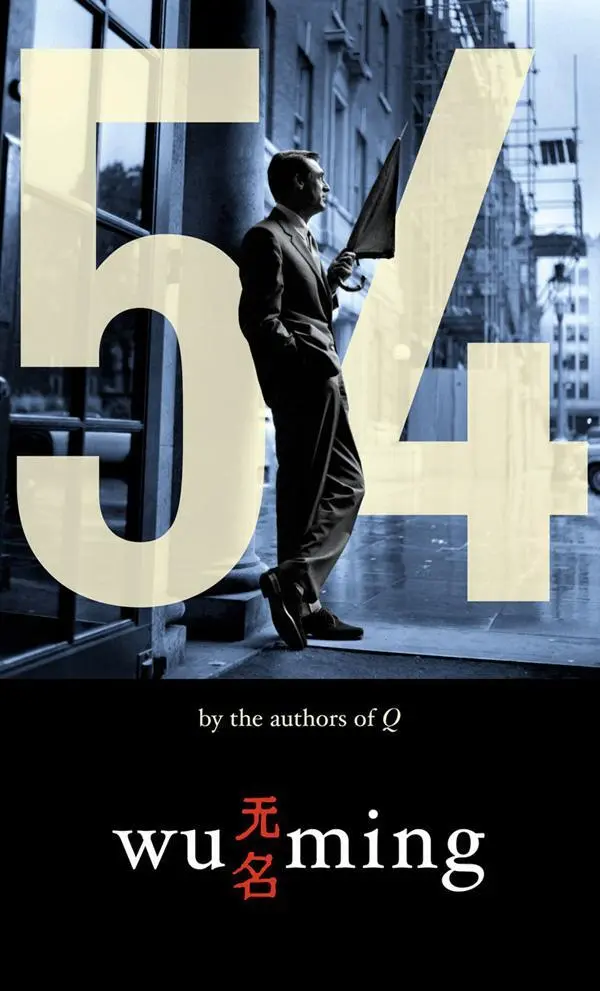
Wu Ming - 54
Здесь есть возможность читать онлайн «Wu Ming - 54» весь текст электронной книги совершенно бесплатно (целиком полную версию без сокращений). В некоторых случаях можно слушать аудио, скачать через торрент в формате fb2 и присутствует краткое содержание. Год выпуска: 2006, Издательство: Houghton Mifflin Harcourt, Жанр: Историческая проза, на английском языке. Описание произведения, (предисловие) а так же отзывы посетителей доступны на портале библиотеки ЛибКат.
- Название:54
- Автор:
- Издательство:Houghton Mifflin Harcourt
- Жанр:
- Год:2006
- ISBN:нет данных
- Рейтинг книги:5 / 5. Голосов: 1
-
Избранное:Добавить в избранное
- Отзывы:
-
Ваша оценка:
54: краткое содержание, описание и аннотация
Предлагаем к чтению аннотацию, описание, краткое содержание или предисловие (зависит от того, что написал сам автор книги «54»). Если вы не нашли необходимую информацию о книге — напишите в комментариях, мы постараемся отыскать её.
Set during the height of the Cold War-with the world divided into East and West-54 features Italian partisans, KGB agents, Parisian lowlifes, and cameos by David Niven, Marshal Tito, and Grace Kelly. Wu Ming brings us a cinematic romp that is by turns edgy social satire and modern comic send up.
54 — читать онлайн бесплатно полную книгу (весь текст) целиком
Ниже представлен текст книги, разбитый по страницам. Система сохранения места последней прочитанной страницы, позволяет с удобством читать онлайн бесплатно книгу «54», без необходимости каждый раз заново искать на чём Вы остановились. Поставьте закладку, и сможете в любой момент перейти на страницу, на которой закончили чтение.
Интервал:
Закладка:
What the document said: the leader of Yugoslavian communism was proud to have done it on his own. He would never have authorised any narrative strategies that took a sixteenth of an ounce of merit from him and his soldiers.
What Cary thought after reading the file: he liked the sound of Josip Broz.
What he concluded after an hour of free association: he and Tito had a great deal in common.
Above all there was his obvious interest in matters of grooming and clothes. According to the file, Tito had personally designed the uniform of the Yugoslavian national army. There was also an anecdote: on 25 May 1944, just before the Normandy landing, the German Oberkommando had unleashed its final attack on Tito’s general staff, which had its headquarters in Drvar, in Bosnia. The officers had made it to safety, but the Germans had stolen a very stylish uniform designed by Tito, to be worn on the day of victory. The high-ranking officials of the Reich must have been au fait with their arch-enemy’s dandyism, since they had displayed the uniform as a war trophy in a gallery in Vienna.
And then there was the fact they had both become famous with a name other than their given name. They had both passed through different identities. Cary for his work, Tito. for the same reason. Wasn’t he a ‘professional revolutionary’?
And also: they were both well known for having indefinable accents.
Cary was born in Bristol, he had spent his adolescence travelling all around England, he had disembarked in New York (where he had socialised with people from all over the world), he had travelled all around the States on long theatrical tours and finally he had pulled up roots and moved to Hollywood, the centre of a multinational community of deracinated artists, refugees, the mentally stateless. All that before the age of thirty. His English intonation was a synthesis of all those experiences.
Tito was twelve years older, and of Croatian origin, but he had been an officer in the Austro-Hungarian army on the Russian front, and had been taken prisoner in 1915. After the Revolution, having joined the Bolsheviks, he had fought against the White Russian armies. Returning to Croatia in 1920, he had pursued underground political activities. Between 1928 and 1934 he had been in prison. He had spent most of the next few years in Moscow, during the time of the great ‘purges’, which he had survived by the skin of his teeth. Then there was the return to Yugoslavia, the war of liberation and the assumption of power. As a result he spoke a strange mixture of Croatian, Serbian and Russian. He had excellent German, and could get by in French and English.
But what fascinated Cary the most was the perpetual quest for independence, both personal and national. During the days of the Fifth Offensive, when Major Stuart had told him that no RAF planes would be covering the breakthrough, Tito had said, ‘It’s better that way. We’ll do it on our own, and after the victory, we won’t have run up any debts with anyone.’ The next thing he had done had been to break with Stalin and the Soviet Union, provoking a real schism within the communist camp.
Cary, for his part, had been Hollywood’s first freelance actor. From the thirties onwards he had freed himself from the grip of the studios. The first actor to win 10 per cent of takings. Cary discussed contracts in person even though he had both an agent and a lawyer-manager.
He was mulling over all this on the back seat of an official AMG car, while his new escort (the changing of the guard had occurred when they touched down at the tiny airport) showed him the city of Trieste, the sole concession to any form of amusement before crossing the border and placing him in the hands of one Major Alexander Dyle. The envelope also contained a file on him, but he hadn’t yet got around to.
‘One moment, gentlemen!’ exclaimed Cary, reading his own name in a newspaper headline. The paper was the Daily Telegraph , which the bodyguard sitting next to the chauffeur was perusing.
‘Is anything wrong, sir?’
‘Could you lend me that newspaper for a moment?’
‘Exclusive interview with CARY GRANT: Now I am a happy man! ’ was the headline. The various subtitles combined to form this message: ‘A year after his retirement from the cinema, we asked the world’s most famous British actor a few questions — in his Palm Springs residence: “I am devoting myself to my wife” — But there are some who swear: soon he will start acting again.’
For a few fractions of a second, Cary feared the worst: Bondurant in the hands of a journalist! Would Raymond and Betsy have dared to do such a thing? Reading on, he realised that the article and the so-called ‘exclusive interview’ were a collage of old statements, repeating inaccuracies that had been corrected at the time. The writer, one Paul Moorish, had not been to the house (he supplied no descriptions), and nor had he met his lookalike. A diversion that screamed ‘MI6’ from the first line to the last. There was also a photograph.
‘Good Lord! Put me in contact with your superiors straight away!’ he erupted from the back seat, as he realised that the photograph did indeed show Bondurant, with an eager smile and the wrong sort of tie.
A regimental tie! Under no circumstances should you even dream of wearing such a tie unless you belong to the club or institution announced by the colours. It was a black and white photograph, but the tie appeared to have its origins in the Royal Pioneer Corps. Typical gaffe by a sloppy yank. In an English newspaper. ‘His’ face!
So, for a moment, Cary stopped thinking about Tito and devoted himself to reprimanding Her Majesty’s servants over the telephone, climbing the hierarchical ladder three steps at a time until he spoke to Sir Lewis in person and threatened to abandon the mission if any similar lapse of style should come to light.
Chapter 48
Bologna, Villa Azzurra, 26 April
Outside it has been raining for hours.
He loves the smell of wet grass and mud and moist air and gleaming tarmac, in which you can see your reflection where it is smoothest. He loves it: people passing with their umbrellas low above their heads like so many vampires and the water roaring along the gutter and the light from the streetlamps dripping on to the street.
He would like to get up, now, open the window, bring in all that good smell and send out the lysoform, bleah, awful, you sniff two drops of it and you’d think you had two litres in your stomach.
And the lysoform calls to mind the bad things, the ones you should never think about, no, it’s better not to think about it, come on, let’s go for a walk. Yes, yes, a walk. Do you want a cigarette? Because when you were a child that was what she used, poor mum, lysoform, down into the hole to drown the monster that jumps out to bite your willy. Die, you horrible thing!
We would really need to open the window, to let the monsters out. But forgive me, if the lysoform dissolves the monsters, then they can’t be here in the lysoform room, not at all. And then where are they? Oh, forget it, his monsters are inside, better not to talk about it.
You’d like to get up, but you can’t. Why not? Well, you know that when you get agitated you’ve got to go to bed. But nothing happened, did it? Say it, say it, nothing happened. Nooo, what on earth is supposed to have happened! If he’s just a bit worked up, that happens every now and again, now let’s give him this special medicine and it will pass.
He gets agitated every now and again, you know? But he never broke a nurse’s nose. Do you think so? He hasn’t been calm since they stopped giving him the medicine.
Can you break a nurse’s nose? Can you have breakfast at night? What does a friend of mine say to me if I grab his snack from him? What happens when I have my impulses? Give me an example. Well, you know you’re not supposed to grab Giorgio’s snack from him, you know that.
Читать дальшеИнтервал:
Закладка:
Похожие книги на «54»
Представляем Вашему вниманию похожие книги на «54» списком для выбора. Мы отобрали схожую по названию и смыслу литературу в надежде предоставить читателям больше вариантов отыскать новые, интересные, ещё непрочитанные произведения.






Обсуждение, отзывы о книге «54» и просто собственные мнения читателей. Оставьте ваши комментарии, напишите, что Вы думаете о произведении, его смысле или главных героях. Укажите что конкретно понравилось, а что нет, и почему Вы так считаете.