Wu Ming - 54
Здесь есть возможность читать онлайн «Wu Ming - 54» весь текст электронной книги совершенно бесплатно (целиком полную версию без сокращений). В некоторых случаях можно слушать аудио, скачать через торрент в формате fb2 и присутствует краткое содержание. Год выпуска: 2006, Издательство: Houghton Mifflin Harcourt, Жанр: Историческая проза, на английском языке. Описание произведения, (предисловие) а так же отзывы посетителей доступны на портале библиотеки ЛибКат.
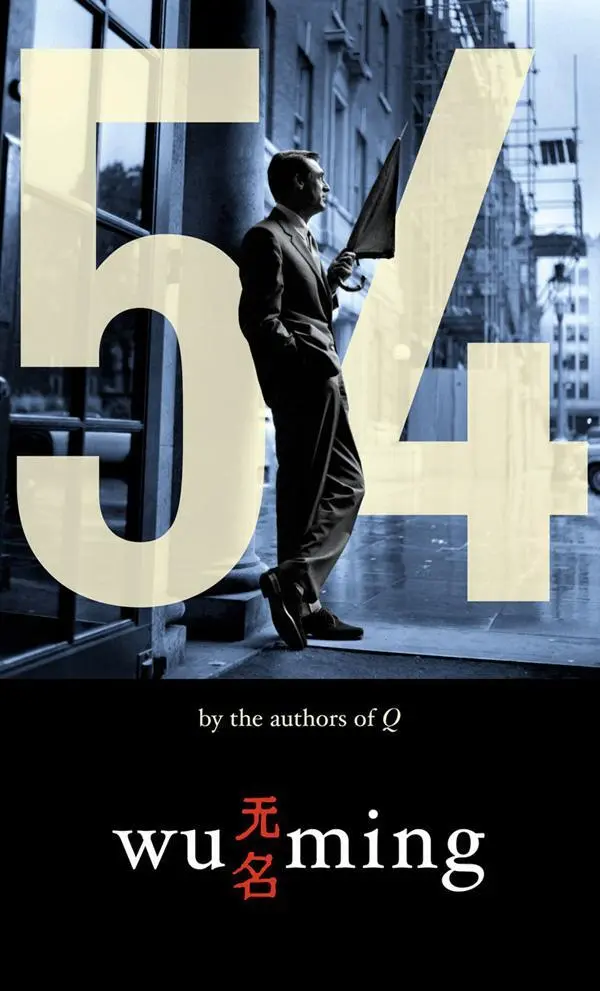
- Название:54
- Автор:
- Издательство:Houghton Mifflin Harcourt
- Жанр:
- Год:2006
- ISBN:нет данных
- Рейтинг книги:5 / 5. Голосов: 1
-
Избранное:Добавить в избранное
- Отзывы:
-
Ваша оценка:
54: краткое содержание, описание и аннотация
Предлагаем к чтению аннотацию, описание, краткое содержание или предисловие (зависит от того, что написал сам автор книги «54»). Если вы не нашли необходимую информацию о книге — напишите в комментариях, мы постараемся отыскать её.
Set during the height of the Cold War-with the world divided into East and West-54 features Italian partisans, KGB agents, Parisian lowlifes, and cameos by David Niven, Marshal Tito, and Grace Kelly. Wu Ming brings us a cinematic romp that is by turns edgy social satire and modern comic send up.
54 — читать онлайн бесплатно полную книгу (весь текст) целиком
Ниже представлен текст книги, разбитый по страницам. Система сохранения места последней прочитанной страницы, позволяет с удобством читать онлайн бесплатно книгу «54», без необходимости каждый раз заново искать на чём Вы остановились. Поставьте закладку, и сможете в любой момент перейти на страницу, на которой закончили чтение.
Интервал:
Закладка:
He got to his feet, they shook hands and he set off with short, quick footsteps.
He hadn’t even touched his coffee.
He spent the evening locked up in his room studying. So much to commit to memory: a new name, date of birth, a brief biography, the details of his itinerary. It took him two hours. On the Bulgarian vessel he would meet the other components of the mission: three exiled Yugoslavians with an expert knowledge of the region. Some hard men who, in 1949, had escaped from Goli Otok, where they had been interned as supporters of the Cominform. They had reappeared in Bulgaria, and the Ministry had picked them up in passing. Memorising the biographies took him another two hours. The years of training at Politics School made the task easier.
He still didn’t have the details of the mission itself. They must be inside the envelope he would give the commander of the vessel.
He gathered together all the documentation and burned it in the fireplace, one page after another.
Then he got dressed, performed three sets of press-ups on the carpet, and went to bed.
He had a long day’s train journey ahead of him.
Chapter 46
Bristol, 25 April
The greatest density of piliferous follicles per square centimetre of facial epidermis is recorded on the upper lip. The least, on the cheek. The type of beard and the frequency with which it requires to be shaved depends in part on anthropometric factors. Put bluntly, some races are hairier than others. Caucasians, vulgarly called ‘white’, are the most hirsute. Amongst these people, the beard reaches its maximum density at the age of about thirty-five.
Within film-going memory, Cary Grant had never displayed a beard longer than a twelfth of an inch. Among the sixty or so films in which he had appeared, the ones in which he did not appear perfectly shaven could be counted on the fingers of one hand. Each of those films coincided with a return of Archie Leach and his searing proletarian sarcasm. It’s difficult to cope with your traumas when you’re busy spying on Hollywood’s Nazis.
In The Talk of the Town , 1942, the Caucasian Grant — at the peak of his own piliferous productivity — played the role of Leopold Dilg, a trade unionist unjustly accused of homicide, who escapes prison and hides in the home of a fastidious law professor.
And after that came None But the Lonely Heart , 1944, practically a session of self-therapy. The head-to-head clash between Cary and Archie, as orchestrated by Clifford Odets. The story of the unemployed cockney Ernie Mott and his bitter, belated reconciliation with his mother after years of separation. (‘Did you love my old man?’ ‘Love is not for the poor, son. No time for it.’)
And then in the unsmiling city of Bristol, escorted by Her Majesty’s grey-suited servants, once again there are two of you.
Two, because you’re ‘Mr Grant’, the one who is obliged to camouflage himself lest anyone recognise him, but you’re also Archibald Alexander Leach, the one paradoxically free of camouflage, authorised to breathe, you’re the one singing silently to yourself the words of Anything Goes:
‘The world has gone mad today, and good’s bad today, and black’s white today, and day’s night today. ’
You’re the one walking the streets of your birthplace, preparing to see Elsie once again.
Your mother.
Elsie, who still calls you both ‘Archie’.
Elsie who talked to herself, washed her hands repeatedly, stripping off layer after layer of skin with a hard-bristled brush, and asked everyone and no one where her dancing shoes were.
Elsie, whom your father Elias had placed without your knowledge in a psychiatric clinic. The Country Home for Mental Defectives, in the crumbling suburb of Fishponds, the terminus of one of Bristol’s tramlines.
You were nine years old. ‘She’s gone to the seaside, to Westonsuper-Mare, for a few days’ holiday.’
When did you work out that she wouldn’t be coming back? When exactly did you conclude that your parents had separated, that your mother had abandoned you?. Archie?
Elsie, just one pound a year to keep her in a state of filth, nonexistent hygiene, aggressive nurses.
Elsie, twenty pounds in all, until the death of her husband and the letter dispatched by an English lawyer.
Elsie, alive. Fifty-seven years old.
December 1935.
Migraines, nightmares, the ghost of your father trying clumsily to justify himself. Stinking breath, worms in the throat of the man who died of cirrhosis of the liver. ‘You can’t ask other people to be transparent, Archie. Even you aren’t transparent.’
Dodging journalists. A few months before, at your father’s funeral, you fell into the hands of a clutch of reporters. Then the meeting:
‘Mother. I’m here.’
She remembers you in short trousers, Archie.
She doesn’t recognise you, Cary. She doesn’t know you’re a famous actor.
‘Archie, my boy. Is it really you? Have you missed your old mum?’
A life annuity. Finances administered by the office of Davies, Kirby and Karath in London. A house all to herself, where you can go and see her. No servants, though: ‘I can manage fine on my own, my darling, I don’t want people buzzing around me telling me what to do, and you see, keeping myself busy keeps me alive, my love.’
And here she is now, in 1954, in Bristol, in the strangest days of your life; you open the door and see the little old woman sitting at the end of the corridor. Will she recognise you, under a quarter of an inch of beard, and wrapped up in a grey duffel-coat? When you take off your hat (Cary hates hats!) your old mother’s face lights up with surprise. She gets up with a little start, throws up her arms and shrieks, ‘Archie! Son! I’m so happy to see you!’
The world has gone mad today.
A few hours after saying goodbye to his old mother, Cary — booked into a small hotel in Swindon under the name of ‘George Kaplan’, his bodyguards’ rooms on the same floor — sought sleep by reading this man Fleming’s little book. The protagonist was a bold and arrogant secret agent on a mission to the French town of Royale-les-Eaux. MI6 had given him an unlimited budget: stratospheric sums to bet at baccarat, extremely generous tips distributed to the hotel concierges, glass after glass of vodka.
For a few moments Bond sat motionless, gazing out of the window across the dark sea, then he shoved the bundle of banknotes under the pillow of the ornate single bed, cleaned his teeth, turned out the lights and climbed with relief between the harsh French sheets. For ten minutes he lay on his left side reflecting on the events of the day. Then he turned over and focused his mind towards the tunnel of sleep.
Cary looked up: around him, peeling, faded wallpaper. Bubbles had formed, distorting aeroplanes and small smiling women. There was a small, almost invisible hole in the pillow. Every now and again a feather came out. The light from the lamp was too faint. The only window looked out on to a little alleyway with no distinguishing features. Outside it was raining.
The plot was about espionage and games of chance. Bond had to trap a communist double-agent, Le Chiffre, by setting a trap for him in the Casino Royale.
Bond liked to make a good breakfast. He consumed half a pint of iced orange juice, three scrambled eggs and bacon and a double portion of coffee without sugar. He lit his first cigarette, a Balkan and Turkish mixture made for him by Morlands of Grosvenor Street.
Paragraph after paragraph of pointless details, depicting a lifestyle that struck Cary as brash and fake:
Bond’s car was his only personal hobby. One of the last of the 4 1/2-litre Bentleys with the supercharger by Amherst Villiers. It was a battleship-grey convertible coupé, which really did convert, and it was capable of touring at ninety with.
Читать дальшеИнтервал:
Закладка:
Похожие книги на «54»
Представляем Вашему вниманию похожие книги на «54» списком для выбора. Мы отобрали схожую по названию и смыслу литературу в надежде предоставить читателям больше вариантов отыскать новые, интересные, ещё непрочитанные произведения.












Обсуждение, отзывы о книге «54» и просто собственные мнения читателей. Оставьте ваши комментарии, напишите, что Вы думаете о произведении, его смысле или главных героях. Укажите что конкретно понравилось, а что нет, и почему Вы так считаете.