Wu Ming - 54
Здесь есть возможность читать онлайн «Wu Ming - 54» весь текст электронной книги совершенно бесплатно (целиком полную версию без сокращений). В некоторых случаях можно слушать аудио, скачать через торрент в формате fb2 и присутствует краткое содержание. Год выпуска: 2006, Издательство: Houghton Mifflin Harcourt, Жанр: Историческая проза, на английском языке. Описание произведения, (предисловие) а так же отзывы посетителей доступны на портале библиотеки ЛибКат.
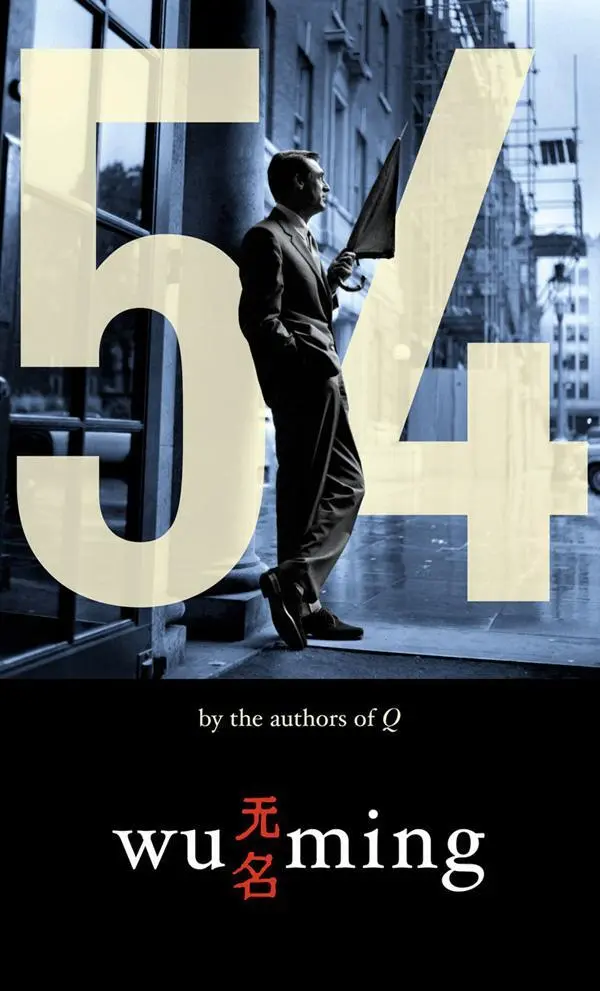
- Название:54
- Автор:
- Издательство:Houghton Mifflin Harcourt
- Жанр:
- Год:2006
- ISBN:нет данных
- Рейтинг книги:5 / 5. Голосов: 1
-
Избранное:Добавить в избранное
- Отзывы:
-
Ваша оценка:
54: краткое содержание, описание и аннотация
Предлагаем к чтению аннотацию, описание, краткое содержание или предисловие (зависит от того, что написал сам автор книги «54»). Если вы не нашли необходимую информацию о книге — напишите в комментариях, мы постараемся отыскать её.
Set during the height of the Cold War-with the world divided into East and West-54 features Italian partisans, KGB agents, Parisian lowlifes, and cameos by David Niven, Marshal Tito, and Grace Kelly. Wu Ming brings us a cinematic romp that is by turns edgy social satire and modern comic send up.
54 — читать онлайн бесплатно полную книгу (весь текст) целиком
Ниже представлен текст книги, разбитый по страницам. Система сохранения места последней прочитанной страницы, позволяет с удобством читать онлайн бесплатно книгу «54», без необходимости каждый раз заново искать на чём Вы остановились. Поставьте закладку, и сможете в любой момент перейти на страницу, на которой закончили чтение.
Интервал:
Закладка:
Cary closed the book, put out the light and ‘focused his mind towards the tunnel of sleep’.
Frances Farmer arrived at two in the morning. Archie and Cary dreamt of her locked up in the lunatic asylum in Fishponds, but tranquilised by American paramedics, rednecks to a man, not even shouting, then alone, her knees in a puddle of urine with saliva and cigarette butts floating about in it.
‘Archie, my son. Have you missed your old mum?’
A crowd of people screamed from a single throat: a nine-year-old child coming home and being unable to find his mother, a famous actor meeting up with his mother after twenty-one years of separation; an English proletarian imprisoned in the body and the myth of the most stylish man in the world; an ex-actor racked with doubts about his future; the double of a certain Jean-Jacques Bondurant; a Caucasian with a terrible nostalgia for the invention of King C. Gillette; a secret agent involved in a bizarre diplomatic enterprise; a paranoid schizophrenic persecuted by ghosts; and last of all, one ‘George Kaplan’.
The little hotel was filled with voices and hubbub. The bodyguards, in their shirtsleeves, burst open the door but stayed out of the opening, then dived on to the floor of the room, revolvers at the ready. When they saw that Cary was (apparently) alone, they got back up, and one of them asked, ‘Is everything all right, Mr Kaplan?’
Cary, in a pair of dark-blue pyjamas with two or three white feathers stuck to it, and a beard almost half an inch long, looked at them and replied, ‘Yes. It was just a bad dream. Forgive me.’
When they had gone, Cary got up, brushed down his pyjamas, took a needle and thread from his jacket pocket and mended the hole in the pillow. He sat down on the bed and opened Fleming’s book again. Chapter 6 was called ‘Two Men in Straw Hats’.
Chapter 47
Flying over the Channel, 26 April
The communist agents were described as utter imbeciles, incompetents with shady attitudes, and recognisable from a hundred yards away.
James Bond walks along the footpath. On the other side of the tree-lined avenue, two strange figures leaning against a plane tree. They are dressed alike: dark, ‘rather hot-looking’ suits (how could you fail to notice a detail like that, from only a hundred yards away?) and straw hats decorated with a black ribbon. They are both wearing cameras around their necks, although one of them is carrying his in a red case, the other in a blue case. Bond makes his way towards them, wondering what sort of attack he’s going to have to deal with. Red-man nods to Blue-man, who takes out his camera, kneels down. and is ripped apart by a terrible explosion. The impact sends Bond flying and blows down the two nearest trees, the others escaping with scorched foliage. All around, the stench of roast mutton. The two figures are reduced to scraps of flesh. The explanation comes a few chapters later: two Bulgarian hired killers. Their instructions: to unleash a smoke screen from the blue case, while the red one was a bomb to be thrown at Bond. Protected by the smoke, the assassins were to make their getaway unharmed. In actual fact, both the cases were bombs, the goal being to eliminate Bond and leave no witnesses alive.
Scratching the dense bristles on his cheeks in disbelief, Cary had reread the whole section out loud, for the benefit of his escort.
‘Who does this guy Fleming think he’s kidding? First of all, there have been no reports of any bombing attacks by Soviet agents in Western Europe; secondly, a sequence of events of that kind is extremely unlikely; and last of all, if every enemy operation were to conclude with the elimination of the perpetrators, there would be no enemy left!’
‘Well said, and in any case Soviet agents aren’t like that, and neither are agents working on Her Majesty’s service: this man Bond is a dandy, and his conduct on the mission is thoroughly reprehensible. Besides, MI6 would never burden the Commonwealth Exchequer with the budget of such a bizarre mission, set entirely in the world of gambling.’
They were as boring as a conference of Flemish podiatrists.
This conversation had taken place in the truck bringing him to the little military airport from which they had taken off for the Free Territory of Trieste.
On the plane, Cary put aside the novel, and concentrated on the files.
Many of the pages of this compendium on the Yugoslavian war of liberation dwelt on the German Fifth Offensive against Tito’s army (the encircling of the freed territories of Montenegro and Hercegovina, May — June 1943).
The Axis forces consist of eight divisions, a total of 120,000 welltrained men, including groups of artillery and armoured units, plus a squadron of Luftwaffe bombers. Tito has 15,000 poorly armed soldiers, starving and exhausted, plus another 4,500 injured men in the field hospitals, many of whom are dragging themselves around with open wounds bared for want of bandages. The partisans — including the wounded — are fighting desperately, always hand to hand, running along rough mountain paths in broken shoes. Finally the remnants of two divisions break through the lines, sacrificing almost two thirds of their effective forces, including some of the best officers.
The Fifth Offensive had been defeated. It was one of the most epic and unbelievable chapters of the whole war. No one should have been surprised that they wanted to get a film out of it, but Cary was perplexed about the role he was supposed to play.
The outline mentioned the ‘participation of British personnel’ in breaking through enemy lines. To Cary, such ‘participation’ seemed relatively insignificant, at least from the military point of view. The British mission consisted of six men, including Major William Stuart and Major F. W. Deakin. They had parachuted into Tito’s headquarters on the night between 27 and 28 May.
In response to Stuart’s question, ‘Where’s the front?’ Tito had replied, ‘Wherever the Germans are.’ Stuart had said, ‘And where are the Germans?’, to which Tito had shot back, ‘Everywhere.’
On 9 June, during a German bombing raid, Stuart had been killed and Deakin had been injured in the foot. On the same occasion a piece of shrapnel had wounded Tito in his left arm, and another had killed his dog Lux.
Who were they suggesting he play, Stuart or Deakin? There wasn’t much to go on in either case, unless the scriptwriters were going to rely on fantasy. Who knows, perhaps they would introduce an imaginary character, to inflate and glorify the ‘involvement of British personnel’. It seemed like a lunatic idea.
. Until he moved on to the long historical and biographical section on Josip Broz, otherwise known as ‘Walter’, ‘Zagorac’, ‘Novak’, ‘Rudi’, ‘Kostanjsek’, ‘Slavko Babic’, ‘Spiridon Mekas’ and above all. Tito. Pseudonyms and false names adopted during his long periods underground.
There were various photographs attached to the seventy pages. All of the pictures taken during the war showed Tito in uniform. A hard expression, features sculpted from marble. Bolt upright, every inch the part. With his arm in a bandage. Thoughtful, smoking a Bent army pipe, slender and curved. With his glasses on, studying topographical maps. Meeting his senior officers. With Winston Churchill in Naples, in 1944. With Stalin the following year.
The photographs from the period after the revolution were very different: Tito was almost always shown in the peace and tranquillity of his own various residences scattered around the country.
On the Brioni islands in June 1952: half-length portrait. Pale suit (beige, perhaps; linen, at a guess) with a narrow lapel, very probably two-buttoned. A lighter-coloured shirt with a tab collar, a tie with a large polka-dot pattern knotted in a tight triangle, (and probably without a loop, given that he wore a tie pin). An unmistakable Panama hat on his head. A sardonic smile, a smug expression directed at the lens. A cigarette smoked with a long holder. He looked a bit like a gangster, but he showed a certain style.
Читать дальшеИнтервал:
Закладка:
Похожие книги на «54»
Представляем Вашему вниманию похожие книги на «54» списком для выбора. Мы отобрали схожую по названию и смыслу литературу в надежде предоставить читателям больше вариантов отыскать новые, интересные, ещё непрочитанные произведения.






Обсуждение, отзывы о книге «54» и просто собственные мнения читателей. Оставьте ваши комментарии, напишите, что Вы думаете о произведении, его смысле или главных героях. Укажите что конкретно понравилось, а что нет, и почему Вы так считаете.