Wally Lamb - We Are Water
Здесь есть возможность читать онлайн «Wally Lamb - We Are Water» — ознакомительный отрывок электронной книги совершенно бесплатно, а после прочтения отрывка купить полную версию. В некоторых случаях можно слушать аудио, скачать через торрент в формате fb2 и присутствует краткое содержание. Жанр: unrecognised, на английском языке. Описание произведения, (предисловие) а так же отзывы посетителей доступны на портале библиотеки ЛибКат.
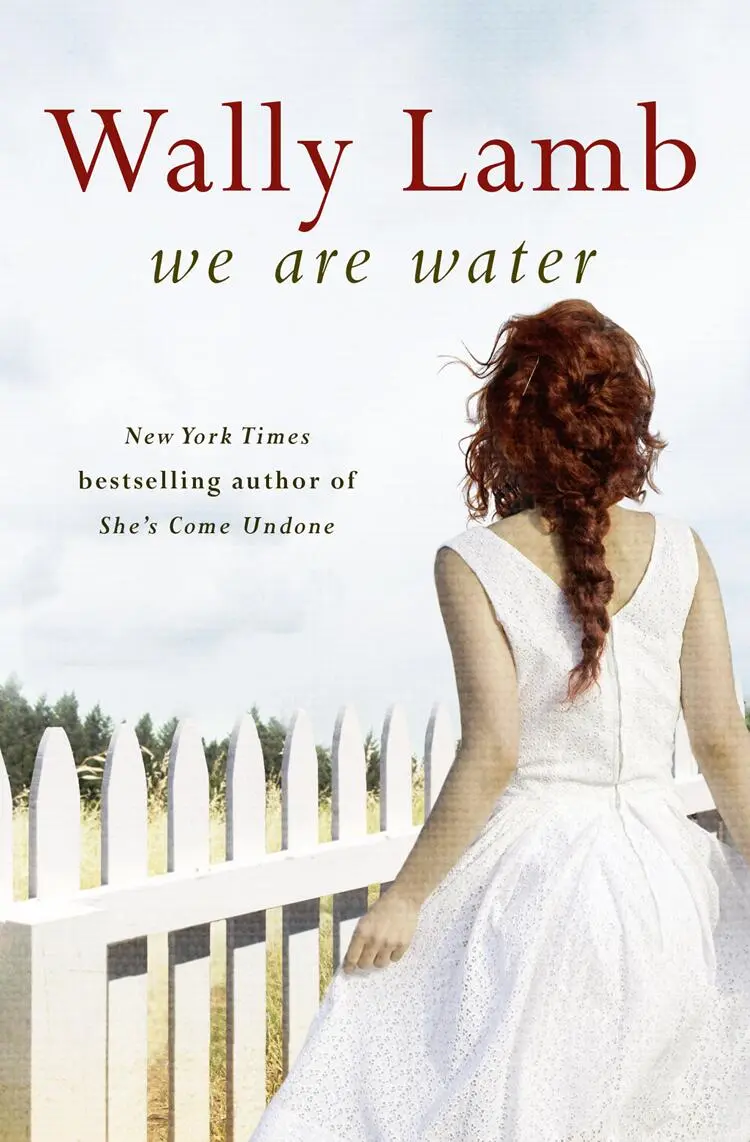
- Название:We Are Water
- Автор:
- Жанр:
- Год:неизвестен
- ISBN:нет данных
- Рейтинг книги:5 / 5. Голосов: 1
-
Избранное:Добавить в избранное
- Отзывы:
-
Ваша оценка:
We Are Water: краткое содержание, описание и аннотация
Предлагаем к чтению аннотацию, описание, краткое содержание или предисловие (зависит от того, что написал сам автор книги «We Are Water»). Если вы не нашли необходимую информацию о книге — напишите в комментариях, мы постараемся отыскать её.
We Are Water — читать онлайн ознакомительный отрывок
Ниже представлен текст книги, разбитый по страницам. Система сохранения места последней прочитанной страницы, позволяет с удобством читать онлайн бесплатно книгу «We Are Water», без необходимости каждый раз заново искать на чём Вы остановились. Поставьте закладку, и сможете в любой момент перейти на страницу, на которой закончили чтение.
Интервал:
Закладка:
It’s not one of the kids calling me; they text me now. Before I left this morning, I deliberated about whether to take the damned cell phone with me or leave it back in Three Rivers. But what if there was an emergency? So I threw it in the glove compartment and locked it. I thought I turned the damn thing off, but I guess not. Ahh, relief. The call has gone to voice mail.
“It’s a little unusual to see them in these cooler Massachusetts waters at this time of year,” the shark expert tells her interviewer, a guy who, for some reason, is calling himself the Mad Hatter. “But the gray seal population’s been on the rise, and we think that’s what’s probably luring them.”
The Mad Hatter chortles. “So you’re saying the problem is that there’s been too much seal sex? Too many pinnipeds puttin’ out?”
“Uh, well …”
The Diane Rehm interview I’d been listening to faded away somewhere between Braintree and Buzzards Bay. Conversely, the Mad Hatter is coming through so loudly and clearly that he might as well be broadcasting from the backseat. “Time now for traffic, news, and weather. And when we come back, we’ll have more with Dr. Tracy Skelly from the Division of Marine Fisheries.”
Despite my initial resistance to the idea, I’m staying rent free at Viveca’s place in North Truro for the month, hoping that a Cape Cod retreat might allow me, after a summer’s worth of drifting and wound licking, to anchor myself. Figure out how to shed my bitterness, forgive myself and others and start over. Orchestrate a reinvention, I guess you’d say. Thirty days has September: it’s a tall order.
My game plan, once I survive this hideous holiday traffic and get settled in, is to eat healthy, cool it on the drinking, exercise. I’ll jog and journal every morning, then bike to the beach for an afternoon swim. After dinner, I’ll read and research—Google phrases like “new professions after 50,” “change career paths.” But with sharks in the water, it doesn’t sound like I’ll be doing a whole lot of swimming. Of course, there’s always the placid bayside, but what I want is turbulence—bodysurfing along the crest of the five- or six-foot swells and getting roughed up a little by the waves I misjudge—the ones that, instead of carrying me, crack against me. I’ve been hoping the wildness of the water might somehow both cleanse me of my failings as a university psychologist and baptize me as … what?
What do you want to be when you grow up? The adults were always asking me that when I was a kid, and because I liked to draw—reproduce the images in comic books and Mad magazine—I’d say I wanted to be an artist. I’d enjoyed my high school art classes, had gotten good grades for my work. And so I’d entered college with a vague plan to major in art. In my first semester, my Intro to Drawing professor, Dr. Duers, had said during my portfolio review that I had a good sense of composition and a talent worth developing. But the following semester, I’d run up against Professor Edwards, an edgy New York sculptor who was disdainful of having to teach studio art to suburban college kids—who had come out and told us he was only driving up from the city twice a week because of the paycheck. It had crushed me the morning he’d stood over my shoulder, snickered at the still life I was drawing, and walked away without a word. But that same semester, I got an A in an Intro to Psych course I really liked. And so I had put away my sketch pad and gone on to the 200-level psychology classes. And then the summer between my sophomore and junior years, I got a job as a second-shift orderly at the state hospital.
I liked working there. Liked shooting the shit with the patients. Not the ones who were really out of it, but the ones who were in there for shorter-term stays. The “walking wounded,” as the nurses called them. Some of those patients would be admitted in pretty rough shape—straitjacketed and sputtering nonsense, or in such deep depressions that they were almost catatonic. But two or three weeks later, with their equilibrium restored by meds and talk therapy, they’d be discharged back into the world.
The psychiatrists were off-putting. Tooled around the wards like they walked on water. But the psychologists were different. More humane, less in a hurry. “You’re good with the patients,” one of them, Dr. Dow, told me one day. “I’ve noticed.” For him, it was nothing more than a casual observation, but for me—a kid who, up to that point, had never gotten noticed for much of anything—it was huge. On my day off, I drove up to the Placement Office at school and took one of those tests that identifies your strengths, suggests what career paths you should consider. When I got my results back, it said I had scored high on empathy and should consider the helping professions: social work, psychology. And so, at the beginning of my fifth semester, I declared psychology as my major.
I kept my job at the hospital. Worked there on weekends. They assigned me to the adolescent unit mostly: boys who had lit fires or tortured the family pet; girls who had attempted suicide or were taking the slow route via eating disorders. And then one night—Christmas Eve it was; I was covering for another orderly who wanted to be with his family—I met a new arrival who’d been admitted because of a holiday meltdown.
Siobhan was a pretty seventeen-year-old with auburn hair and pale skin. She’d been a competitive Irish step-dancer until a torn ACL had brought all that to a halt. She was type A all the way, and a big reader. Jane Eyre, Wuthering Heights , Tess of the d’Urbervilles : the kinds of books that, back in high school, it had been torture for me to get through. Siobhan told me, straight-faced, that she was misplaced in time—that she should have been born in an earlier, more romantic era. Fashioned herself as a tragic heroine, I guess. We weren’t friends, exactly—that was against hospital policy—but we were friendly. I liked her sarcastic sense of humor and she liked mine. And believe me, humor was in short supply at that place. She nicknamed me Heathcliff—because of my “dark, swarthy looks,” she said. My “big, soulful brown eyes.” One time, she asked me what kind of a name “Oh” was, and when I told her, she wanted to know why I didn’t look Chinese. “Because I’m Italian, too,” I told her.
She reached out and touched my face when I said that. Studied it so intently that I had to look away. I was, at the time, an insecure, blend-in-with-the-woodwork twenty-year-old, not used to such focused attention. “Now I can see it,” she finally said.
“It?”
“The Orient. It’s in your eyes. It makes you uniquely handsome, but I suspect you already know that.” Handsome? Me? I laughed. After that exchange, she stopped calling me Heathcliff. Now I was Marco Polo.
Sometimes, if things were slow on the ward after I had cleared away the dinner trays, I’d play Scrabble or Monopoly with her and some of the other patients. More often than not, Siobhan would win, and after a while I figured out how. She’d cheat. I didn’t call her on it. Didn’t really give a shit who won. But she knew that I knew. “Better watch out for that one,” one of the old guard nurses warned me. “She’s got a crush on a certain someone.”
At the nurses’ station one night, Siobhan’s chart was out on the counter and I took a peek. It read: “Manic-depressive disorder. Psychomotor agitation during manic phase that manifests itself as oral fixation.” The latter wasn’t surprising. For one thing, Siobhan smoked like a chimney. And when she was out of cigarettes and couldn’t bum them, she would put other things in her mouth and chew on them: hard candies, pens and pencils, the cuffs of her shirts. The covers of her paperbacks were crisscrossed with teeth marks.
Читать дальшеИнтервал:
Закладка:
Похожие книги на «We Are Water»
Представляем Вашему вниманию похожие книги на «We Are Water» списком для выбора. Мы отобрали схожую по названию и смыслу литературу в надежде предоставить читателям больше вариантов отыскать новые, интересные, ещё непрочитанные произведения.






Обсуждение, отзывы о книге «We Are Water» и просто собственные мнения читателей. Оставьте ваши комментарии, напишите, что Вы думаете о произведении, его смысле или главных героях. Укажите что конкретно понравилось, а что нет, и почему Вы так считаете.