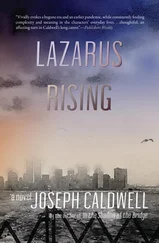
John Howard - Lazarus Rising
Здесь есть возможность читать онлайн «John Howard - Lazarus Rising» — ознакомительный отрывок электронной книги совершенно бесплатно, а после прочтения отрывка купить полную версию. В некоторых случаях можно слушать аудио, скачать через торрент в формате fb2 и присутствует краткое содержание. Жанр: unrecognised, на английском языке. Описание произведения, (предисловие) а так же отзывы посетителей доступны на портале библиотеки ЛибКат.
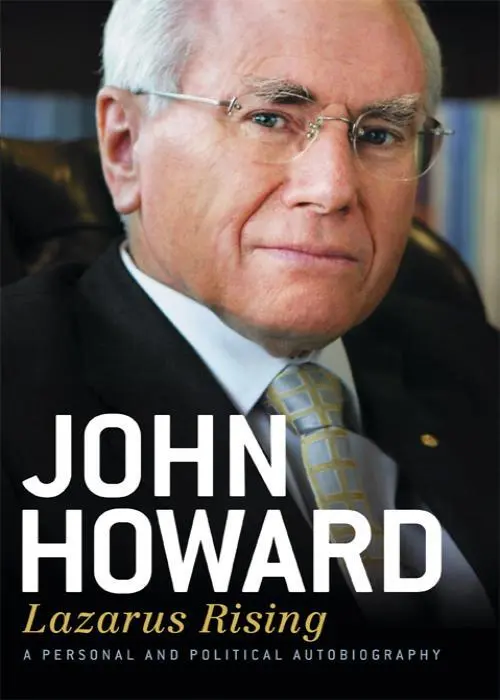
- Название:Lazarus Rising
- Автор:
- Жанр:
- Год:неизвестен
- ISBN:нет данных
- Рейтинг книги:4 / 5. Голосов: 1
-
Избранное:Добавить в избранное
- Отзывы:
-
Ваша оценка:
Lazarus Rising: краткое содержание, описание и аннотация
Предлагаем к чтению аннотацию, описание, краткое содержание или предисловие (зависит от того, что написал сам автор книги «Lazarus Rising»). Если вы не нашли необходимую информацию о книге — напишите в комментариях, мы постараемся отыскать её.
Lazarus Rising — читать онлайн ознакомительный отрывок
Ниже представлен текст книги, разбитый по страницам. Система сохранения места последней прочитанной страницы, позволяет с удобством читать онлайн бесплатно книгу «Lazarus Rising», без необходимости каждый раз заново искать на чём Вы остановились. Поставьте закладку, и сможете в любой момент перейти на страницу, на которой закончили чтение.
Интервал:
Закладка:
* * *
The 1980 budget will chiefly be remembered as the one which was almost fully leaked by Laurie Oakes, then with Channel 10. Oakes got hold of one of the close-to-final drafts of my budget speech, and its leaking a few nights before the budget was a huge embarrassment for the Government. I later thought that the leak had come from a public service source.
The leak completely overshadowed the fact that for the first time in years Australia was projected to record a domestic budget surplus. After five years of grind, it was a significant achievement but its symbolism was completely lost in the bigger story of the budget’s premature disclosure.
The 1980 election and its immediate aftermath would markedly change my relationship with Malcolm Fraser on policy issues. I had retained my enthusiasm for taxation reform involving the introduction of a broad-based indirect tax accompanied by reductions in personal income tax. After the election had been called I reached an understanding with the Prime Minister, which he honoured in full, that neither of us, nor indeed the Deputy Prime Minister, Doug Anthony, would, during the course of the campaign, rule out future taxation reform. I wanted to keep open the option of moving on this issue if the Government were returned.
Hayden exceeded expectations in the campaign but Labor still fell short, with the Government winning with a reduced majority of 23 seats. Bob Hawke entered parliament via the safe Labor seat of Wills, in Victoria. There was a big swing against the Liberal Party in Victoria, although we held up better in New South Wales. Most people attributed this to the effective fear campaign waged by the Government on the capital gains tax issue during the dying days of the campaign. Peter Walsh, who became Finance Minister in the Hawke Government, had raised the possibility of a capital gains tax. Fraser grabbed hold of this with an impressive ferocity, reminding all of us what a formidable campaigner he could be. Walsh should have known that Fraser would hurt Labor with a claim it would tax the family home.
When the remarks were made by Walsh, the Government was struggling in the polls, and although Labor had a huge leeway to make up there was considerable nervousness in the Liberal camp. Property values in Sydney were higher than in any other part of the country, and the capital gains tax issue resonated in the nation’s biggest city more than anywhere else. Ten days out from the election, Fraser rang me at home and said that ‘our polling says that Labor is in a clear winning position'. I had spent most of my time in New South Wales, and told him that the mood in that state was still strong for the Government.
As a measure of Fraser’s nervousness, he rang me on the Tuesday before polling, when I was campaigning for Michael Baume at the Moss Vale Golf Club in his electorate of Macarthur. Fraser told me that he had a number of ministers, mainly Victorians, gathered in his office discussing the state of the campaign. They were canvassing the possibility of the Prime Minister announcing that the Government would boost family allowances if it were returned. I said I thought that would be regarded as a panic move by the electorate, and might backfire. He asked me to seek Michael Baume’s view, given that Michael held a marginal seat. Michael replied, ‘Tell the big bastard to calm down and focus on the Government’s record.’
The 1980 election result was a real shock for Malcolm Fraser. It should not have been. The 1977 result simply reflected the unwillingness of the electorate to seriously contemplate Whitlam again. Once Whitlam had gone, things were bound to return to a more normal political situation.
When Malcolm Fraser and I discussed the election outcome, he said that part of the reason why the Government had lost so many seats was that he had not been able to give people lower taxes. He said that his Government had been elected on a smaller-government, lower-tax platform and more had to be done on this front, and that he intended to do something about it. This was encouraging, because I had to agree with him that that was part of the problem. Now that Whitlam himself was gone, it was no longer tenable to hark back to the Whitlam days too much.
He established what became known as the ‘razor gang', under the chairmanship of Phillip Lynch. This group of ministers was charged with trawling through all areas of government, to find expenditure savings to form the basis of a major statement about the size and direction of the Government. This was quite separate from my earlier understanding with Fraser to reform the taxation system.
As well as Phillip Lynch as chairman, the committee included me, Margaret Guilfoyle, the newly appointed Finance Minister, Peter Nixon, and Ian Viner. Fraser wanted the committee to start work immediately and have only minimal time off over the Christmas period, with a view to the major statement being made early in 1981.
Margaret Guilfoyle had replaced Eric Robinson as Finance Minister. Fraser demoted Robinson from cabinet to the outer ministry — for no good reason — and Robinson refused to serve in the lesser post. He died suddenly only weeks later (from a congenital heart condition). Robinson had been Queensland Liberal president, and the Nationals in that state unreasonably resented his continued, aggressive advocacy of the Liberal cause in Queensland. The friction this produced would have heavily influenced Fraser’s decision to treat Robinson as he did.
In keeping with our understanding, I announced that the Government would immediately start an examination of the taxation system, including the possibility of introducing a broad-based indirect tax, accompanied by reductions in personal income tax. Once again I felt quite excited, as this was a reform I was convinced was needed. There had been a false start two years earlier. There was only a six-month window of opportunity, as the Government would lose control of the Senate by 1 July 1981. There was not a moment to be lost, and I was keen to get to work on the tax proposal immediately.
On 3 December, the Monetary Policy Committee of cabinet, on my recommendation, decided that interest rates paid on deposits taken by banks from customers be deregulated. I had also argued for deregulation of lending rates, but this change was rejected. This was a significant decision and set the ball rolling on interest-rate deregulation, which would emerge a year later as one of Campbell’s major recommendations. Once rates offered by banks were deregulated, it was only a matter of time before the rates charged by banks had to be deregulated. Nonetheless, the ball rolled very slowly, as it was not until early 1986 that the Hawke Government moved to phased deregulation of lending rates by removing the ceiling for new loans, thus adopting a policy I had advocated as Opposition leader.
When announcing the 3 December decision to parliament, I challenged decades of orthodoxy on interest-rate controls, from both sides of the house, by pointing out that, in particular, they had resulted in small borrowers being denied access to funds. Today such comments would be accepted as a statement of the obvious; in 1981 they were anything but.
After a gruelling year, I was relieved when I arrived at Hawks Nest, on the Central Coast of New South Wales, for a family holiday late in January. This would be the first of many holidays at Hawks Nest for our youngest child, Richard, who had been born the previous September. It went extremely well until I received a message from the motel owner asking me to ring Michelle Grattan, chief political correspondent of the Age. There was nothing strange in this of itself. Michelle was never one to be deterred by the fact that somebody was on holidays. When I rang back, she said, ‘Your indirect tax is dead, cobber.’ I asked her what she meant, and she told me that Malcolm Fraser had been on Melbourne radio a short while before, pointing out some of the difficulties in broadening the indirect tax base, including the time taken to put the proposal together, and its inflationary impact. The Age quoted him on 10 February as having said on radio the previous day that it would cost $3.5 million to cut the standard rate of tax from 32 to 25 cents in the dollar. He was reported as saying, ‘If you were going to raise the same amount of revenue by indirect tax you would add about 5 to 7 per cent to Australia’s inflation rate.’ 1 Fraser gave me no warning of his intervention.
Читать дальшеИнтервал:
Закладка:
Похожие книги на «Lazarus Rising»
Представляем Вашему вниманию похожие книги на «Lazarus Rising» списком для выбора. Мы отобрали схожую по названию и смыслу литературу в надежде предоставить читателям больше вариантов отыскать новые, интересные, ещё непрочитанные произведения.


Обсуждение, отзывы о книге «Lazarus Rising» и просто собственные мнения читателей. Оставьте ваши комментарии, напишите, что Вы думаете о произведении, его смысле или главных героях. Укажите что конкретно понравилось, а что нет, и почему Вы так считаете.