John Howard - Lazarus Rising
Здесь есть возможность читать онлайн «John Howard - Lazarus Rising» — ознакомительный отрывок электронной книги совершенно бесплатно, а после прочтения отрывка купить полную версию. В некоторых случаях можно слушать аудио, скачать через торрент в формате fb2 и присутствует краткое содержание. Жанр: unrecognised, на английском языке. Описание произведения, (предисловие) а так же отзывы посетителей доступны на портале библиотеки ЛибКат.
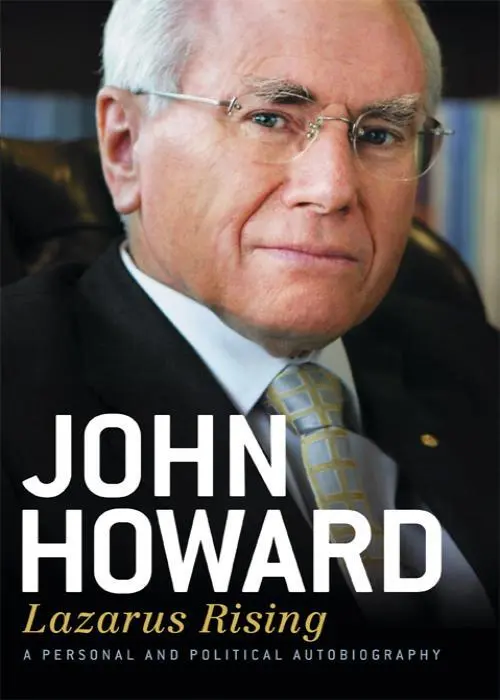
- Название:Lazarus Rising
- Автор:
- Жанр:
- Год:неизвестен
- ISBN:нет данных
- Рейтинг книги:4 / 5. Голосов: 1
-
Избранное:Добавить в избранное
- Отзывы:
-
Ваша оценка:
Lazarus Rising: краткое содержание, описание и аннотация
Предлагаем к чтению аннотацию, описание, краткое содержание или предисловие (зависит от того, что написал сам автор книги «Lazarus Rising»). Если вы не нашли необходимую информацию о книге — напишите в комментариях, мы постараемся отыскать её.
Lazarus Rising — читать онлайн ознакомительный отрывок
Ниже представлен текст книги, разбитый по страницам. Система сохранения места последней прочитанной страницы, позволяет с удобством читать онлайн бесплатно книгу «Lazarus Rising», без необходимости каждый раз заново искать на чём Вы остановились. Поставьте закладку, и сможете в любой момент перейти на страницу, на которой закончили чтение.
Интервал:
Закладка:
Fraser had committed the Coalition to an inquiry into the financial system at the 1977 election, and early in 1979 I established the Committee of Inquiry into Australia’s Financial System, to be chaired by Keith Campbell, the boss of LJ Hooker Limited, the leading real-estate developer; other committee members also had impeccable credentials for the task.
It produced a landmark report which reshaped, fundamentally, Australia’s financial system. I doubt that any major inquiry in past decades saw as many of its key recommendations adopted by governments as did the Campbell Inquiry. All of the members I appointed to the committee shared my view that the financial system should be deregulated. Therein lay its great strength — philosophical consistency. I ignored the urgings of some to appoint a token regulator. Sadly, Keith Campbell would not live to see the full implementation of his blueprint for modernisation. He died in 1983, shortly after the change of government.
The financial press may have welcomed the Campbell Inquiry, but such things meant little to the average citizen, who was still hoping for some reduction in interest rates. The general economic news, however, was slowly getting better. Unemployment finally began to fall, and something of a mining boom was gathering pace, especially in Western Australia and Queensland.
12 ‘YOUR INDIRECT TAX IS DEAD, COBBER’
As Treasurer I worked in close collaboration with the Prime Minister. Malcolm Fraser was a highly intelligent person with prodigious energy and a total preoccupation with the responsibilities of his high office. He was always the best informed on the widest range of subjects within cabinet. Having previously been a minister in both a major domestic portfolio (Education) and one with national security emphasis (Defence), he could bring perspectives to cabinet discussions lacking in others.
But he held too many cabinet meetings, and they went on for too long. Moreover, too many of them were called at very short notice, thus causing chaos with arrangements made to address gatherings in different parts of the country. On several occasions, I had to pull out of speeches or events to which several hundred people had committed themselves, in order to attend a Fraser meeting.
Malcolm Fraser made great demands of the public service. He was entitled to. Any prime minister is. They must, however, be prioritised demands. It is the worst possible administrative style to treat every request made of the public service as urgent. It is not the case. Nothing saps the willingness of public servants more than having to work over a weekend preparing a paper for ministers, only to have ministerial consideration delayed or, at the best, consisting of a cursory glance and a scrawled ‘noted’ on the paper.
There were regular clashes between Treasury and the Department of Prime Minister and Cabinet over economic policy. Fraser’s department mistrusted the Treasury, and Treasury elite were resentful that their advice should in any way be questioned or qualified. Tension could reach absurd dimensions. For one premiers’ conference, two completely separate working documents were produced for the discussion between the Prime Minister, me, and our respective advisors. Clearly there should have been agreement on one set of figures.
Having wanted the financial system inquiry, Fraser seemed to go cold on the idea of financial deregulation as Campbell’s work proceeded. His own utterances increasingly ran counter to what I expected the inquiry would recommend. At monetary policy meetings he would frequently criticise banks, and talk of the desirability of greater, not less, control of financial institutions. On several occasions he asked that consideration be given to proclaiming part IV of the Financial Corporations Act. That would have further extended financial regulation.
I arranged for Keith Campbell to brief Fraser on the work of his committee to date. As I sat through the briefing, it became clear that Fraser was uncomfortable, even irritated, by the direction the briefing was taking. Campbell made no attempt to disguise his view that significant deregulation of the financial system was essential.
John Hewson and the financial community, especially in Sydney, were enthusiastic about Campbell’s work and eagerly anticipated wide-ranging plans to shake up the system. Treasury was unenthusiastic, with the Reserve Bank being more supportive of deregulation. I did not think that the Monetary Policy Committee would be champing at the bit to adopt Campbell’s recommendations.
None of this affected Malcolm Fraser and me working together closely on the immediate economic goals: to keep the budget under control; reduce the deficit; and hopefully make room for further taxation relief. The deficit had fallen significantly over a two-year period, and by the time the 1980 election arrived we had a good story to tell on the expenditure-restraint front.
Malcolm Fraser rightly saw me as a close political ally within the Liberal Party. I was conscious of an underlying tension between him and ‘the young man', as he called Andrew Peacock. In part it was a product of their former rivalry regarding John Gorton, and the understandable ambitions which Peacock himself entertained about the leadership of the Liberal Party. To some degree I probably filled a gap left by the fracturing of Fraser’s relationship with Phillip Lynch, and the complete termination of it with Reg Withers. These two had been very close to Fraser through the Constitutional crisis of 1975, and in the early months of the new Government. Whilst Lynch and he continued to work together, I do not believe that trust was ever fully restored to the relationship following the events on the eve of the 1977 election.
I remained ambitious about my future, but it would have been a grand delusion to have imagined that, by 1978, I had developed any hard core of people who saw me as having a future beyond continuing as Treasurer. The economic dries remained supportive of Lynch. Those unhappy with Fraser, or still, for one reason or another, carrying lingering resentments about earlier disputes, tended to coalesce around Reg Withers and Andrew Peacock. Overwhelmingly, however, Fraser commanded the loyalty and support of the parliamentary party. He had won two massive victories, and had a demeanour which transmitted commitment and toughness.
On the other side of politics Hayden had replaced Whitlam after the 1977 election. He was respected within the political class for having done a good job as Treasurer in quite impossible circumstances. Deciding to stay out of the leadership for the first two years had been a sensible move. He had a Herculean task to restore his party’s credibility on financial matters.
Bob Hawke was by this point strutting across the national political stage as president of the ACTU, openly ambitious about winning a seat in federal parliament. It now seems incredible that it should have taken the Labor Party so long to find an electorate for him. Once he did win the prime ministership, he would demonstrate a connection with the Australian electorate stronger than any Labor leader, before or since. That, of course, was still several years into the future.
The other Labor figure outside the federal parliament who continued to make an impact was Neville Wran, the Premier of New South Wales. In my view, Wran joins Bob Hawke as one of the two most significant Labor figures of that generation. Wran gave Labor victory, and also competence in government, at a time when national morale for the party had hit rock bottom. Remember that Whitlam was routed in December 1975, and having waited 23 years in opposition to see their dream of a viable Labor alternative in government destroyed so quickly, Labor people despaired of the future. Winning government in New South Wales in May 1976 gave Labor new heart. Wran was a polished media performer — as good as any I have seen on TV news bulletins — got on well with what he called ‘the big end of town', and provided something of a role model for future state Labor governments around the country.
Читать дальшеИнтервал:
Закладка:
Похожие книги на «Lazarus Rising»
Представляем Вашему вниманию похожие книги на «Lazarus Rising» списком для выбора. Мы отобрали схожую по названию и смыслу литературу в надежде предоставить читателям больше вариантов отыскать новые, интересные, ещё непрочитанные произведения.









Обсуждение, отзывы о книге «Lazarus Rising» и просто собственные мнения читателей. Оставьте ваши комментарии, напишите, что Вы думаете о произведении, его смысле или главных героях. Укажите что конкретно понравилось, а что нет, и почему Вы так считаете.