Gordon Stevens - Peace on Earth
Здесь есть возможность читать онлайн «Gordon Stevens - Peace on Earth» — ознакомительный отрывок электронной книги совершенно бесплатно, а после прочтения отрывка купить полную версию. В некоторых случаях можно слушать аудио, скачать через торрент в формате fb2 и присутствует краткое содержание. Жанр: unrecognised, на английском языке. Описание произведения, (предисловие) а так же отзывы посетителей доступны на портале библиотеки ЛибКат.
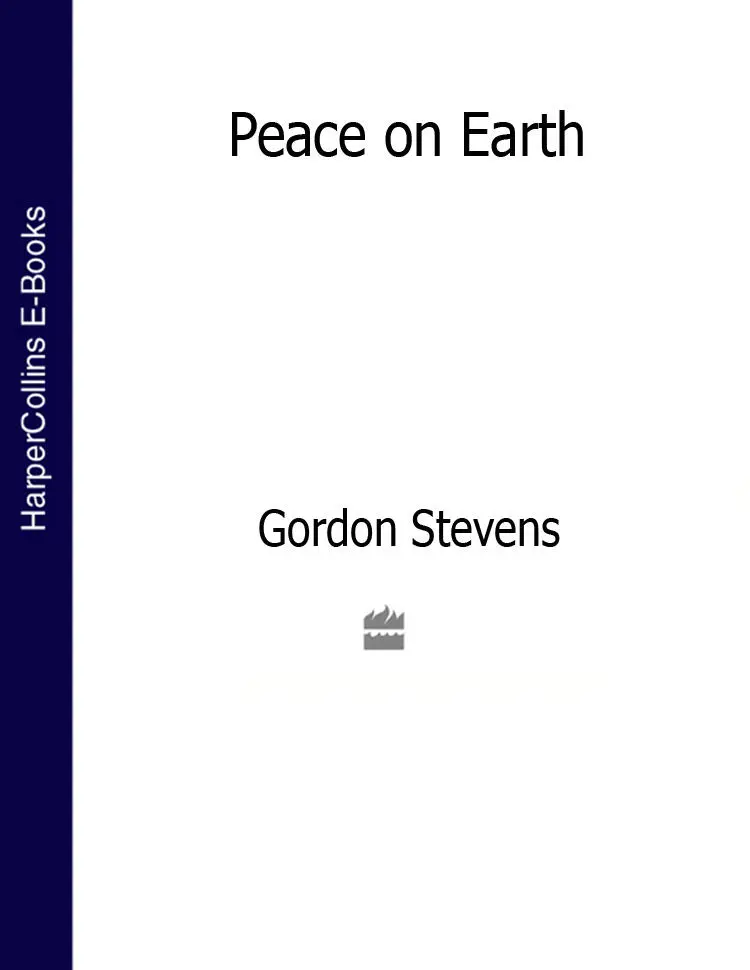
- Название:Peace on Earth
- Автор:
- Жанр:
- Год:неизвестен
- ISBN:нет данных
- Рейтинг книги:3 / 5. Голосов: 1
-
Избранное:Добавить в избранное
- Отзывы:
-
Ваша оценка:
Peace on Earth: краткое содержание, описание и аннотация
Предлагаем к чтению аннотацию, описание, краткое содержание или предисловие (зависит от того, что написал сам автор книги «Peace on Earth»). Если вы не нашли необходимую информацию о книге — напишите в комментариях, мы постараемся отыскать её.
Peace on Earth — читать онлайн ознакомительный отрывок
Ниже представлен текст книги, разбитый по страницам. Система сохранения места последней прочитанной страницы, позволяет с удобством читать онлайн бесплатно книгу «Peace on Earth», без необходимости каждый раз заново искать на чём Вы остановились. Поставьте закладку, и сможете в любой момент перейти на страницу, на которой закончили чтение.
Интервал:
Закладка:
‘Every morning at six?’ she asked incredulously.
‘Every morning at six,’ he confirmed.
Walid Haddad sat in the darkness, the windows and doors closed, his shoulders hunched and his hands clasped tight in front of him.
Leish ya’Allah a hijack? Why in the name of Allah a hijack?
The thought crossed and re-crossed his mind. He moved his legs slightly, easing the pressure on them, and pushed himself even deeper into the chair. He had been like this, locked into himself, for the past four hours, ever since he had returned from the briefing with Abu Nabil.
The concentration was consuming him. He eased himself forward, searched for the small lamp on the floor at the side of the chair, switched it on, and made himself coffee.
There were hijacks, of course, often bloody, always spectacular, and there were groups who would carry them out. But they were the small groups, the fringe groups, who believed in violence for its own sake, not as a means to an end. He sat down again, leaving the light on, and placing the cup on the arm of the chair. Hijacks were no good if they made you enemies, if they lost you friends. Nabil had long seen that, used it as a criterion against which to judge every action on which he sent his men, quoted it when he had vetoed the many ideas that were placed in front of him.
So why a hijack? he thought again.
It was getting cold. He stood up, pulled on a sweater, and slumped back into the chair, pushing the reasons for the hijack to the back of his mind, turning his attention to the logistics and concentrating on the two basic requirements that were within his responsibility: how the hijack would take place, and where.
The two could not be separated, he was aware, separated them anyway, studying each in turn, beginning with the second.
Almost certainly Europe, Nabil had said. Definitely Europe, if a West German was to be in his team, Haddad thought, if the West German government was to be the target of their demands. All the big hijacks of the past had started in Europe. It was good for the publicity, the ease with which the television people could get their pictures out, the images without which the hijack would have no impact. Bad for everything else, especially the security. With the exception of Athens, most airports in Europe were tight, not water-tight, but tight. He wondered if he could turn the fact to his advantage, and began to reflect on what, in his mind, he already thought of as the Dubai factor, knowing that he would return to it, then switched his attention to the other requirement.
Getting his team on the plane would be simple, they would have no difficulty posing as ordinary passengers, using false identities and passports. The problem was how to get their weapons and explosives on with them. Not just pistols, not just inflight perfumes and spirits splashed round the cabin in the hope they would ignite. The weapons and explosives had to be good, the best. Not only that, they would have to be seen to be the best.
There was no sense in hoping he could pick up additional materials half way through, stop for refuelling in, say, Libya, and trust that Gadafy would supply him with what he needed. Gadafy aside, it was too obvious, with too many political as well as military complications. It had also been done before, it was one of the things they would expect, and the only way the hijack would succeed, the only way he would get through it, was if he always did what they did not expect.
Not always , the thought came into his mind, it was not correct that he should always do what they did not expect. Sometimes he would do what they expected. Or would appear to do what they expected. He thought again about what in his mind he referred to as the Dubai factor and began to analyse why he had always thought it was important, how he had always known that one day he would use it.
In December 1984 a group of Shi’ite Moslems had hijacked an airbus of Kuwaiti Airlines en route from Dubai to Karachi and diverted it to Teheran. The hijack had ended six days later when they were over-powered by the Ayatollahs security police dressed as doctors and mechanics. What had attracted his attention, however, was not the way it had ended, despite the fact that it had previously been assumed that Khomeini supported both the hijackers and their cause, nor even the period of waiting in the middle, but the day on which and the circumstances under which the hijackers had boarded the aircraft. It was this which had established itself in his mind as the Dubai factor.
He rose from the chair and made himself a fresh coffee, wondering if they had also seen it, wondering if they would see how he was using it. It was interesting, he was thinking, that he was not just considering those against whom he was being sent, but also those who would be sent against him. He knew they would see it, that it was their job to see it, and began to calculate how he could use that fact against them.
John Kenshaw-Taylor selected a log from the wrought-iron basket inside the inglenook and placed it on the fire. The lounge was warm; he loved the smell and sound of wood burning, the sparkle of lights from the chandelier in the centre of the ceiling. On the oak beam which spanned the massive fireplace stood a glass of his favourite malt. Christmas, he thought, had been good, very good, made even better, he could not help admitting to himself, by the rumours of despondency which had filtered through from the other ministries, worries at Central Office about the decline in popularity ratings, and concern at the Exchequer about the gradual but persistent fall in the value of sterling, the acrimonious sessions in his own previous department about his successor’s failure to find the means to a settlement of the oil dispute which was increasingly being seen as the major underlying cause of the weakness of the pound. In two days’ time the new Energy Minister would fly to Zurich for the latest round of oil negotiations. It would not, Kenshaw-Taylor felt, be a successful trip. As a member of Her Majesty’s government, he reflected, reaching for the malt, he could take no pleasure in such a failure by a fellow member of government, especially one who, like him, had been short-listed as a potential leader of the party within the next decade.
The door opened and his wife came into the room. He stood up, told her how lovely she looked, and poured her a sherry. ‘Thanks for a really lovely Christmas, darling,’ he said. ‘I’ve really enjoyed it.’ They stood looking at the fire. ‘Pity it has to end. Pity I have to be away for a few nights.’
The first guests arrived five minutes early, the last a mere ten minutes late. The people he and Samantha had invited were those whose company he enjoyed, a merchant banker, a barrister, a shooting partner, rather than those, like the chairman of the local Conservative Association, whom he felt compelled to entertain regularly in order to protect his constituency base. They were, however, not without influence, both inside and outside the party.
The dinner, he insisted, was simple and straightforward, though he did concede that it had been tastefully prepared and presented, joining his guests’ demands that cook should leave the kitchen to receive the accolades personally. Thinly-sliced raw salmon, marinated briefly in a mix of fresh lime juice, crushed coriander seed and olive oil from a recipe he had picked up in a little auberge he knew in the South of France, with a Riesling Clos Ste Hune 1976 vintage. Pheasant Souvaroff, the game shot by himself and hung for two days and no more (Kenshaw-Taylor did not stand on the custom of hanging a bird till the flesh was falling from its bones), with a purée of celeriac, a mélange of carrots and leeks, and almond potatoes, plus a 1978 vintage Château Rayas. And tartlet with kiwi fruit and raspberry sauce, accompanied by a Schloss Vollrads Trockenbeerenauslese by Graf Matushka-Greiffenclau, whom, he happened to mention, he had met at Claridge’s in the autumn. When they had finished he suggested they tried a Stilton he had bought for Christmas but which he judged had not come right in time, ignoring their protests when he fetched a 1960 Quinta do Noval from the cellar.
Читать дальшеИнтервал:
Закладка:
Похожие книги на «Peace on Earth»
Представляем Вашему вниманию похожие книги на «Peace on Earth» списком для выбора. Мы отобрали схожую по названию и смыслу литературу в надежде предоставить читателям больше вариантов отыскать новые, интересные, ещё непрочитанные произведения.








Обсуждение, отзывы о книге «Peace on Earth» и просто собственные мнения читателей. Оставьте ваши комментарии, напишите, что Вы думаете о произведении, его смысле или главных героях. Укажите что конкретно понравилось, а что нет, и почему Вы так считаете.