Gordon Stevens - Peace on Earth
Здесь есть возможность читать онлайн «Gordon Stevens - Peace on Earth» — ознакомительный отрывок электронной книги совершенно бесплатно, а после прочтения отрывка купить полную версию. В некоторых случаях можно слушать аудио, скачать через торрент в формате fb2 и присутствует краткое содержание. Жанр: unrecognised, на английском языке. Описание произведения, (предисловие) а так же отзывы посетителей доступны на портале библиотеки ЛибКат.
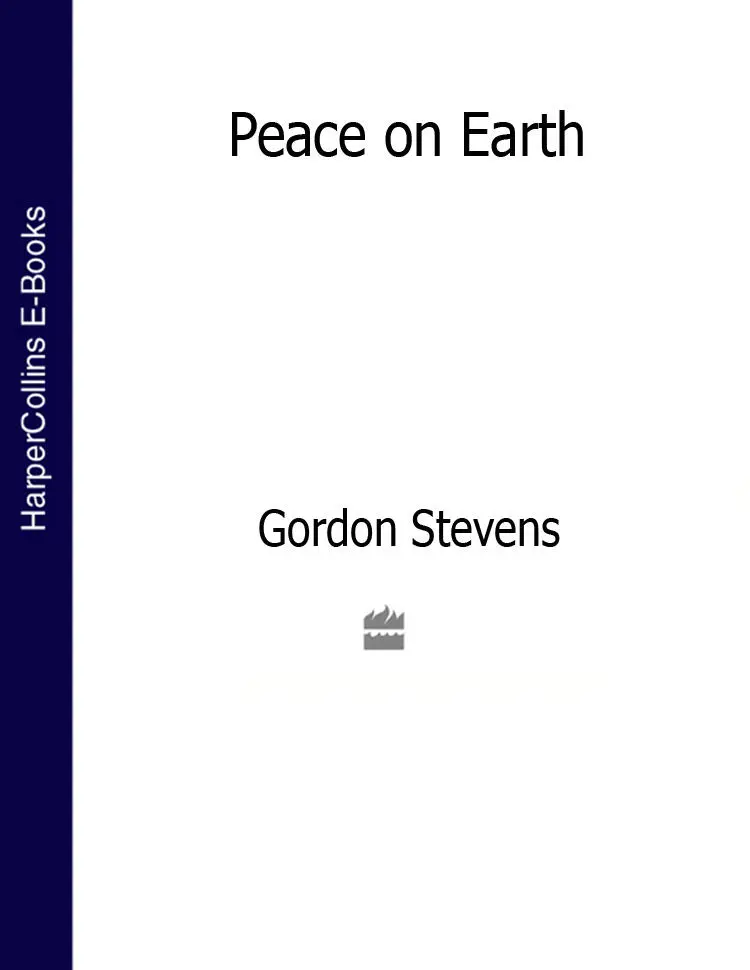
- Название:Peace on Earth
- Автор:
- Жанр:
- Год:неизвестен
- ISBN:нет данных
- Рейтинг книги:3 / 5. Голосов: 1
-
Избранное:Добавить в избранное
- Отзывы:
-
Ваша оценка:
Peace on Earth: краткое содержание, описание и аннотация
Предлагаем к чтению аннотацию, описание, краткое содержание или предисловие (зависит от того, что написал сам автор книги «Peace on Earth»). Если вы не нашли необходимую информацию о книге — напишите в комментариях, мы постараемся отыскать её.
Peace on Earth — читать онлайн ознакомительный отрывок
Ниже представлен текст книги, разбитый по страницам. Система сохранения места последней прочитанной страницы, позволяет с удобством читать онлайн бесплатно книгу «Peace on Earth», без необходимости каждый раз заново искать на чём Вы остановились. Поставьте закладку, и сможете в любой момент перейти на страницу, на которой закончили чтение.
Интервал:
Закладка:
‘So Henry Armstrong will be the next major foreign affairs negotiator for the United States of America?’
‘Yes.’
Nabil leaned forward and turned the photograph of Henry Armstrong face down on the desk. Not from disdain or disrespect, but from habit. ‘And who will be the catalyst?’ he asked. ‘Who will be the man who will have his ear?’
Hussein took a second sheet of paper from the file. Attached to it was another photograph and a cutting from a newspaper.
‘The Jacksonian Institute is a political think tank in Washington. It is highly respected, both nationally and internationally, with considerable justification. Henry Armstrong is a regular contributor to its foreign affairs seminars, he is also a major benefactor of the institute.’ He smiled again. ‘Most things in America are, of course, tax deductible.’
‘That aside the institute plays an important role in Armstrong’s life. It is one of the reasons he must be considered in line for a top post in government.’ Nabil heard the words and knew that Armstrong was the man he wanted, wondering whether Hussein’s second choice would be as good as his first. ‘Each year,’ continued the industrialist, ‘the institute hosts a number of international forums to which guest speakers from various parts of the world are invited. Several years ago Armstrong himself chaired a seminar on strategic politics at which one of the guest speakers was this man.’ He unclipped the photograph from the sheet of paper in front of him and passed it to Nabil. The man in it was in his late thirties, good-looking, immaculately groomed. ‘The speaker was a British Member of Parliament, one of the up and coming breed who seem set to control things in the future. Armstrong was so impressed that he invited him back. They are now close friends.’
‘How important was he?’
‘He wasn’t important then, he is important now, he will be extremely important in the future.’ He passed Nabil the sheet of paper with the newspaper cutting fastened to it.
Nabil took it. ‘What do you mean?’ he asked.
Hussein looked at him. ‘John Kenshaw-Taylor entered the British Parliament in a bye-election in 1978 after a successful career in the City. Like others of his kind, it was important to him that he was seen to make his first million by the time he was thirty. Politics, in any case, was always a strong possibility for him; his family has had its hands on British foreign affairs for most of the past half-century, probably well before that. Since 1978 his rise has been spectacular. Two years ago he was made Minister of Energy.’
Nabil knew there was more.
‘Eight weeks ago he was promoted to Number Two at the British Foreign Office. The day he moved, the London Times said it was merely one more step to his becoming Prime Minister.’
Nabil looked at the dates on the newspaper cutting Ahmad Hussein had given him. The day, he thought, that he had seen the article which had planted the first seed of the plan in his mind, the day he had played tawli with the old man in the café. The day, he did not know, that Yakov Zubko and his family had left Moscow and begun their journey to the West.
‘How can we get at him?’ he asked.
‘He’s ambitious,’ Hussein replied, equally succinctly.
The meeting finished at twelve. At twelve thirty Hussein drove them to a Lebanese restaurant where they ate a quiet and discreet lunch. When they parted, Nabil gave him the gifts he had bought for his children; that night Hussein gave them to his son and daughter; when they asked who they were from, he told them they were from an uncle who loved them very much but whom they had never met. His wife knew not to ask.
At four thirty that afternoon Nabil made a single international telephone call, checked out of the Plaza Hotel, took a cab to John F. Kennedy, and caught the six forty-five TWA flight to Rome.
CHAPTER THREE
The sherry was manzanilla. He had a standing order for it from Green’s in the City and kept it chilled in a walnut cabinet in the corner of the office.
‘If this is how a bad day ends, Minister, how do we end a good one?’ The civil servant’s question was only half a joke. For the first time since he had taken office the Foreign Minister had sent back a briefing with a request that it should contain more information.
John Kenshaw-Taylor sat down on the edge of his desk. ‘Edward,’ the Under-Secretary was his senior by at least fifteen years, ‘you know I will always take your advice, as long as you make me think it was my idea in the first place.’
The man called Edward smiled. ‘Precisely, Minister.’
The exchange had cleared the air, they settled back into the chesterfields and relaxed.
It was the way Kenshaw-Taylor had always anticipated ending each day at the Foreign Office, a quality he considered the other newer members of the government lacked, a style, in addition to his ability to digest a brief and reproduce it with maximum impact in the House or in cabinet committee, that had already marked him out in the minds of the Whitehall mandarins as the man to watch, the one who would get to the top.
The lighting in the room on the third floor overlooking Horse Guards Parade was subdued, in the semi-gloom he could see the outlines of the mementoes he had brought with him from the sanitised corridors of the Department of Energy. None of them referred to himself, at least not directly. On the left of the antique clock on the wall facing his desk was a portrait of his grandfather, below it a letter signed personally by George V. On the wall to the left of the desk, an original newspaper report of the Balfour Declaration, to which the same grandfather had been an advisor, in the gloom to the right a black and white photograph of his father standing behind the seated figures of Churchill, Roosevelt and Stalin at Yalta in 1945.
John Kenshaw-Taylor had dreamt of the Foreign Office, had savoured its charisma and its power, ever since his father had brought him there when he was eight years old. He had taken it with him when he returned to his prep school that evening, held on to it through Eton and Oxford, even during his days in the City, when his natural instincts, as well as his undoubted connections, had amassed him a considerable personal wealth. He remembered the decision to enter politics, the bye-election, his first ministerial post, remembered above all the evening a few short weeks ago, the telephone call inviting him to see the Prime Minister at Number Ten, the suggestion that he should leave Energy and take over as Number Two at the Foreign Office. He sipped the manzanilla and looked at the winter sky gathering outside the window. What a way to start Christmas, he thought, recalling his first day in the building itself, the portraits, their oils glinting in the strange light which seemed to stalk the corridors, the images of the men who had directed the nation’s course and its relationship with the rest of the world, the men who had led the nation itself.
‘Thank you, Minister.’ The Under-Secretary rose to leave, placing his glass on the silver tray on the side. ‘Perhaps it has been a good day after all.’ He meant it. For forty years, the British Foreign Office had presided over the dissolution of an empire; after the Falklands campaign, it had been said by some, even the Prime Minister had seen fit to question what remained of its role on the world stage. The new minister, the civil servant felt, was not long for the Number Two job, and when he was at the top, things would change. An old wind blowing through the corridors, someone had remarked. ‘Thank you, Minister,’ he said again.
Kenshaw-Taylor watched the man leave, staring for a few moments out of the window, looking through the darkness towards Buckingham Palace, then turned back to his desk. Kenshaw-Taylor’s mind was the epitome of clarity and logic. He took pride not only in organising to the last degree whatever he was doing, but in sticking to it, whether in the day-to-day management of his personal affairs, or the advancement of his political career.
Читать дальшеИнтервал:
Закладка:
Похожие книги на «Peace on Earth»
Представляем Вашему вниманию похожие книги на «Peace on Earth» списком для выбора. Мы отобрали схожую по названию и смыслу литературу в надежде предоставить читателям больше вариантов отыскать новые, интересные, ещё непрочитанные произведения.



Обсуждение, отзывы о книге «Peace on Earth» и просто собственные мнения читателей. Оставьте ваши комментарии, напишите, что Вы думаете о произведении, его смысле или главных героях. Укажите что конкретно понравилось, а что нет, и почему Вы так считаете.