Gordon Stevens - Peace on Earth
Здесь есть возможность читать онлайн «Gordon Stevens - Peace on Earth» — ознакомительный отрывок электронной книги совершенно бесплатно, а после прочтения отрывка купить полную версию. В некоторых случаях можно слушать аудио, скачать через торрент в формате fb2 и присутствует краткое содержание. Жанр: unrecognised, на английском языке. Описание произведения, (предисловие) а так же отзывы посетителей доступны на портале библиотеки ЛибКат.
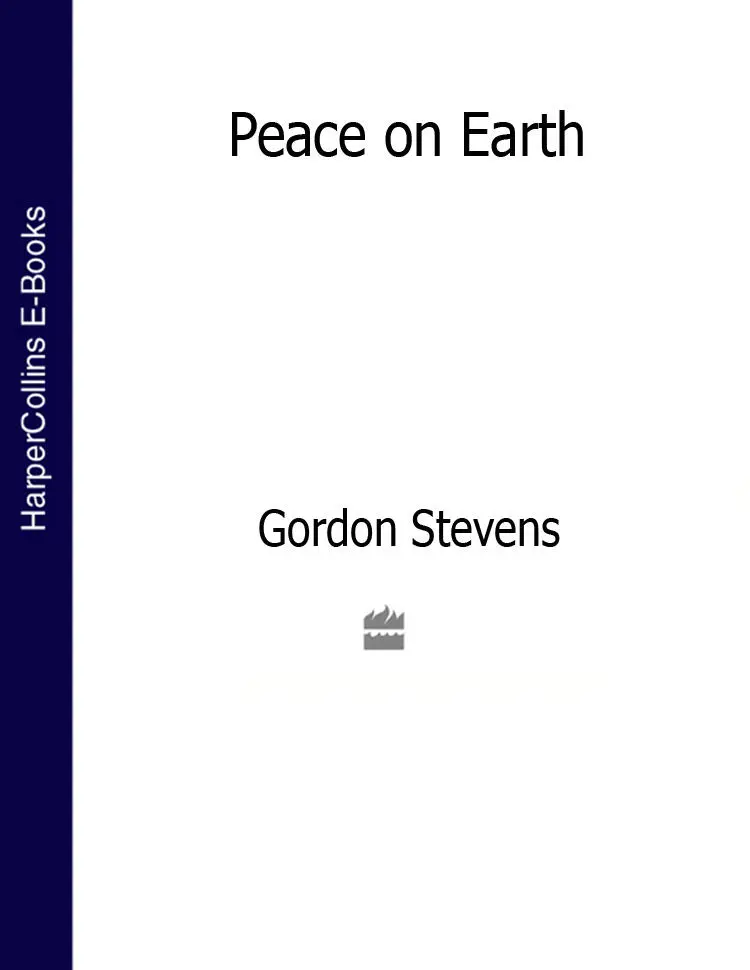
- Название:Peace on Earth
- Автор:
- Жанр:
- Год:неизвестен
- ISBN:нет данных
- Рейтинг книги:3 / 5. Голосов: 1
-
Избранное:Добавить в избранное
- Отзывы:
-
Ваша оценка:
Peace on Earth: краткое содержание, описание и аннотация
Предлагаем к чтению аннотацию, описание, краткое содержание или предисловие (зависит от того, что написал сам автор книги «Peace on Earth»). Если вы не нашли необходимую информацию о книге — напишите в комментариях, мы постараемся отыскать её.
Peace on Earth — читать онлайн ознакомительный отрывок
Ниже представлен текст книги, разбитый по страницам. Система сохранения места последней прочитанной страницы, позволяет с удобством читать онлайн бесплатно книгу «Peace on Earth», без необходимости каждый раз заново искать на чём Вы остановились. Поставьте закладку, и сможете в любой момент перейти на страницу, на которой закончили чтение.
Интервал:
Закладка:
It was seven fifteen. He picked up the telephone and dialled his home in the country; the phone rang for thirty seconds before his wife answered. ‘Samantha, darling, it’s me.’ They talked for ten minutes about what she had done that day, what he had done. That evening, because of his commitments in London, she was due to open the Christmas fayre at the village hall in his stead; tomorrow, she reminded him, the children would be home from school. He assured her he would be back by the following afternoon, and that he was looking forward to Christmas. She said she was already late and would have to go. ‘OK, darling. Love you. Bye.’
He put the phone down and turned his attention to the despatch boxes. Three to get through. He already knew what they contained and worked out his timetable for the evening. One hour on the first box, the reception he had to attend for fifty minutes, a couple of hours in the flat to finish off the other two. Thank God he wasn’t still at Energy, the midnight meetings about the miners’ strike, the problems about the instability of North Sea oil prices. The move had come just at the right time, and to the right department, kept him away from the law and order problems at the Home Office and the financial worries at the Exchequer.
He was in an enviable position, he knew, not just because he was in the Foreign Office, but because of his position within it, aware that he would look back on these days with just a tinge of nostalgia. His hands were on the first trappings of power, real power, but he was still far enough from that power not to be encumbered with its disadvantages. He could still take his wife to dinner, could still go Christmas shopping with the children without the armed bodyguards who were always just a pace away from his senior colleagues. He could ask his driver to wait for him, or he could tell the man to drop the despatch boxes at his flat and make his own way home.
He shut his mind off and opened the first box.
At eight thirty, precisely according to the schedule he had mapped out earlier, he finished the box. At eight forty-five his driver dropped him at the reception and continued to Pimlico where he left the two remaining boxes at the minister’s London flat.
Kenshaw-Taylor stayed at the reception until twenty minutes to ten. Pimlico is five minutes from Westminster by car, fifteen by foot. When the Foreign Minister arrived at the flat it was eleven thirty.
The temperature in Rome was minus three and falling; it was also wet, the blanket of rain sweeping across the runway, sounding like the roll of kettle drums as it cascaded off the metal roof of the terminal building.
The TWA jumbo was thirty minutes late, delayed by an air traffic control dispute. Abu Nabil hurried through immigration and customs, showered, shaved and changed his clothes in the gents’ toilet, made a telephone call to the hotel in the city centre explaining that he had been delayed, and was asked to attend as quickly as he could. On the cab rank outside he picked up a taxi, told the driver there was an extra tip for him if he could get to the city centre in record time, and settled back into his seat. The traffic was heavy, he did not feel it was the best preparation for the meeting ahead.
He arrived at the hotel thirty-five minutes later, tipped the driver well, and was shown immediately to the suite on the fifth floor. Sheikh Saeed Khaled was waiting. Nabil apologised for being late, Khaled in turn apologised that he had little time to spare that day and had to leave the hotel for an appointment in thirty minutes. Breakfast arrived two minutes later.
Whilst Khaled poured them both coffee they discussed the outline of their London meeting, concentrating on the sheikh’s suggestion that Nabil needed what they had called a friend, as well as the friend who would influence that friend.
‘That is why I have come to see you again,’ Nabil brought the conversation into focus.
‘You mean you have found the friend you were looking for?’
‘Possibly.’
‘Who?’ asked Khaled.
‘I am told that Henry Armstrong will be the next major United States Foreign Affairs negotiator and that he has a special interest in the Middle East.’
Khaled smiled, nodding his head. ‘I wonder who told you that.’ He drew his hands together and rested his chin on them. ‘You’re probably right. Henry Armstrong has the right connections, the right ambitions. Who will influence him on your behalf?’
‘The British Foreign Minister, John Kenshaw-Taylor.’
The choice did not appear to surprise Khaled. Nabil began listing the details contained in the brief Ahmad Hussein had given him in New York, but Khaled interrupted. ‘I know him. We met during the oil discussions before he was moved to the Foreign Office. How are they connected?’
Nabil explained the Jacksonian Institute link.
There is one thing about Kenshaw-Taylor that you should know,’ Khaled said slowly and carefully. Nabil noted that the sheikh still had not passed comment on his choice and feared he was preparing the ground for a rejection. ‘One thing,’ continued the sheikh, ‘that might make him an ideal target, but which might also prejudice you against him.’
‘What is it?’
‘Think of the betrayal of your country. Think when the betrayal started.’
It was ironic, Nabil had already thought, and probably inevitable, that the man he had chosen to help his people return to their homeland should be the Foreign Minister of the imperial power which had played such a role in their original exodus from it.
‘Most people would say the United Nations decision of 1947,’ he began. ‘They would be wrong. It actually began in 1917. The Balfour Declaration. The first open support by the British for the idea of a separate Jewish state.’
Khaled looked at him again. ‘Kenshaw-Taylor has a very long political pedigree. His father was in politics, his father before him.’
‘I knew he came from a political family.’
‘Did you know his grandfather was a senior advisor to Balfour?’
‘No,’ said Nabil. ‘I did not.’
He sat silently, remembering the terms of the support, remembering the way his father had taught him to despise what the Declaration had done to his country and people.
‘Why did you choose him?’ asked Khaled.
‘Because he is ambitious.’
‘Some who know him would say he is too ambitious for his own good,’ said the power broker. ‘He is a good choice.’
Nabil sensed his relief. ‘What else is there to know of him?’ He did not know what answer he expected, only knew later that he had not expected the answer he received.
Khaled sat back, remembering the first time he had met Kenshaw-Taylor, the many times they had observed each other prior to negotiations, the informal conversations in the receptions after. Something about the man, he thought, something they might be able to use. ‘I don’t know, but I will find out.’
The coloured lights were shining brightly, even though it was only four in the afternoon, the pavements were crowded. Enderson could smell the roast chestnuts on the corner of the street. It was as Christmas Eve used to be, as it should be, he could not help thinking.
The children were tugging at his sleeve, forgetting that his left arm was in a sling. It still hurt, where it had been burned and torn, where the surgeon at the Queen Elizabeth Military Hospital in Woolwich had pulled it together and informed him that it was to be checked every month until it was healed. Jane was in front of him, struggling under the weight of the turkey. In his one good hand he carried a bag of food and wine.
‘Dad,’ said his children, ‘come on, Dad, you know what, Dad.’ His wife pretended not to hear. ‘Look, love,’ he suggested, ‘you’ll want to get the turkey started. Why don’t you go home and the kids and I will finish here.’ His wife smiled. ‘OK, but don’t be late.’ She watched as Enderson and the children turned back down the pavement and headed for Chadds. ‘Great, Dad, great,’ she heard the boy say. ‘About time,’ said the girl.
Читать дальшеИнтервал:
Закладка:
Похожие книги на «Peace on Earth»
Представляем Вашему вниманию похожие книги на «Peace on Earth» списком для выбора. Мы отобрали схожую по названию и смыслу литературу в надежде предоставить читателям больше вариантов отыскать новые, интересные, ещё непрочитанные произведения.




Обсуждение, отзывы о книге «Peace on Earth» и просто собственные мнения читателей. Оставьте ваши комментарии, напишите, что Вы думаете о произведении, его смысле или главных героях. Укажите что конкретно понравилось, а что нет, и почему Вы так считаете.