Gordon Stevens - Peace on Earth
Здесь есть возможность читать онлайн «Gordon Stevens - Peace on Earth» — ознакомительный отрывок электронной книги совершенно бесплатно, а после прочтения отрывка купить полную версию. В некоторых случаях можно слушать аудио, скачать через торрент в формате fb2 и присутствует краткое содержание. Жанр: unrecognised, на английском языке. Описание произведения, (предисловие) а так же отзывы посетителей доступны на портале библиотеки ЛибКат.
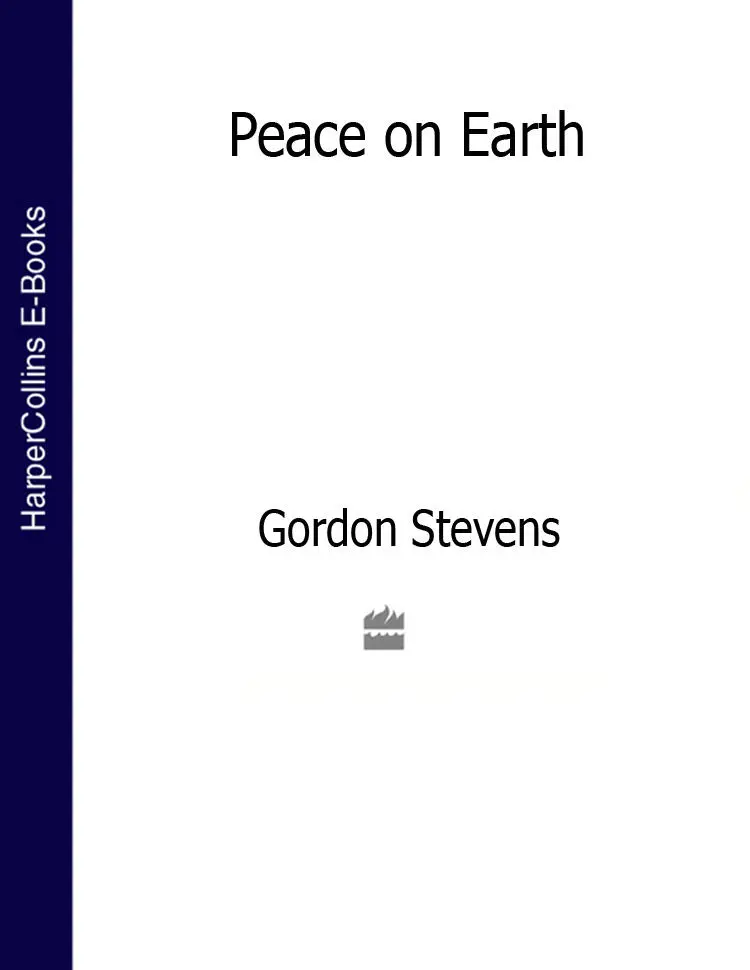
- Название:Peace on Earth
- Автор:
- Жанр:
- Год:неизвестен
- ISBN:нет данных
- Рейтинг книги:3 / 5. Голосов: 1
-
Избранное:Добавить в избранное
- Отзывы:
-
Ваша оценка:
Peace on Earth: краткое содержание, описание и аннотация
Предлагаем к чтению аннотацию, описание, краткое содержание или предисловие (зависит от того, что написал сам автор книги «Peace on Earth»). Если вы не нашли необходимую информацию о книге — напишите в комментариях, мы постараемся отыскать её.
Peace on Earth — читать онлайн ознакомительный отрывок
Ниже представлен текст книги, разбитый по страницам. Система сохранения места последней прочитанной страницы, позволяет с удобством читать онлайн бесплатно книгу «Peace on Earth», без необходимости каждый раз заново искать на чём Вы остановились. Поставьте закладку, и сможете в любой момент перейти на страницу, на которой закончили чтение.
Интервал:
Закладка:
The ground floor of the department store was crowded: he followed the children, protecting his arm. Two weeks in a sling, he had been told, then a plaster. It would not affect his work as long as he took it carefully, the surgeon had said, as long as he came back for the monthly checks. They reached the perfume counter, he watched as the children worked out the prices, how much they could afford, then bought their mother her Christmas presents. ‘You want them wrapped here or shall we do it when we get home?’ He already knew the answer. ‘When we get home, Dad.’ It was his first Christmas with them for three years.
By the time they left the store it was four thirty. ‘Can we have a Wimpy, Dad?’ He knew it was a conspiracy against which he could not win. ‘OK,’ he conceded, ‘you can have a Wimpy.’ On the way they passed a news-stand, he bought a copy of the Evening News, tucked it under his arm, and followed the children.
The Wimpy bar was quieter than he would have thought; they sat at a table near the window: the children ordered burgers and coke, he asked for a tea and began to browse through the paper. At the third table to their left, his back against the wall, was a tramp, he had just finished a plate of chips and was eking out his cup of tea. The music in the bar was seasonal. Enderson remembered when he had last sat in a Wimpy bar, what the music had been then, and was glad that the food arrived. The tune changed and he recognised the words. On the table to his left the tramp had finished his tea; in the corner of his eye Enderson saw the waitress approach the man, assuming, he did not know why, that she was going to ask him to leave. She reached across the table and gave him another cup of tea. In the loudspeaker in the ceiling he heard the words of the tune.
‘They said there’d be snow at Christmas,
They said there’d be peace on earth.’
He looked out the window at the sky. No snow, he thought, remembering the boy in Belfast, the bombings and killings in Europe, the assassination on the motorway near Heathrow, not much peace on earth either.
He turned to the foreign page of the newspaper. In the right-hand column was an item from the Reuters office in Bonn which a desperate sub-editor had used to fill up space. The piece was headed ‘Christmas terror alert in Germany’. The West German terrorist leader Klars Christian Mannheim, convicted on three bombing charges, had announced that from the New Year he would go on hunger strike in support of demands for greater civil liberties in the country’s prisons.
On the table to his left the tramp was warming his fingers round the cup of tea. ‘Look, Dad, look.’ His son was pulling at his coat, drawing his attention to a woman in the street outside, trying to push a Christmas tree into the boot of her car. He began to laugh. ‘Can we have another drink, Dad?’ The woman closed the boot, cutting off the top of the tree. He called the waitress.
‘Two more cokes, please.’
She saw what they were laughing at, saw that the tramp had also seen. ‘Why not?’ she began laughing with them. ‘After all, it’s Christmas.’
Enderson thought of the newspaper article, the man who would begin to die in the New Year. ‘Why not,’ he smiled back, it’s Christmas.’
John Kenshaw-Taylor sat back in his chair and sipped the malt whisky, he had been shooting since seven and polished off the despatch boxes after lunch. The house was quiet, the children would not be back from the party till six. In the kitchen, the nanny was preparing tea, at the table behind him his wife was wrapping presents. ‘These killings in Europe,’ she suddenly asked. ‘This man who said he will go on hunger strike. It won’t affect you, will it?’
John Kenshaw-Taylor sat forward, threw a log on the fire, and poured himself another drink. ‘Shouldn’t think so, darling,’ he said confidently.
*
The night air was warm, much warmer than Yakov Zubko had ever expected in Moscow. He stood in the window and breathed it in. It was going well, he thought, better than they could ever have hoped; he had been found a job, not as good a job as others with his qualifications would have expected, but a job. They had even been promised a house.
He walked through to the children’s room, opening the door quietly so that he did not wake them, and looked at them, hearing the sound of their breathing. In the kitchen Alexandra heard the singing from the street below. That afternoon they had been shopping; there had not been enough money and they had bought nothing for themselves, just a present each for the children to show to the friends they had made. It did not worry her.
She left the kitchen and walked into the corridor, saw her husband looking into the children’s room, saw that he was oblivious of her. He was a good man, she thought, remembered, for the first time since they had arrived in Israel, how he had worked for them, stolen for them, how he had got the money for their tickets to Vienna. Remembered her reaction when he had told her about the unmarked car at the top of Dmitrov, about the quiet voice that had told him to run for them all.
Slowly, quietly, she crept forward, slid her arm through his, and kissed him.
Book Three
CHAPTER ONE
At half past seven on the morning of Friday, January 4th, Klars Christian Mannheim began to die.
He had woken at five, alert and fresh. The depth and soundness of his sleep that night had not surprised him. The sleepless nights had been before, when he was in doubt, when he was still turning the decision over and over in his mind. The night before, however, he had gone to bed knowing the only issue which remained was the execution of that decision.
Execution had never disturbed Klars Christian Mannheim.
From five until seven thirty he had sat on his bed, enjoying the silence. For three years now he had hated the silence, hated those who had imposed it upon him. Now it was a strength, now it was the authorities who waited. Ever since he had made his announcement on Christmas Eve. And each day he did not start, each day he took food, they relaxed a little, breathed a little more easily, convinced themselves a little more that he lacked the resolve to die for his cause.
They were wrong.
Mannheim was a man of precision. The date of the commencement of his hunger strike, therefore, was not a matter of chance but of calculation.
He was twenty-eight years old and weighed sixty-eight kilos. On a diet of water he would lose approximately ten kilos in the first twenty days, most of which would consist of water contained naturally within the body. After that the rate of weight loss would slow as the body used up its supply of fat before the crucial phase when it was forced to draw on its own tissue, first the muscles of his arms and legs, then of his heart, and finally the muscles of his chest. At this stage his breathing would begin to be affected.
Mannheim also believed in self-determination, man’s ability to control his own life and, in his case, his own death. Others, he knew, would calculate the number of days he would take to die, as he himself had calculated the figure, and would build into it a margin of error.
He himself had rejected this. He had calculated the number of days it would take, and determined that he would sustain his hold on life for that period precisely, no more nor less.
He would die exactly twenty-nine years after his mother had brought him into the world.
The door opened and the warder brought in his breakfast. Mannheim did not bother to look up or to thank the man; the guards were, in any case, under strict instructions not to talk to their high-security wards, to avoid all form of communication, even eye contact. When the man collected the tray twenty minutes later only the water had been consumed.
Читать дальшеИнтервал:
Закладка:
Похожие книги на «Peace on Earth»
Представляем Вашему вниманию похожие книги на «Peace on Earth» списком для выбора. Мы отобрали схожую по названию и смыслу литературу в надежде предоставить читателям больше вариантов отыскать новые, интересные, ещё непрочитанные произведения.










Обсуждение, отзывы о книге «Peace on Earth» и просто собственные мнения читателей. Оставьте ваши комментарии, напишите, что Вы думаете о произведении, его смысле или главных героях. Укажите что конкретно понравилось, а что нет, и почему Вы так считаете.