Peter Friend - Scotland
Здесь есть возможность читать онлайн «Peter Friend - Scotland» — ознакомительный отрывок электронной книги совершенно бесплатно, а после прочтения отрывка купить полную версию. В некоторых случаях можно слушать аудио, скачать через торрент в формате fb2 и присутствует краткое содержание. Жанр: unrecognised, на английском языке. Описание произведения, (предисловие) а так же отзывы посетителей доступны на портале библиотеки ЛибКат.
- Название:Scotland
- Автор:
- Жанр:
- Год:неизвестен
- ISBN:нет данных
- Рейтинг книги:3 / 5. Голосов: 1
-
Избранное:Добавить в избранное
- Отзывы:
-
Ваша оценка:
Scotland: краткое содержание, описание и аннотация
Предлагаем к чтению аннотацию, описание, краткое содержание или предисловие (зависит от того, что написал сам автор книги «Scotland»). Если вы не нашли необходимую информацию о книге — напишите в комментариях, мы постараемся отыскать её.
Scotland — читать онлайн ознакомительный отрывок
Ниже представлен текст книги, разбитый по страницам. Система сохранения места последней прочитанной страницы, позволяет с удобством читать онлайн бесплатно книгу «Scotland», без необходимости каждый раз заново искать на чём Вы остановились. Поставьте закладку, и сможете в любой момент перейти на страницу, на которой закончили чтение.
Интервал:
Закладка:
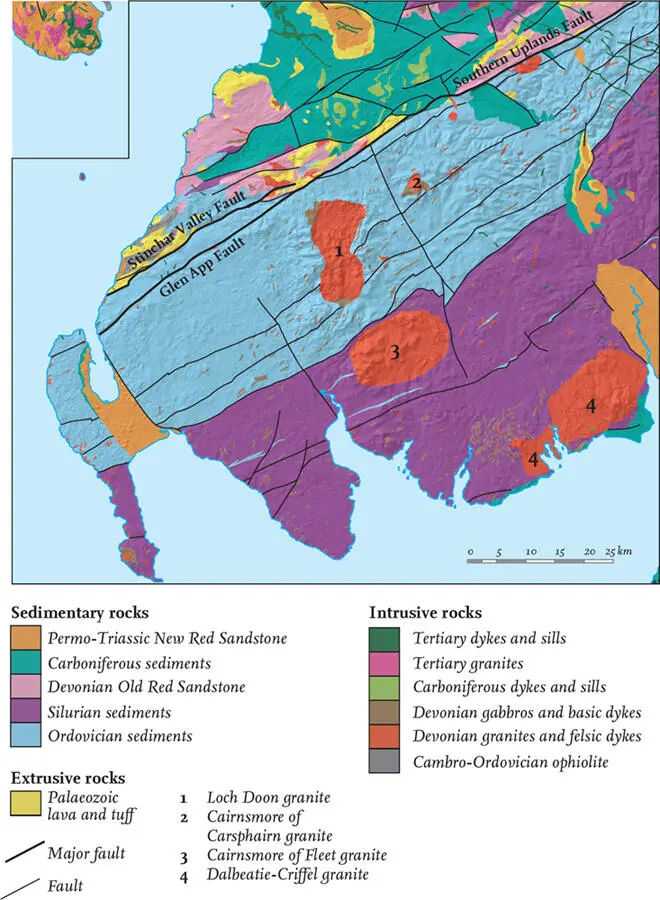
FIG 47. Simplified geology and hill-shaded topography for Area 1.
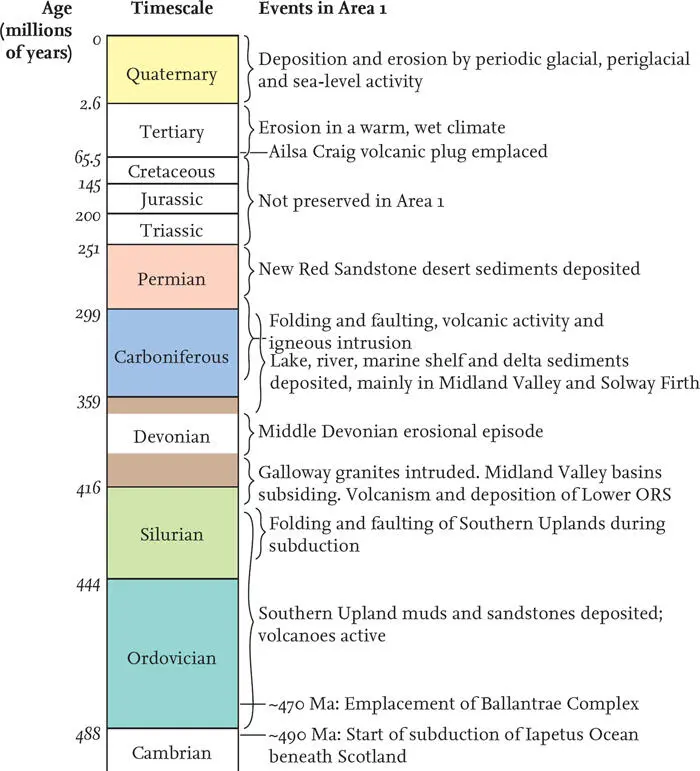
FIG 48. Timeline of bedrock and surface-layer events in Area 1.
Prior to the Caledonian mountain building, the crustal foundations of Scotland and England were separated by the Iapetus Ocean. Around 490 million years ago, this ocean began to be destroyed by subduction: oceanic crust moved down into the mantle beneath the Grampian Highlands, and then beneath the Midland Valley (see Chapter 4). A small fragment of this oceanic crust escaped subduction, being instead thrust up onto the margin of Scotland, to be ‘welded’ onto the Midland Valley by around 470 million years ago. Today, this small but intensively studied area of complexly interfolded rock units outcrops around Ballantrae, the so-called the Ballantrae Complex. Rocks characteristic of the deep sea and oceanic crust are found – sediments such as black shale and chert, basalt lavas with pillow structures, ash, sheets of dykes and upper mantle rocks. The latter originated at depths of up to 40 km in the Earth’s crust, and are today coarse-grained (mafic) gabbros and serpentinite.
The main deformation of the Southern Uplands terrane occurred during the later stages of the Caledonian mountain building, between the mid-Ordovician and the early Devonian. As oceanic crust continued to be subducted, the sediments which today make up the Southern Uplands were scraped off the ocean floor along a series of thrust faults and stacked up in a pile against the edge of the Midland Valley ( Fig. 28). During this deformation, the sediments became tightly folded and weakly metamorphosed: fine-grained mudstone and siltstone became slate, while cement within sandstones recrystallised to produce a tough, hard rock (greywacke). Today, bedding in the Southern Uplands is aligned in a general northeast/southwest direction and dips very steeply to the southeast, and northeast/southwest faults divide the region into numerous fault blocks.
By the start of the Devonian (around 415 million years ago), the major deformation of the Southern Uplands had ceased and Scotland and England were welded along the Iapetus Suture. It was around this time that the major granite bodies of the Southern Uplands ( Fig. 47) were emplaced: partial melting at the base of the thickened crust produced liquid magma, which then rose up into the upper crust where it slowly solidified to form coarse-grained igneous bodies (plutons). As the overlying rocks were subsequently removed by erosion, three major plutons were revealed in the Southern Uplands. The most northerly of these is the hourglass-shaped Loch Doon intrusion, said to be one of the finest examples in Scotland of a concentrically zoned pluton: the interior of the body is silica-rich (felsic) granite, separated from the outer silica-poor grey granodiorite which makes up most of the body by a transition zone. Similar well-developed concentric zonation is seen in the eastern half of the Criffel–Dalbeattie body on the south coast, although overall this body is much less compositionally evolved (i.e. it has a lower silica content) than the other Southern Uplands granites. It is also the most deformed: originally oval, its western part has been distorted southwards by complex faulting. Porphyrite dykes and sills commonly surround the main intrusion (e.g. at Black Stockarton Moor), made up of large crystals embedded in a fine, glassy groundmass. Between the two, the roughly oval Fleet pluton was intruded around 390 million years ago (Devonian) into a broad ductile shear zone, making it the youngest reliably dated Caledonian pluton in mainland Scotland ( Fig. 49). It is also the most evolved of the Southern Uplands intrusions, consisting entirely of granite, and is the only intrusion whose magmas were sourced wholly from the melting of metamorphosed sediments (rather than igneous rocks). Because of both its young age and its evolved composition, this pluton has more in common with the Lake District and Northern Ireland granites than with those of Scotland, and it has been suggested that these areas shared a magma source.
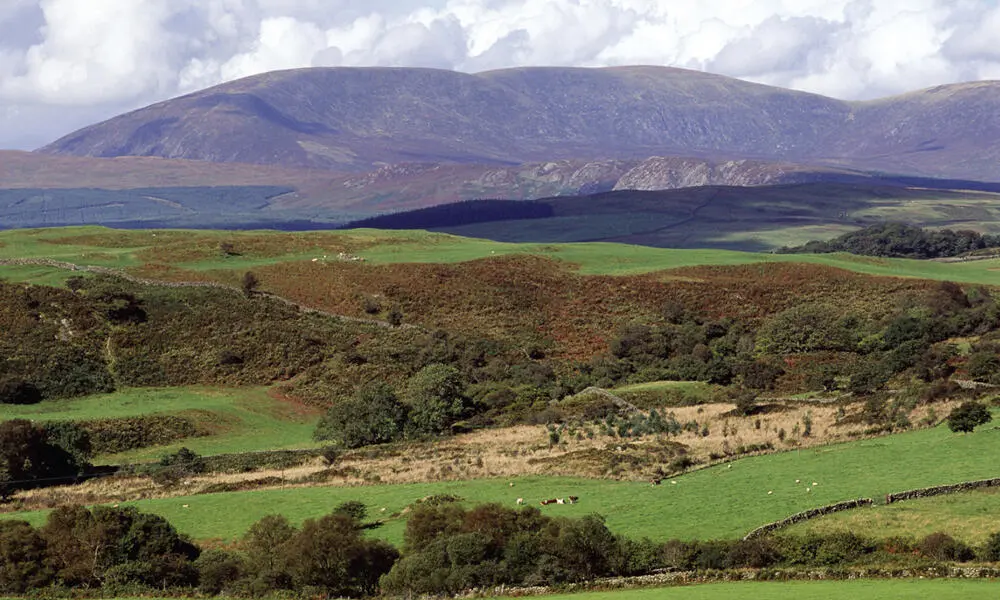
FIG 49. Cairnsmore of Fleet, 711 m (10 km east of Newton Stewart), viewed from the southeast. This mountain landscape has been created by erosion of the Fleet granite intrusion. (© Lorne Gill, Scottish Natural Heritage)
As these hot granite bodies were emplaced, their heat baked the surrounding rocks, creating an encircling metamorphosed zone (an aureole) 1 km or, in the case of the Criffel–Dalbeattie intrusion, even 2 km wide. These aureoles are often rich in mineral veins, deposited by hot circulating fluids released by the crystallising granite. Gold, silver, copper, lead and zinc are common, particularly around the Fleet intrusion, and over 60 copper and iron-rich carbonate veins have been located northwest of the Criffel–Dalbeattie pluton.
Volcanic vents active during the early Devonian are also present in the area, although they are generally poorly preserved. An exception is the large vent at Shoulder o’ Craig, 17 km southwest of Castle Douglas, on the Dee estuary. The headland here is principally made up of a vent-filling intrusion breccia, which consists of Silurian sandstone and siltstone clasts within a basalt (mafic) matrix. Both vent rock and country rock are cut by very potassium-rich dykes, indicating a magma source deep within the mantle. These dykes often have irregular shapes, and one dyke in the area is known as the ‘Loch Ness Monster’ due to its particularly bizarre outcrop pattern. On a regional scale, this area presents a bit of a conundrum, as volcanic vents, mantle-derived dykes and granite plutons, i.e. igneous rocks from all depths within the crust, were intruded around the same time (between around 415 and 400 million years ago, earliest Devonian), and are now seen at the same level of erosion.
Further north, the late Silurian and early Devonian was the time when a series of basins first began to develop in what would become the Midland Valley, as crustal tension caused movement on the Highland Boundary and Southern Uplands faults. At this time (around 420 to 400 million years ago), Scotland lay in the interior of a large continent some 20 degrees south of the equator, and in this environment the new Caledonian mountains were eroded rapidly because soil-binding plant cover had not yet evolved. Rivers and streams washed the sediment into the developing Midland Valley basins, forming coarse conglomerates, red sandstones and mudstones, collectively called the Lower Old Red Sandstone. Volcanic rocks (associated with crustal extension) are common in the upper 600 m of the Lower Old Red Sandstone, where lava sheets (predominantly andesite) are intercalated with river and lake sediments, mostly sandstones. Today, principal outcrops include a 400 m-thick lava pile underlying the Carrick Hills and a 600 m-thick lava pile in the Dalmellington area (20 and 30 km east of Girvan, respectively).
The Carrick Hills lava pile is particularly well exposed along the coast around Dunure (10 km southwest of Ayr). This coastal section has been studied for over a century in an attempt to unravel the complex relationships between the lava and intervening sediment; the upper and lower surfaces of andesite (mafic) sheets are often very irregular, with bulbous, finger-like protrusions that extend upwards and downwards into the sediment, or have become detached completely, forming zones of lava pillows. In places, lava engulfs patches of sediment; elsewhere, the lava is surrounded by sediment. The andesite sheets are generally well jointed, and these joints are often filled with hardened sandstone. Despite these contorted relationships, lamination in the sandstones is generally intact, save for a small zone near the contact. Such irregular contacts are thought to result from the sills being intruded into wet, unconsolidated sediment; as hot magma was emplaced, it vaporised water at the magma–sediment contact, fluidising the sediment in a narrow zone next to the contact. This vapour and its entrained sediment then flowed away along the hot contact surface, offering very little resistance to the magma and allowing bulbous protrusions to form. Likewise, the liquid magma could not push directly against the wet host sediment, and so this sediment remains largely undeformed, except at the contact zone. After intrusion, large amounts of water vapour were trapped in sediment enclaves and at contact zones. As the andesite then cooled, it contracted and cracked, often resulting in a sudden decrease of pressure in the sediment. This led to explosive boiling of the water, fluidising the sediment and blasting it along the fractures and cooling joints. Vesicles (cavities formed by gas bubbles) are also very common in the lavas, generally now infilled by minerals such as quartz, agate or chalcedony precipitated by circulating groundwaters.
Читать дальшеИнтервал:
Закладка:
Похожие книги на «Scotland»
Представляем Вашему вниманию похожие книги на «Scotland» списком для выбора. Мы отобрали схожую по названию и смыслу литературу в надежде предоставить читателям больше вариантов отыскать новые, интересные, ещё непрочитанные произведения.












Обсуждение, отзывы о книге «Scotland» и просто собственные мнения читателей. Оставьте ваши комментарии, напишите, что Вы думаете о произведении, его смысле или главных героях. Укажите что конкретно понравилось, а что нет, и почему Вы так считаете.