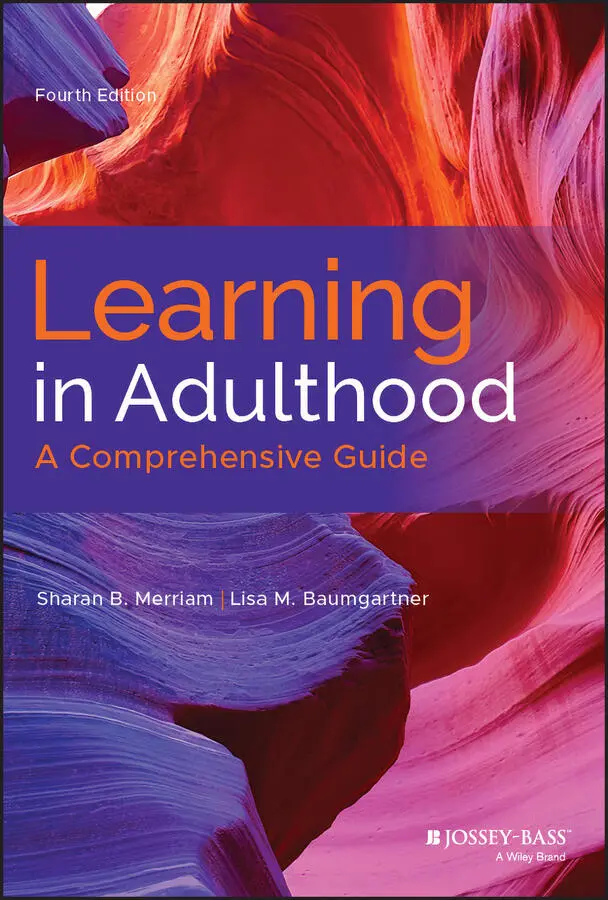
Sharan B. Merriam - Learning in Adulthood
Здесь есть возможность читать онлайн «Sharan B. Merriam - Learning in Adulthood» — ознакомительный отрывок электронной книги совершенно бесплатно, а после прочтения отрывка купить полную версию. В некоторых случаях можно слушать аудио, скачать через торрент в формате fb2 и присутствует краткое содержание. Жанр: unrecognised, на английском языке. Описание произведения, (предисловие) а так же отзывы посетителей доступны на портале библиотеки ЛибКат.
- Название:Learning in Adulthood
- Автор:
- Жанр:
- Год:неизвестен
- ISBN:нет данных
- Рейтинг книги:4 / 5. Голосов: 1
-
Избранное:Добавить в избранное
- Отзывы:
-
Ваша оценка:
Learning in Adulthood: краткое содержание, описание и аннотация
Предлагаем к чтению аннотацию, описание, краткое содержание или предисловие (зависит от того, что написал сам автор книги «Learning in Adulthood»). Если вы не нашли необходимую информацию о книге — напишите в комментариях, мы постараемся отыскать её.
has been the definitive guide in the field of adult education. Now in its fourth edition, this comprehensive volume is fully revised to reflect the latest developments in theory, research, and practice. The authors integrate foundational research and current knowledge to present fresh, original perspectives on teaching and learning in adulthood. Written by internationally-recognized experts, this market-leading guide draws from work in sociology, philosophy, critical social theory, psychology, and education to provide an inclusive overview of adult learning.
Designed primarily for educators of adults, this book is accessible for readers new to adult education, yet suitably rigorous for those more familiar with the subject. Content is organized into four practical parts, covering topics such as the social context of adult learning, self-directed and transformational learning, postmodern and feminist perspectives, cognitive development in adulthood, and more. Offering the most comprehensive single-volume treatment of adult learning available, this landmark text:
Offers a wide-ranging perspective on adult learning Synthesizes the latest thinking and work in the field Includes coverage of the sociocultural perspectives of adult learning Explores the broader social implications of adult education
is an indispensable resource for educators and administrators involved in teaching adults, as well as faculty and students in graduate programs in adult education.
Learning in Adulthood — читать онлайн ознакомительный отрывок
Ниже представлен текст книги, разбитый по страницам. Система сохранения места последней прочитанной страницы, позволяет с удобством читать онлайн бесплатно книгу «Learning in Adulthood», без необходимости каждый раз заново искать на чём Вы остановились. Поставьте закладку, и сможете в любой момент перейти на страницу, на которой закончили чтение.
Интервал:
Закладка:
Chapter 4profiles who participates in adult learning, why adults participate, and what an adult chooses to learn. Most of this information on participation and motivation is in reference to formal learning, such as that provided by educational institutions and employers. Estimates of the percentage of the adult population that participates in learning have steadily risen over the past 50 years, with the most current study suggesting that approximately 44% of all adult Americans participate in learning. Studies of self-directed learning and other nonformal types of education reveal the percentage of participation to be even higher. Clearly, learning is an important activity for today's adults. What motivates adults to participate and what deters participation is important information, especially for program developers. This chapter also reviews motivational studies.
The final section of Chapter 4“problematizes” the concept of participation. By examining the assumptions that underlie participation we squarely confront the issues of access and opportunity in adult education. The gap between the better educated who seek out continuing education and those who do not continues to widen. Adult learning seems to have become a vehicle for solidifying a socioeconomic structure that limits access and opportunity, contrary to the stated goal of equal access to education in our society. We examine the rhetoric, which espouses one set of values, and the reality, which demonstrates another, in the provision of adult learning opportunities.
Chapter 1 The Social Context of Adult Learning
Learning, even self-directed learning, rarely occurs “in splendid isolation from the world in which the learner lives; … it is intimately related to that world and affected by it” (Jarvis, 2012, p. 11). What one wants to learn, what is offered, and the ways in which one learns are determined to a large extent by the nature of the society at any time. Contrast the young male apprentice of colonial times learning to be a blacksmith with today's middle-aged woman learning a new smartphone app, or the preparation needed to become a medical doctor at the turn of the twentieth century—less than a high school diploma—with today's long and specialized training.
It can also be argued that the nature of society at any point in time determines the relative emphasis placed on adult learning. In preindustrial societies, the rate of change was such that what a person needed to know to function as an adult could be learned in childhood. In societies hurrying to catch up, however, and in our own society with its accelerated rate of change, the urgency of dealing with social realities is felt by adults. In this global, increasingly technologically interconnected world, “the context for adult learning is growing more complex” (Nicolaides & Marsick, 2016, p. 9). The challenge for learners and adult educators is to understand the learning context whether it be “simple, complicated, complex [or] chaotic” and to adapt our learning and teaching (p. 10). Further, social issues such as immigration and climate change and individual concerns such as those related to health or family or finances often result in individuals attending courses or learning informally about these issues.
Although adult education is responsive to the context in which it takes place, it affects that same context. Take, for example, enormous changes in our society brought on by advances in technology. Advances in telemedicine mean doctors can diagnose patients who live at a distance using increasingly sophisticated web-based communication and patients can use smartphone apps to monitor their health. Auto mechanics must now be trained to diagnose engine problems using computers; auto manufacturers tout self-driving cars; a smartphone can be turned into a 3D printer; misplaced items such as keys, wallets, and backpacks can be located via smartphone. Adult education has responded to these technological advances by offering courses to learn this technology so that we can better function in our digital environment.
Although the preceding examples of learning are particularly contemporary, historically there has always been an interlocking of adult learning needs with the social context in which they occur. The skills needed in colonial America reflected the agrarian context; further, since early settlers were fleeing religious persecution in Europe, there was a moral and religious imperative in learning to read so that one could study the Bible. After the Revolutionary War, the newly independent nation needed leaders and informed citizens to build the democratic society. In this new world, civic education, which included learning about philosophy, science, and politics, eclipsed religious education and became paramount in the education of adults.
With the Industrial Revolution of the late nineteenth and early twentieth centuries, industry-based skills training became a necessity. Also, because of the massive influx of immigrants to the United States at this time, “Americanization” and citizenship programs became a prominent form of adult education. It was felt that these immigrants needed to learn the ways of their adopted country so that they would “melt” into society. Interestingly, immigrants themselves organized their own schools to maintain their culture, but these were largely invisible to society at large.
Although a major thrust of adult education at any particular time reflects the sociohistorical context, varied purposes and learning interests coexist. We might argue that technology is a major thrust of learning today, but there is still job training, literacy, civic education, liberal (such as Great Books clubs) and leisure learning, along with community-based social-action initiatives. As Stubblefield and Keane (1994, p. 312) observed from their survey of adult education from colonial times until the present, regardless of the historical era, “Americans learned because there was knowledge to master, technology to adapt, and life's uncertainties to be resolved.”
Thus, to a large extent, the learning that goes on in adulthood can be understood through an examination of the social context in which it occurs. How is learning in adulthood shaped by the society in which it takes place? How does the sociocultural context determine what is learned and by whom?
This chapter explores three conditions characteristic of the current sociocultural context that are shaping the learning needs of adults in today's world: changing demographics, the global economy, and information and technology. Although we present each of these separately at first, these three factors are very much interrelated, and thus their convergence and subsequent impact on learning in adulthood are discussed in the final section of this chapter.
Changing Demographics
Changing demographics is a social reality shaping the provision of learning in contemporary American society. Demographics is about people, groups of people, and their respective characteristics. For the first time in our society, adults outnumber youth, there are more older adults, the population is better educated than ever before, and there is more cultural and ethnic diversity. For various reasons, individuals and groups of people seek out learning experiences; for other reasons, society targets learning activities for certain segments of the population. Thus, certain learning activities are learner initiated and others are society initiated in response to the changing demographics. The field is concerned with the growth and development of adult learners, while at the same time, there are emerging groups of learners with special needs.
To begin, there are simply more adults in our society than ever before, and the population will continue to age. In comparison to colonial times when half the population was under age 16, in 1990, fewer than one in four Americans were under age 16 and half were age 33 or older. The median age of the American population was 38 years in 2017 up from of 35.3 years in 2000 and this figure is expected to increase to 43 by 2060 (U.S. Census Bureau, 2017b, 2018a, 2018b). The so-called Baby Boomers, born between 1946 and 1964, are a contributing factor to this change in the population. The Baby Boomers started turning 65 in 2011 and by 2056 those over age 65 will outnumber individuals under 18 (Ortman, 2012, U.S. Census Bureau, 2017b).
Читать дальшеИнтервал:
Закладка:
Похожие книги на «Learning in Adulthood»
Представляем Вашему вниманию похожие книги на «Learning in Adulthood» списком для выбора. Мы отобрали схожую по названию и смыслу литературу в надежде предоставить читателям больше вариантов отыскать новые, интересные, ещё непрочитанные произведения.












Обсуждение, отзывы о книге «Learning in Adulthood» и просто собственные мнения читателей. Оставьте ваши комментарии, напишите, что Вы думаете о произведении, его смысле или главных героях. Укажите что конкретно понравилось, а что нет, и почему Вы так считаете.