Sharan B. Merriam - Learning in Adulthood
Здесь есть возможность читать онлайн «Sharan B. Merriam - Learning in Adulthood» — ознакомительный отрывок электронной книги совершенно бесплатно, а после прочтения отрывка купить полную версию. В некоторых случаях можно слушать аудио, скачать через торрент в формате fb2 и присутствует краткое содержание. Жанр: unrecognised, на английском языке. Описание произведения, (предисловие) а так же отзывы посетителей доступны на портале библиотеки ЛибКат.
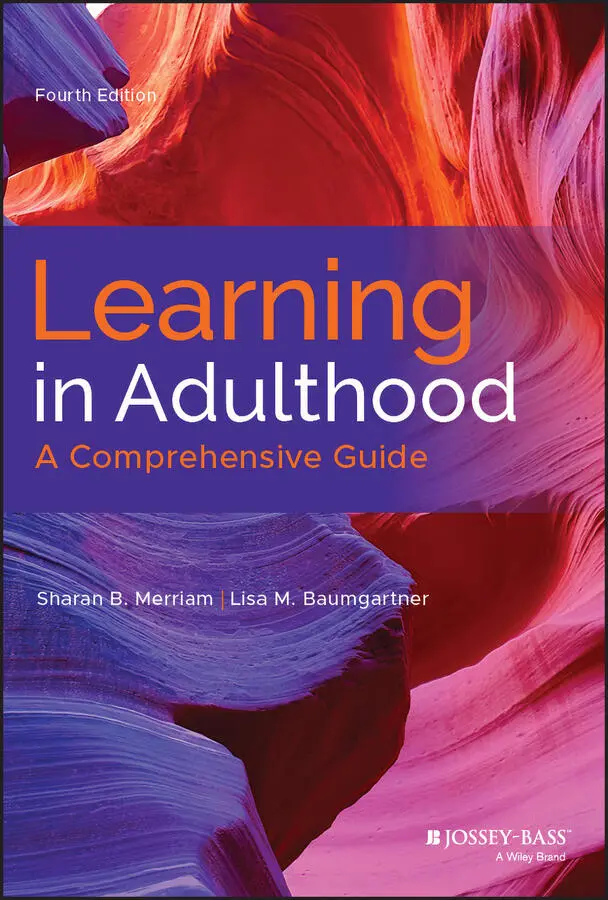
- Название:Learning in Adulthood
- Автор:
- Жанр:
- Год:неизвестен
- ISBN:нет данных
- Рейтинг книги:4 / 5. Голосов: 1
-
Избранное:Добавить в избранное
- Отзывы:
-
Ваша оценка:
Learning in Adulthood: краткое содержание, описание и аннотация
Предлагаем к чтению аннотацию, описание, краткое содержание или предисловие (зависит от того, что написал сам автор книги «Learning in Adulthood»). Если вы не нашли необходимую информацию о книге — напишите в комментариях, мы постараемся отыскать её.
has been the definitive guide in the field of adult education. Now in its fourth edition, this comprehensive volume is fully revised to reflect the latest developments in theory, research, and practice. The authors integrate foundational research and current knowledge to present fresh, original perspectives on teaching and learning in adulthood. Written by internationally-recognized experts, this market-leading guide draws from work in sociology, philosophy, critical social theory, psychology, and education to provide an inclusive overview of adult learning.
Designed primarily for educators of adults, this book is accessible for readers new to adult education, yet suitably rigorous for those more familiar with the subject. Content is organized into four practical parts, covering topics such as the social context of adult learning, self-directed and transformational learning, postmodern and feminist perspectives, cognitive development in adulthood, and more. Offering the most comprehensive single-volume treatment of adult learning available, this landmark text:
Offers a wide-ranging perspective on adult learning Synthesizes the latest thinking and work in the field Includes coverage of the sociocultural perspectives of adult learning Explores the broader social implications of adult education
is an indispensable resource for educators and administrators involved in teaching adults, as well as faculty and students in graduate programs in adult education.
Learning in Adulthood — читать онлайн ознакомительный отрывок
Ниже представлен текст книги, разбитый по страницам. Система сохранения места последней прочитанной страницы, позволяет с удобством читать онлайн бесплатно книгу «Learning in Adulthood», без необходимости каждый раз заново искать на чём Вы остановились. Поставьте закладку, и сможете в любой момент перейти на страницу, на которой закончили чтение.
Интервал:
Закладка:
Finally, in the last chapter we step back from the accumulated knowledge base to summarize and integrate the material on adult learning presented in earlier chapters. Chapter 16also reflects how we ourselves have come to think about learning in adulthood.
About the Authors
Sharan B. Merriamis professor emerita of adult education and qualitative research methods at the University of Georgia. Merriam's research and writing activities have focused on the foundations of adult education, adult development, adult learning, and qualitative research methods. She has published more than 30 books and dozens of chapters and articles and held major editorship roles throughout her career. For 5 years she was coeditor of Adult Education Quarterly , the major research and theory journal in adult education. She was also coeditor for the book series Professional Practices in Adult Education and Lifelong Learning. She has won the Cyril O. Houle World Award for Literature in Adult Education for four different books. Various of her books have been translated into Chinese, Korean, Japanese, Farsi, Italian, and French. Her most recent books include Qualitative Research in Practice: Examples for Discussion and Analysis (with Robin S. Grenier, 2019), Qualitative Research: A Guide to Design and Implementation (with Elizabeth J. Tisdell, 2016), A Guide to Research for Educators and Trainers of Adults (with Patricia Cranton, 2015), and Adult Learning: Linking Theory and Practice (with Laura Bierema 2014). Based on her widespread contributions to the field of adult education, Merriam has been inducted into the International Adult and Continuing Education Hall of Fame and was the first to receive the American Association of Adult and Continuing Education's Career Achievement award. She has served on steering committees for the annual North American Adult Education Research Conference, the Qualitative Research in Education Conference held at the University of Georgia, and the Commission of Professors of Adult Education. She has conducted workshops and seminars on adult learning and qualitative research throughout North America and overseas, including countries in southern Africa, Southeast Asia, the Middle East, and Europe. In 1998 she was a Senior Fulbright Scholar to Malaysia, in 2006 a Visiting Scholar to South Korea, and from 2016 to 2018 she was a Distinguished Visiting Scholar to Northwest University in South Africa.
Lisa M. Baumgartneris an associate professor of adult education at Texas State University, San Marcos. Her research and writing focus on adult learning and development in marginalized populations. A recipient of the W. K. Kellogg Foundation Cyril O. Houle Scholars Research Grant for Emerging Scholars in Adult Education, she completed a study on civil rights activist Septima P. Clark's lifelong contributions to social justice adult education. She received the Houle O. Cyril Award for Outstanding Literature in Adult Education for the coauthored text Learning in Adulthood: A Comprehensive Guide (3rd edition) in 2007. She has served on the steering committee for the annual North American Adult Education Research Conference. She was a coeditor of Adult Education Quarterly from 2011 to 2014 and serves on the editorial boards of several journals including Adult Education Quarterly, Adult Learning, and the Journal of Transformative Education . In 2004, she received the Commission of Professors of Adult Education Early Career Award, which honors individuals in the early stages of their academic career who have made significant contributions in scholarship and service to the field. In 2019, she received the Circle of 50 Award from the Learning, Leadership and Organizational Development Program at the University of Georgia. Awardees are seen as having made an impact on the research and practice of adult education, learning, leadership, and organizational development.
Part I Adult Learning in Contemporary Society
It is very much the perspective of this book that learning is a personal process—but a process that is shaped by the context of adult life and the society in which one lives. Compare how industrialization of the early years of the twentieth century affected what an adult needed and wanted to learn with the knowledge economy of the early twenty-first century. This learning in turn affects the social context. For example, as we become more technologically savvy, businesses respond by developing more sophisticated systems and gadgets that then require us to keep learning. It is indeed an interactive process between the learner and the social context. The four chapters in Part I explore the current sociocultural context, the range of learning opportunities available to adults in this context, and who takes advantage of these opportunities and why.
Chapter 1describes three factors characteristic of American society today that affect what adults want to learn. First, dramatic changes are occurring in the demographic base of our society. Adults outnumber those under 18 years old for the first time ever. Moreover, the percentage of the population over age 65 continues to grow, commanding the attention of policymakers, businesspeople, and educators alike. Our population as a whole is also better educated than ever before, and there is more cultural and ethnic diversity. Therefore, there are simply more adults seeking learning opportunities, as well as more groups of adults with particular learning needs.
The second and third factors shaping the learning enterprise are globalization and technology. These are very much interrelated, of course; technology has had an enormous impact on the economy. Robotics and automation displace production workers but create other jobs; technology has fostered whole new work structures, such as job sharing and telecommuting. The effect of the global economy and technological advances on the nature of adult learning is staggering. Adults find that they must continue their learning past formal schooling in order to function at work, at home, and in their communities. The need for new knowledge, for updating old information, for retraining, has resulted in a multibillion-dollar educational enterprise.
Because of its ever-increasing presence in our lives, we have added a new chapter on technology and adult learning. From online courses offered by educational institutions and corporations to the myriad of online sites on the World-Wide Web to technological innovations that are pervading our everyday world, technology is both creating learning demands and facilitating learning in adult life. Chapter 2is thus devoted to broadly examining the role of technology in the context of adult learning today. Some of the topics include the history of distance education, online learning theories, and the role of technology in informal and nonformal learning.
Some of this learning takes place in formal settings sponsored by countless institutions and agencies. As might be expected, business and industry and educational institutions offer many adult learning opportunities, but so do the military, cooperative extensions, churches, hospitals, and other institutions. Chapter 3explores how the context of formal institutional settings influences the learner and the learning process. Also reviewed are learning opportunities that are nonformal, such as those offered by community-based agencies such as museums, libraries, hospitals, and so on, and informal, incidental, and self-directed opportunities, as might happen in the course of the workday or by looking up something on the Internet. In addition, we briefly discuss online learning, a fourth environment for learning that overlays formal, nonformal, and informal modes of learning. In the second half of this chapter, we explore the interrelated concepts, first, of organizational learning and the learning organization, and second, of lifelong learning and the learning society.
Читать дальшеИнтервал:
Закладка:
Похожие книги на «Learning in Adulthood»
Представляем Вашему вниманию похожие книги на «Learning in Adulthood» списком для выбора. Мы отобрали схожую по названию и смыслу литературу в надежде предоставить читателям больше вариантов отыскать новые, интересные, ещё непрочитанные произведения.






Обсуждение, отзывы о книге «Learning in Adulthood» и просто собственные мнения читателей. Оставьте ваши комментарии, напишите, что Вы думаете о произведении, его смысле или главных героях. Укажите что конкретно понравилось, а что нет, и почему Вы так считаете.