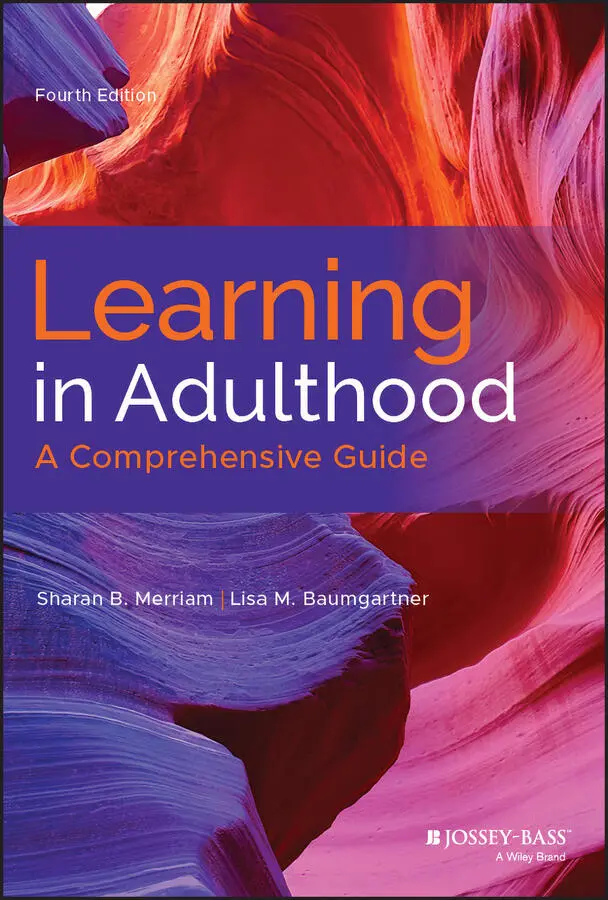
Sharan B. Merriam - Learning in Adulthood
Здесь есть возможность читать онлайн «Sharan B. Merriam - Learning in Adulthood» — ознакомительный отрывок электронной книги совершенно бесплатно, а после прочтения отрывка купить полную версию. В некоторых случаях можно слушать аудио, скачать через торрент в формате fb2 и присутствует краткое содержание. Жанр: unrecognised, на английском языке. Описание произведения, (предисловие) а так же отзывы посетителей доступны на портале библиотеки ЛибКат.
- Название:Learning in Adulthood
- Автор:
- Жанр:
- Год:неизвестен
- ISBN:нет данных
- Рейтинг книги:4 / 5. Голосов: 1
-
Избранное:Добавить в избранное
- Отзывы:
-
Ваша оценка:
Learning in Adulthood: краткое содержание, описание и аннотация
Предлагаем к чтению аннотацию, описание, краткое содержание или предисловие (зависит от того, что написал сам автор книги «Learning in Adulthood»). Если вы не нашли необходимую информацию о книге — напишите в комментариях, мы постараемся отыскать её.
has been the definitive guide in the field of adult education. Now in its fourth edition, this comprehensive volume is fully revised to reflect the latest developments in theory, research, and practice. The authors integrate foundational research and current knowledge to present fresh, original perspectives on teaching and learning in adulthood. Written by internationally-recognized experts, this market-leading guide draws from work in sociology, philosophy, critical social theory, psychology, and education to provide an inclusive overview of adult learning.
Designed primarily for educators of adults, this book is accessible for readers new to adult education, yet suitably rigorous for those more familiar with the subject. Content is organized into four practical parts, covering topics such as the social context of adult learning, self-directed and transformational learning, postmodern and feminist perspectives, cognitive development in adulthood, and more. Offering the most comprehensive single-volume treatment of adult learning available, this landmark text:
Offers a wide-ranging perspective on adult learning Synthesizes the latest thinking and work in the field Includes coverage of the sociocultural perspectives of adult learning Explores the broader social implications of adult education
is an indispensable resource for educators and administrators involved in teaching adults, as well as faculty and students in graduate programs in adult education.
Learning in Adulthood — читать онлайн ознакомительный отрывок
Ниже представлен текст книги, разбитый по страницам. Система сохранения места последней прочитанной страницы, позволяет с удобством читать онлайн бесплатно книгу «Learning in Adulthood», без необходимости каждый раз заново искать на чём Вы остановились. Поставьте закладку, и сможете в любой момент перейти на страницу, на которой закончили чтение.
Интервал:
Закладка:
Last, LMSs (learning management systems) will continue to incorporate tools such as Google Apps and iTunes so the learner experience can be more seamless (Adams Becker et al., 2017). The next shift in LMS is to move from completing “administrative tasks to deepening the act of learning” (p. 44). This means that the learning experience needs to be more personalized and adapted to the learning needs of the student. Ideally, the next generation of LMS will integrate various types of data seamlessly and use open source web apps (Becker et al., 2017). Designers may continue to “create apps that accommodate mobile challenges, such as partial user attention and interruption, or exploit technologies with novel features in an attempt to hook the learner into using the technology to complete the learning task” (Khaddage, Müller, & Flintoff, 2016, p. 23). Between the evolution of mobile apps and the ever-changing landscape of social media (e.g., Facebook, Twitter, Reddit, wikis, etc.), self-directed learners will have a multitude of resources from which to learn.
A technology that may continue to develop is virtual reality. We have seen its use for training in the workplace, and it will be applied in a variety of contexts. Individuals can virtually tour museums and cities through Internet sites such as fullscreen 360 ( www.fullscreen360.com) or take virtual fieldtrips to such places as dairy farms, the Ford Motor Company, and universities. They can enter discussion boards on topics such as the opioid epidemic, or take courses such as “The Science of Well-Being” via Coursera. Learners with binocular headsets connected to a computer can immerse themselves in virtual experiences (Varnum, 2017). Libraries and museums have embraced this technology so patrons can learn more about their world, and this technology continues to improve.
In this tech-rich learning environment, learning how to learn and how to critically evaluate information remain important skills. Although technology has changed through the years, the need to understand and interpret information has not. Given the amount of information we are exposed to each day, the ability to critically evaluate information is even more important.
Summary
Learning has been shaped by technology through the ages. Higher education institutions used the mail to deliver material to learners as evidenced by efforts to educate women and the correspondence courses offered by universities. Radio and television expanded adults' access to higher education in the early and mid-twentieth century. By the 1970s, British Open University and Empire State College opened. These institutions combined television, radio, and correspondence courses in addition to face-to-face courses to appeal to working adults who wanted to further their education. As technology has advanced, online education has become common. Online education increased in the 1990s and gave rise to brick and mortar institutions such as Penn State University and the State University System of New York offering online programs. For-profit institutions increasingly offered online courses and by the early 2010s, MOOCs became more popular. However, they lost some of their appeal due to high dropout rates. In 2014, blended learning technologies meant that student–faculty interactions could be more personal, and this trend toward personalization of the learning experience is expected to continue.
Not only has technology affected formal course delivery, we also use technology during our daily, informal learning. We perform Internet searches on a variety of topics, look up YouTube videos to learn skills, and use mobile phones and use virtual reality technology for workplace learning. We read, reflect, and comment on social media posts and find online support and interest groups where we can share ideas. We use our mobile phones to engage in informal and nonformal learning. With the advancements in technology, including smaller and faster computers and cloud computing, we have “an expanding view of our personal and collective adult learning universe” (Parker, 2014, p. 218).
Technology has evolved. Computers have become smaller and faster. Cloud computing has made access to materials easier. Educators' attempts at a teacherless classroom have progressed from Pressey's Teaching Machine to the use of artificial intelligence to help students with their writing. Technology has provided us with future technological developments that seem to suggest an increasingly learner-centered, personalized experience.
Chapter 3 Learning Environments and Learning Concepts
If asked about their learning, adults first picture classrooms with “students” and “teachers” and will often respond that they haven't taken any classes lately. We've been conditioned to think of learning as courses or workshops sponsored by the workplace, colleges and universities, public schools, and other formal organizations. Yet most learning in adulthood is much more informal. When we ask these same adults about what they have learned over the last year related to their hobbies, communities, family activities, or health, they typically respond with descriptions of learning activities outside of formal settings. They discuss, for example, remodeling a kitchen, which has involved everything from reading and talking with friends to conversations with carpenters, plumbers, and electricians. Or they may focus on an important change in their life, such as an illness, parenthood, or job change, which has precipitated numerous learning events, sometimes over an extended period of time. In considering the spectrum of learning opportunities available to adults, it is important to acknowledge all of these arenas of learning, from the highly structured to the more informal ways adults go about learning.
Why is it important that educators of adults recognize that learning happens in so many and varied places in the lives of adults? First, appreciating and taking into consideration the prior knowledge and experience of learners has become a basic assumption of our practice as educators of adults, wherever this knowledge was learned. In working with low-income mothers, for example, instructors might recognize that these parents have had to learn how to take care of their children on very constrained budgets, keep their families safe and healthy under difficult living conditions, and in general make do with very little. Rather than asking questions about how they have learned to do this successfully, the focus is often on their lack of formal education and skills training. Formal schooling and skills training are important, but so are the ways they have informally learned about life skills that have kept them and their families fed and clothed. Likewise, workshop leaders designing staff development programs for teachers might first learn as much as possible about the background and experience of the teachers in that school and what their knowledge base is with respect to the content of the workshop. There is nothing that alienates teachers more in these programs than being treated as if they know very little about the subject matter, especially if they have been dealing with it on a daily basis.
Second, if educators helped learners recognize the many places and ways they have gone about learning in adulthood, more adults might see themselves as active learners. As a result, they might be less cautious about learning new things and even be more willing to enter formal programs of learning. One of our favorite stories is about a duck carver who was interviewed as part of a study on self-directed learning (Berger, 1990). This man, who considered himself both a nonreader and “definitely not a very good student,” taught himself how to carve ducks. He started this process by carving some ducks by himself and then taking them to duck carving shows, where he could talk with other artists about his initial attempts. In addition, he read every book he could get his hands on related to duck carving (and remember, he thought of himself as a nonreader). He now raises ducks so he can have live models, in itself another learning project. As a result of the interview process, this man saw himself as much more of a learner than he had before. Our hope is that as more individuals view themselves as active and competent learners, at least in some areas, they might be better able to address the many life challenges that come in adulthood, through both formal and informal learning modes.
Читать дальшеИнтервал:
Закладка:
Похожие книги на «Learning in Adulthood»
Представляем Вашему вниманию похожие книги на «Learning in Adulthood» списком для выбора. Мы отобрали схожую по названию и смыслу литературу в надежде предоставить читателям больше вариантов отыскать новые, интересные, ещё непрочитанные произведения.









Обсуждение, отзывы о книге «Learning in Adulthood» и просто собственные мнения читателей. Оставьте ваши комментарии, напишите, что Вы думаете о произведении, его смысле или главных героях. Укажите что конкретно понравилось, а что нет, и почему Вы так считаете.