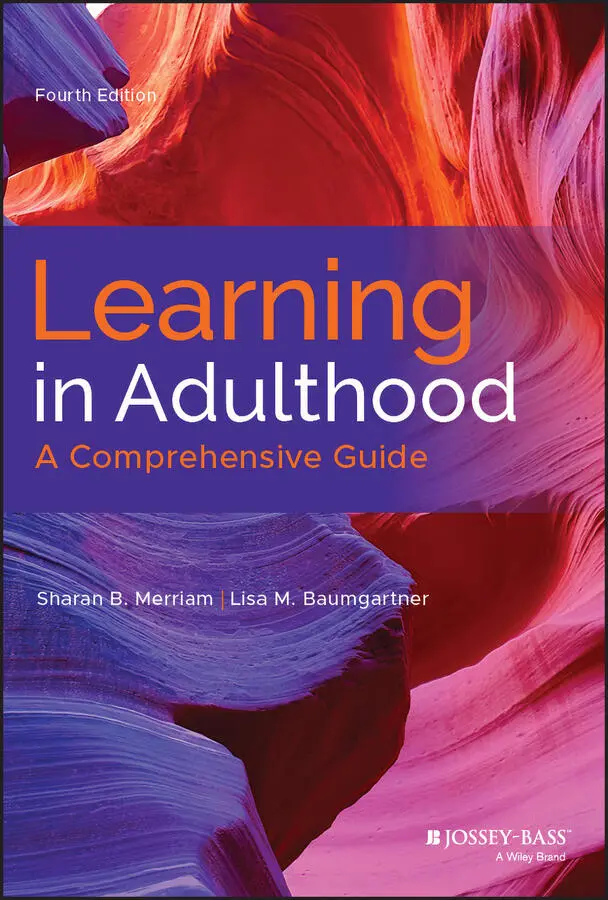
Sharan B. Merriam - Learning in Adulthood
Здесь есть возможность читать онлайн «Sharan B. Merriam - Learning in Adulthood» — ознакомительный отрывок электронной книги совершенно бесплатно, а после прочтения отрывка купить полную версию. В некоторых случаях можно слушать аудио, скачать через торрент в формате fb2 и присутствует краткое содержание. Жанр: unrecognised, на английском языке. Описание произведения, (предисловие) а так же отзывы посетителей доступны на портале библиотеки ЛибКат.
- Название:Learning in Adulthood
- Автор:
- Жанр:
- Год:неизвестен
- ISBN:нет данных
- Рейтинг книги:4 / 5. Голосов: 1
-
Избранное:Добавить в избранное
- Отзывы:
-
Ваша оценка:
Learning in Adulthood: краткое содержание, описание и аннотация
Предлагаем к чтению аннотацию, описание, краткое содержание или предисловие (зависит от того, что написал сам автор книги «Learning in Adulthood»). Если вы не нашли необходимую информацию о книге — напишите в комментариях, мы постараемся отыскать её.
has been the definitive guide in the field of adult education. Now in its fourth edition, this comprehensive volume is fully revised to reflect the latest developments in theory, research, and practice. The authors integrate foundational research and current knowledge to present fresh, original perspectives on teaching and learning in adulthood. Written by internationally-recognized experts, this market-leading guide draws from work in sociology, philosophy, critical social theory, psychology, and education to provide an inclusive overview of adult learning.
Designed primarily for educators of adults, this book is accessible for readers new to adult education, yet suitably rigorous for those more familiar with the subject. Content is organized into four practical parts, covering topics such as the social context of adult learning, self-directed and transformational learning, postmodern and feminist perspectives, cognitive development in adulthood, and more. Offering the most comprehensive single-volume treatment of adult learning available, this landmark text:
Offers a wide-ranging perspective on adult learning Synthesizes the latest thinking and work in the field Includes coverage of the sociocultural perspectives of adult learning Explores the broader social implications of adult education
is an indispensable resource for educators and administrators involved in teaching adults, as well as faculty and students in graduate programs in adult education.
Learning in Adulthood — читать онлайн ознакомительный отрывок
Ниже представлен текст книги, разбитый по страницам. Система сохранения места последней прочитанной страницы, позволяет с удобством читать онлайн бесплатно книгу «Learning in Adulthood», без необходимости каждый раз заново искать на чём Вы остановились. Поставьте закладку, и сможете в любой момент перейти на страницу, на которой закончили чтение.
Интервал:
Закладка:
Table 2.3 Exemplary Online Teaching Practices
SOURCE: Adapted from Baran, Correia & Thompson (2013), pp. 13, 23.
| Theme | Teaching Strategies |
| Knowing and creating course content | Break course content into manageable chunks.Adopt the content from face-to-face courses.Get student input into course creation.Give feedback to students immediately.Create a conceptual outline of the course.Match learning outcomes with course activities. |
| Knowing the students | Gather information from student introductions.Communicate frequently with students.Use video and text chat. |
| Guiding student learning | Give frequent feedback.Use discussion boards and group e-mails to provide group synergy.Use online office hours.Resolve issues right away. |
| Enhancing the student–teacher relationship | Use video conferences.Share personal information on course wikis.Establish trust through frequent communication. |
| Evaluating the online courses | Use midsemester and final course evaluations to improve courses.Implement evaluation tools designed for online courses. |
| Sustaining teacher presence | Use online videos to present content.Provide updates.Give feedback to students.Make communication a priority. |
Given the popularity of MOOCs, scholars conducted a literature review of studies that discussed “innovations in scalable (italics in original) (not requiring any physical presence or manual grading or feedback) [active] learning strategies” (Davis, Chen, Hauff, & Houben, 2018, p. 327). They reviewed 126 studies that met the following criteria: the learning strategy discussed had to be scalable; “the evidence [came] from empirical analyses of randomized controlled experiences with a combined sample size of at least ten across all conditions” and the subjects were at least 18 years old (p. 328). The most scalable techniques included cooperative learning, simulations and gaming, and interactive multimedia. Learners involved in competitive games had higher test scores than learners who were not competing (Cagiltay, Ozcelik & Ozcelik, 2015, as cited in Davis et al., 2018). However, games and simulations are costly to develop so institutions must first determine if the investment is worth the reward.
Challenges in the Online Learning Environment
Online learning is “education that takes place over the Internet” (Stern, n.d., p. 1). As previously noted, this learning can be formal or informal. In this section, we discuss two challenges found in the online learning environment: incivility and the digital divide.
Incivility is an aspect of the digital world. It has been shown to be on the rise in recent years especially within the realm of politics (Kim & Park, 2019) and in informal learning settings such as a Facebook group (Ballantyne, Lowe, & Beddoe, 2017). Researchers surveyed those in a “closed Facebook group established to discuss professional social work issues” (p. 20) and found that participants valued
feeling connected to a wider community of practice… being able to post and share information in issues relevant to the social work community… obtaining access to information [and] links to open access journal articles and other professional development materials. (p. 28)
However, 77% of the respondents also said they were reluctant to discuss or post “their point of view on policy or politics” because they did not want to deal with criticism from the group or they knew others in the group did not share their same sentiments. Participants expressed concerns about online incivility that included personal attacks.
Whether the learning occurs in a formal class or in a nonformal setting such as an online interest group, incivility can be an issue. Incivility can be any behavior that disrupts a harmonious learning environment (Galbraith & Jones, 2010). Acts of incivility include making offensive remarks, refusing to participate in online discussions, challenging the facilitator's credibility, asking for special treatment, making threats, and “inappropriate use of social media for sharing or promotion of academic work” (Galbraith & Jones, 2010; Hopkins et al., 2017, p. 310).
Researchers have examined faculty and student perceptions of online incivility. In a survey that measured “nursing faculty and student perceptions of incivility in an online learning environment” (Clark, Werth, & Ahten, 2012b, p. 150), faculty and students considered online incivility a mild or moderate problem and most frequently listed name calling, making unkind comments about a faculty member, and making “racial, ethnic, sexual or religious slurs” (p. 151) as examples of uncivil behavior. Faculty reported experiencing uncivil behaviors such as students failing to complete assignments in a timely manner, posting terse or vague responses to discussion board questions, and not fulfilling group responsibilities. Students said that the uncivil behaviors of faculty included having unclear expectations about assignments, posting an unclear or vague syllabus, failing to respond to student postings in a timely manner, and failing to provide meaningful feedback on assignments. These results demonstrate the importance of faculty needing to provide “organized, timely and quality feedback” (p. 155) and giving students clear expectations for course interaction.
In a survey of 19 nursing faculty and 152 nursing students, respondents provided several ways to promote civility in online courses including having “clearly defined course and behavioral expectations, norms, and consequences” (Clark, Ahten, & Werth, 2012a, p. 193), faculty being role models and setting a positive example for online behavior, addressing uncivil behavior immediately and holding individuals accountable for their behavior and “encouraging and rewarding civility” (p. 195). Students added that having an orientation about civility would be helpful. Based on these findings the authors recommended that “faculty and students work together to co-create and implement behavioral norms in the [online learning environment]” (p. 196). This conversation can begin by listing behaviors to emulate and to avoid. Discussions about how often members will access the discussion boards and actions for violating the norms should be discussed (Clark et al., 2012a, 2012b).
Galbraith and Jones (2010) have several recommendations for instructors when responding to incivility. They suggest instructors remain calm, respond to the issue immediately, do not waiver on the consequences for the uncivil behavior, and act on the consequences quickly. Providing clear expectations regarding response time to e-mails and grading assignments is important as incivility can occur when learners do not know these expectations.
Fostering emotional intelligence may curb online incivility. Emotional intelligence includes the capacities of “emotional self-control, conflict management, teamwork, cultural awareness, and inspirational leadership (Boyatzis & Saatcioglu, 2008)” (Majeski, Stover, Valais, & Ronch, 2017, p. 135). (See Chapter 14for more on emotional intelligence.) In designing the course, the instructor can “model emotional intelligence” (p. 136) through having clear guidelines for discussion that focus on creating a safe environment that promotes respect for all. Instructors can create activities that foster emotional intelligence. Majeski et al. (2017) give an example of an activity used in a “Aging, People, Policy, and Management” undergraduate course where students listened to a narrative of Eva Kor, a Holocaust survivor, to see how that event shaped her life course and revealed Eva's resilience. Encouraging learners “to be mindful of the process of their own and other learners' ways of thinking about issues rather than the outcomes of thinking such as opinions” is another way to foster emotional intelligence (p. 138).
Читать дальшеИнтервал:
Закладка:
Похожие книги на «Learning in Adulthood»
Представляем Вашему вниманию похожие книги на «Learning in Adulthood» списком для выбора. Мы отобрали схожую по названию и смыслу литературу в надежде предоставить читателям больше вариантов отыскать новые, интересные, ещё непрочитанные произведения.











Обсуждение, отзывы о книге «Learning in Adulthood» и просто собственные мнения читателей. Оставьте ваши комментарии, напишите, что Вы думаете о произведении, его смысле или главных героях. Укажите что конкретно понравилось, а что нет, и почему Вы так считаете.