Sharan B. Merriam - Learning in Adulthood
Здесь есть возможность читать онлайн «Sharan B. Merriam - Learning in Adulthood» — ознакомительный отрывок электронной книги совершенно бесплатно, а после прочтения отрывка купить полную версию. В некоторых случаях можно слушать аудио, скачать через торрент в формате fb2 и присутствует краткое содержание. Жанр: unrecognised, на английском языке. Описание произведения, (предисловие) а так же отзывы посетителей доступны на портале библиотеки ЛибКат.
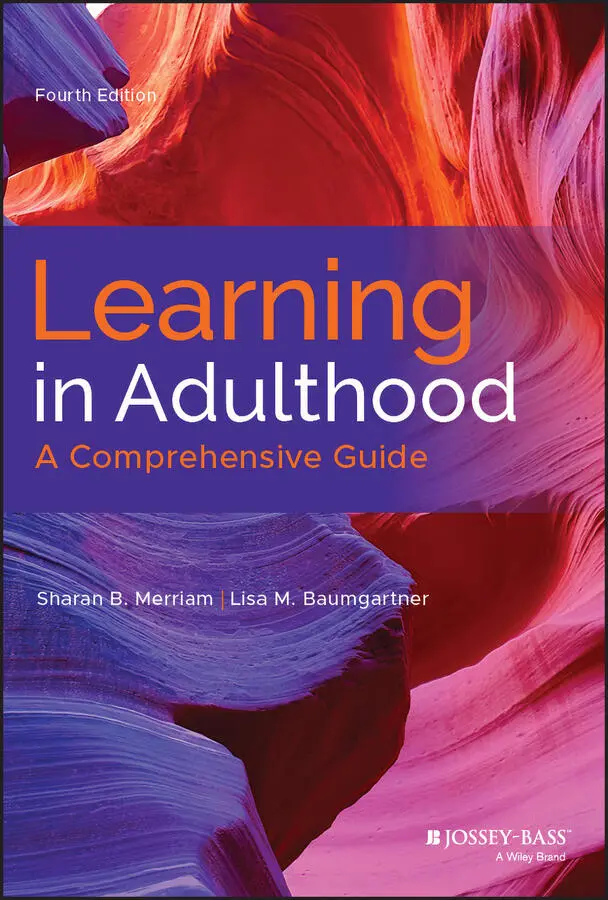
- Название:Learning in Adulthood
- Автор:
- Жанр:
- Год:неизвестен
- ISBN:нет данных
- Рейтинг книги:4 / 5. Голосов: 1
-
Избранное:Добавить в избранное
- Отзывы:
-
Ваша оценка:
Learning in Adulthood: краткое содержание, описание и аннотация
Предлагаем к чтению аннотацию, описание, краткое содержание или предисловие (зависит от того, что написал сам автор книги «Learning in Adulthood»). Если вы не нашли необходимую информацию о книге — напишите в комментариях, мы постараемся отыскать её.
has been the definitive guide in the field of adult education. Now in its fourth edition, this comprehensive volume is fully revised to reflect the latest developments in theory, research, and practice. The authors integrate foundational research and current knowledge to present fresh, original perspectives on teaching and learning in adulthood. Written by internationally-recognized experts, this market-leading guide draws from work in sociology, philosophy, critical social theory, psychology, and education to provide an inclusive overview of adult learning.
Designed primarily for educators of adults, this book is accessible for readers new to adult education, yet suitably rigorous for those more familiar with the subject. Content is organized into four practical parts, covering topics such as the social context of adult learning, self-directed and transformational learning, postmodern and feminist perspectives, cognitive development in adulthood, and more. Offering the most comprehensive single-volume treatment of adult learning available, this landmark text:
Offers a wide-ranging perspective on adult learning Synthesizes the latest thinking and work in the field Includes coverage of the sociocultural perspectives of adult learning Explores the broader social implications of adult education
is an indispensable resource for educators and administrators involved in teaching adults, as well as faculty and students in graduate programs in adult education.
Learning in Adulthood — читать онлайн ознакомительный отрывок
Ниже представлен текст книги, разбитый по страницам. Система сохранения места последней прочитанной страницы, позволяет с удобством читать онлайн бесплатно книгу «Learning in Adulthood», без необходимости каждый раз заново искать на чём Вы остановились. Поставьте закладку, и сможете в любой момент перейти на страницу, на которой закончили чтение.
Интервал:
Закладка:
Digital Divide
A second concern in the information age is the “digital divide.” The “primary digital divide” refers to differences in the ability to access the Internet whereas the “secondary digital divide” concerns “differences in internet use” (Joiner, Stewart, & Beaney, 2015, p. 74). Although men and women have equal access to the Internet, what men and women use the Internet for is different. Men tend to use the Internet for entertainment whereas women use it for communication, and this pattern has held since studies done in 2001 (Joiner et al., 2015). An increasing number of individuals access the Internet via their mobile phones and the same gendered use patterns occur. This difference is “best explained by a combination of negative gendered stereotypes concerning technology and social expectations based on individuals' gender roles” (p. 85).
Richardson and Jelfs (2015) surveyed 7,000 students over the age of 21 who attended Open University. Results were stratified by age. Almost everyone had access to the Internet in their homes. Younger students were more likely to have completed more types of activities online (e.g., only 9.5% of those 21–29 had never used a social network site whereas 68.1% of those 70 and older had not used a social network site). Those whose work involved digital technologies were more confident about using them. Younger students had a more positive attitude toward technology than older students. In addition, those who had disabilities appreciated assistive technologies such as speech-to-text programs.
The digital divide is a complex issue as it concerns motivations for using technology, access to digital technology, level and extent of digital technology usage, and variance in digital skills (Conceição & Martin, 2016). In Conceição and Martin's (2016) study of Black men and the digital divide, the authors report that Black men take three positions on their motivation to use technology. Some see digital technology as a form of enslavement and reject it, others assimilate to the world of technology and see its opportunities, and a third group views technology as a way to challenge the status quo (Kvasny & Trauth, 2003 as cited in Conceição & Martin, 2016). Access to technology is influenced by several factors. African Americans who are over age 65 who have not attended college are less likely to go online than Whites with less education, but younger college educated African Americans (age 18–29) with higher incomes are equally likely to have broadband and use the Internet as much as their White counterparts (Smith, 2014, as cited in Conceição & Martin, 2016). Smartphone ownership is similar among Blacks, Whites, and Hispanics, but people of color tend to rely on their phones for Internet access more than Whites do (Anderson, 2015, as cited in Conceição & Martin, 2016).
Lower income Black men struggle with a digital divide that begins in elementary school and continues to adulthood (Conceição & Martin, 2016). The authors provide recommendations to narrow the digital divide. Because smartphone use is more prevalent in the African American community, “educational and service providers should design their websites to be easily navigated via the use of cell phones” (pp. 32–33). In addition, community-based organizations can help Black men understand the importance of technology in their lives and can help them obtain appropriate technology if they don't have access to broadband access at home.
The digital divide can also involve older adults' ability to use technology. Some different techniques may be needed to teach older adults. Researchers observed classes at senior centers, interviewed teachers, and collected teaching materials to uncover instructors' teaching strategies for teaching technology to older adults. At senior centers, the same learners continue to appear at the classes, so teachers use the “reserved teaching” technique (Chiu, Tasi, Yang, & Guo, 2019, p. 67). Reserved teaching refers to adding new course content based on what has already been learned. There needs to be a bridge between what was learned in an earlier class and content required for a more advanced class. Earlier content may need to be revisited depending on student knowledge. The sequence of materials may have to vary for learners, and peer teaching may be helpful to learners.
Researchers conducted an ethnographic study with 420 older adults ranging in age from 58 to 90 over 4 years to understand how they became successful learners regarding information and communication technology (Sayago, Forbes, & Blat, 2013). They observed learners as well as conducting in-depth interviews with 20 participants. Learners were monitored at a “computer clubhouse” located on the University of Dundee and at an adult education center. Successful information and communication technologies learners connected learning to “real life needs” (p. 527), learned collaboratively, shared learning strategies with classmates, and used techniques to aid their memory. Researchers concluded that activities should be related to real-life concerns of learners, social interaction among learners is important, and materials should contain places to have notes.
When designing web-based training for older adults, course designers have several recommendations. First, they encourage instructors to have a highly structured learning environment. Learning objectives should be clearly defined and learners should be “directed to crucial information” (Wolfson, Cavanagh, & Kraiger, 2014, p. 31). Second, using principles from cognitive load theory or cognitive theory of multimedia learning is important. Some of these recommendations include self-paced instruction and removing information that is irrelevant to the learning goal. Third, “customize training programs in terms of feedback and adaptive guidance” (p. 31). This means correcting errors quickly, advising learners what to focus on, and giving feedback on past performance and “future-oriented information” (p. 31). Fourth, “encourage use of metacognitive and cognitive strategies” (p. 31). Techniques such as paraphrasing information or creating their own self-tests on material are two of these strategies. Fifth, have a course design that accommodates sight issues such as having large font sizes and good contrasts between the font and background. Screen-reading software or “eye gaze systems” that helps learners use technology using their eye movements is also a good idea. (p. 31). Last, the instructor should show confidence in the abilities of older learners to learn materials.
In summary, the digital divide is multifaceted. Access to the Internet remains an issue for some individuals, and digital literacy varies among individuals. Interventions for older adults and those with less exposure to technology may be useful in closing the gap.
Informal and Nonformal Learning and Technology
Informal learning is generally any learning that occurs outside a formal context such as a school (Sloep, 2012 as cited in Song & Lee, 2014) and is part of our everyday lives. Technology and informal learning are intertwined. We perform Google searches on myriad topics. We look up YouTube videos to learn how to fly a drone, replace a keyboard on our laptop, or remove that burned popcorn smell out of our microwave oven! Some of us use apps such as DuoLingo or Babbel on our mobile phones to learn another language.
We engage in informal learning when we blog. Learning is inherent in blogging as reflection occurs on one's writing and reflective dialogue can take place when readers comment on bloggers' ideas (Deng & Yuen, 2011 as cited in Harju, Pehkonen, & Niemi, 2016). These interactive discussions can change individuals' thinking about an issue (Webb, 2013 as cited in Harju et al., 2016). Blogging can be part of self-directed learning (SDL). For example, a woman who was learning to cook tried new recipes and reported on their results on her blog. The social nature of the blog provides a forum for bloggers to write and receive comments. In a study that discussed blogging as a form of lifelong learning, researchers found that bloggers provided “teaching and guidance” to readers (Harju et al., 2016, p. 10) and believed they were helping others and “bringing new perspectives to public discussions” (p. 11). They shared their expertise and wanted to have accurate information on their blogs. Bloggers liked being “part of a digital media culture” (p. 12). Bloggers wrote about topics of interest to them and responded to readers' interests. In short, blogging is an area of self-expression where bloggers can post, get attention from others, and be part of a community that “promotes… lifelong learning activities, people's well-being and mental health” (p. 14).
Читать дальшеИнтервал:
Закладка:
Похожие книги на «Learning in Adulthood»
Представляем Вашему вниманию похожие книги на «Learning in Adulthood» списком для выбора. Мы отобрали схожую по названию и смыслу литературу в надежде предоставить читателям больше вариантов отыскать новые, интересные, ещё непрочитанные произведения.











Обсуждение, отзывы о книге «Learning in Adulthood» и просто собственные мнения читателей. Оставьте ваши комментарии, напишите, что Вы думаете о произведении, его смысле или главных героях. Укажите что конкретно понравилось, а что нет, и почему Вы так считаете.